
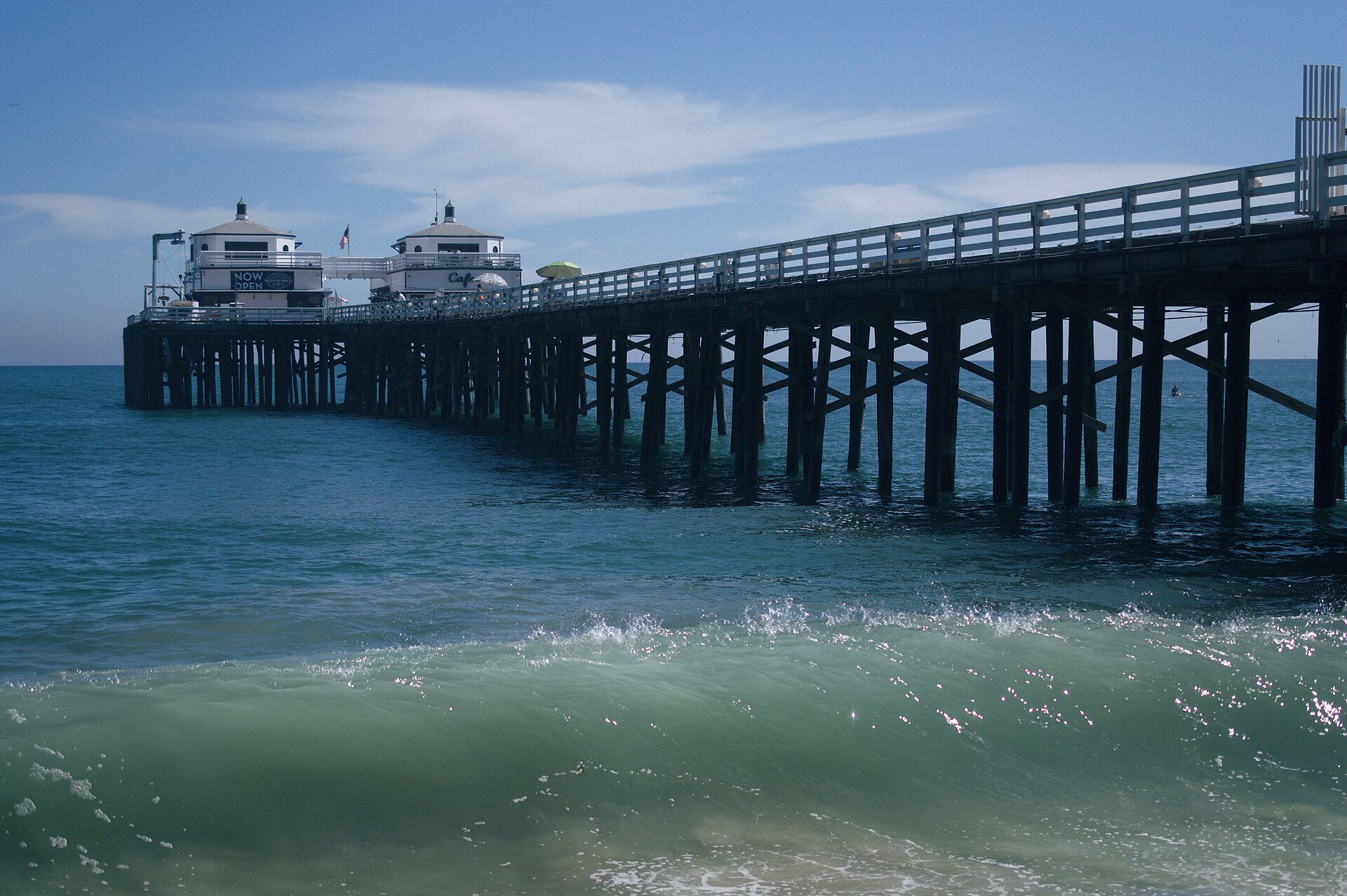
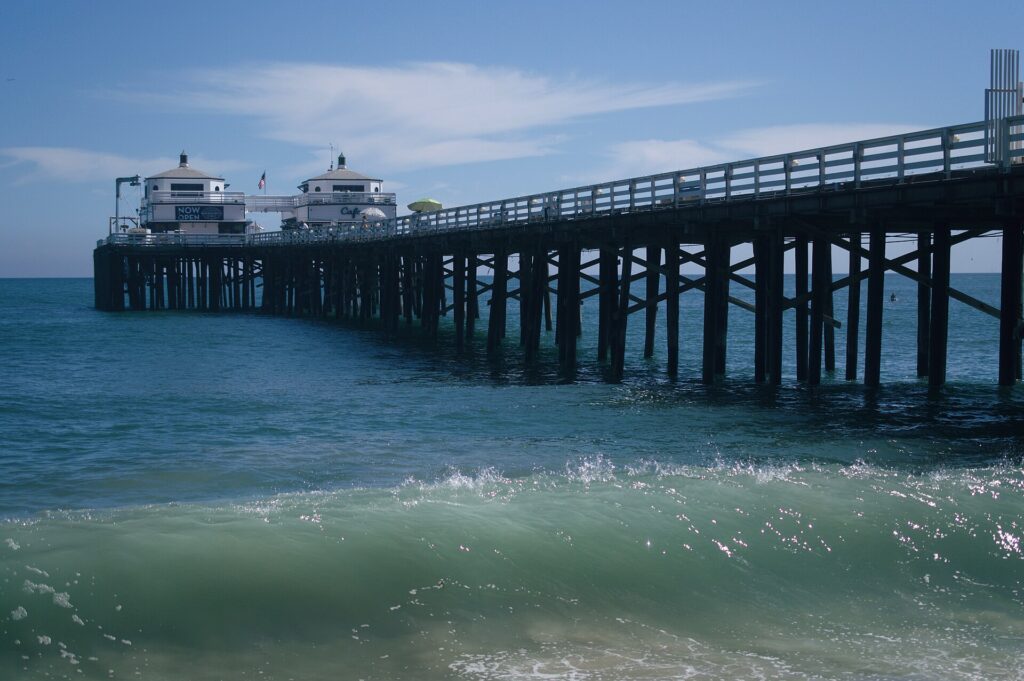
The Malibu Pier is the most recognizable landmark on the Malibu coast: a 780-foot wooden pier with twin buildings at its end, standing beside Surfrider Beach, one of the most famous surf breaks in the world. It is a fishing pier, a place to eat with your feet almost over the water, and the natural starting point for a walk along Malibu Lagoon to the tiled rooms of the Adamson House.
This guide covers the pier’s history, what is open and closed right now, Surfrider Beach and its surf, fishing rules, Malibu Lagoon, the Adamson House, parking, PCH traffic, the best times to go and what is nearby at Cross Creek. The end of the pier has been closed for repairs since January 2025, and hours, fees and roadwork change through the year, so check the official State Parks and pier pages before you go.
Malibu Pier at a glance
- Where: 23000 Pacific Coast Highway, Malibu, at the east end of Malibu Lagoon State Beach, next to Surfrider Beach.
- Who runs it: California State Parks owns the pier; the restaurant, shops and other businesses are run by the concessionaire Malibu Pier Partners.
- Hours: the pier is open daily, sunrise to sunset.
- Cost: walking onto the pier is free; you pay only for parking, food and rentals.
- Current status (November 2026): the outer end of the pier is closed while State Parks repairs the pilings. The rest of the pier, the Malibu Farm restaurant and the surrounding beaches are open.
- Best for: a sunset walk, watching surfers at close range, pier fishing without a license, and a long lunch on the water.
A short history of the pier
The pier was built in 1905 to serve the Rindge family’s Malibu Rancho, the huge ranch that covered most of what is now the city of Malibu. Frederick Hastings Rindge, who died that same year, and his widow May Knight Rindge used it to ship hides, grain and fruit and to bring in building materials. At the time there was no public road along this coast, and the Rindges fought for years to keep railroads and highways off their land.
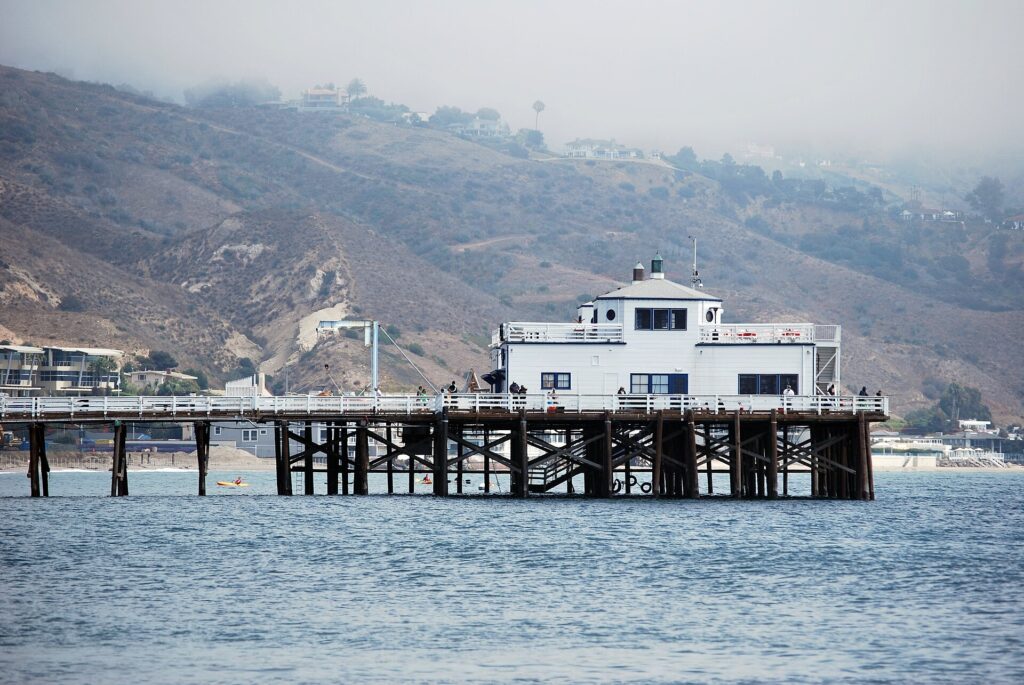
The pier opened to the public for fishing in 1934, and by 1938 it had been extended to its current length of 780 feet. During World War II the Coast Guard used the end as a daytime lookout. A storm in the winter of 1943–44 wrecked the end of the pier, and the remains were sold to William Huber’s Malibu Pier Company, which rebuilt and extended it after the war and added the twin buildings at the ocean end, one for bait and tackle, one for a restaurant. That silhouette has been the pier’s signature ever since.
The State of California bought the pier in 1980. El Niño storms damaged it badly in 1993, another storm hit in 1995, and the state declared it unsafe and closed it. Reconstruction began in 1999 with the goal of restoring its 1950s look, and in 2008 Malibu Pier Partners brought restaurants and shops back. The restoration won a Los Angeles Conservancy Preservation Award in 2009.
Malibu Pier in 2026: what is open and what is closed
The end-of-pier closure and repairs
State Parks closed the end of the pier in January 2025 as a precaution after early findings of structural problems. Inspections above and below the water confirmed that significant repairs were needed, and a June 2026 engineering assessment found deteriorated and missing pilings. In October 2026 State Parks awarded a $2.125 million emergency contract, funded by the 2024 Climate Bond (Proposition 4), to repair or replace pilings and replace bracing. Work began in mid-October and is expected to wrap up by the end of January 2027, after which State Parks will reassess. No reopening date for the end of the pier has been set.
For visitors this means you can walk a good part of the pier, eat at the restaurant near the shore and fish from the open sections, but you cannot walk all the way out to the end buildings. State Parks does not expect major closures of the rest of the pier during construction, though there may be short interruptions when heavy equipment is moved. Updates are posted on the State Parks Malibu Pier FAQ page.
Eating on the pier: Malibu Farm
Malibu Farm Restaurant, the full-service restaurant on the pier near the shore, is open because it sits outside the closure area. It serves organic, farm-to-table food with a dining room, a patio and a bar looking down the coast. At the time of writing, brunch runs daily from 9 a.m. to 3 p.m. and lunch and dinner from 3 p.m. to close. Reservations are taken online, and parties of eight or more get an automatic 18% gratuity. Book ahead for a sunset table on weekends.
The more casual Malibu Farm Pier Café at the end of the pier is closed along with that section, as is the surf and souvenir shop out there.
Shops, rentals and boat tours
At the base of the pier, The Malibu Cabana sells beachwear and souvenirs, and the pier’s bait and tackle business, Ranch at the Pier, is operating out of it for now, with bait, tackle and rod rentals. State Parks says beach rentals and equipment are available before the pier entrance. Pier boat tours are suspended for the time being, and car and surf rentals on the pier are listed as “coming soon,” so do not plan around them.
Surfrider Beach and the World Surfing Reserve
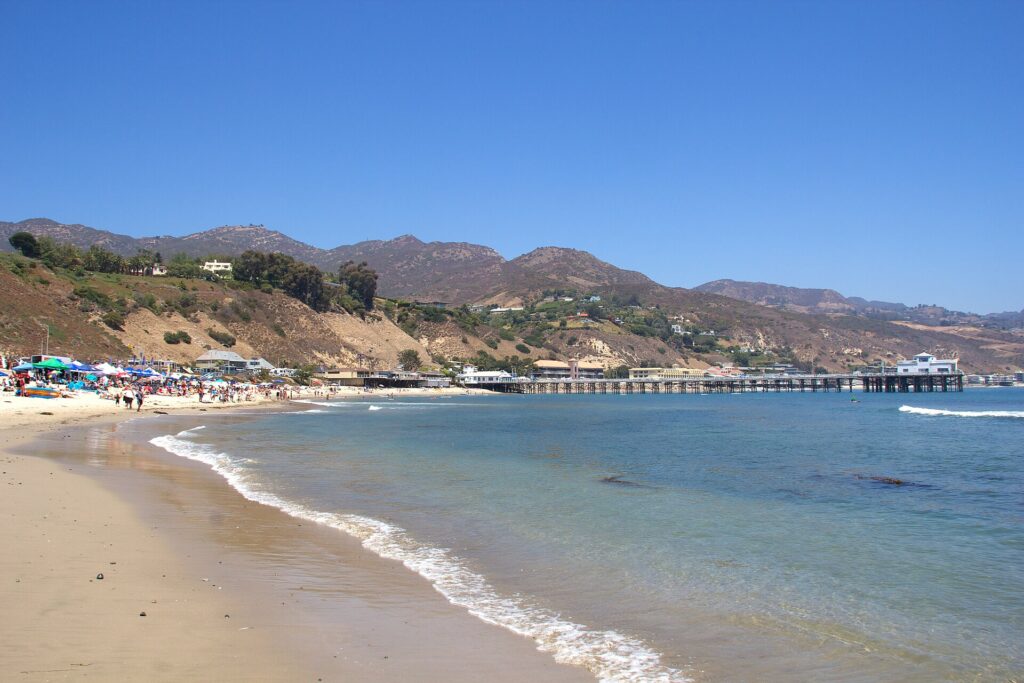
The beach on the west side of the pier is Surfrider Beach, part of Malibu Lagoon State Beach. Its long, peeling right-hand point waves helped shape Southern California surf culture, and the beach was made famous by the surf films of the 1950s and 1960s. On October 9, 2010, Malibu was dedicated as the first World Surfing Reserve, a program that recognizes and helps protect outstanding surf zones around the world. The dedication began with a sunrise blessing by Chumash leader Mati Waiya and a paddle-out.
First, Second and Third Point
Surfers divide the break into three sections. First Point, closest to the pier, is the classic longboard wave. Second Point, farther up toward the lagoon, is faster and draws more high-performance surfing. Third Point, near the lagoon mouth, breaks both left and right. On a good south swell, rides can run all the way down the point to the pier. The beach is almost a mile long, LA County lifeguards are on duty during daylight hours, and there are restrooms and showers by the county lot.
Surf lessons and board rentals
The line-up at First Point is crowded with experienced locals on a good day. If you want to learn, book a lesson with an established surf school that supplies a board and wetsuit and picks the right spot for the conditions; some teach at Surfrider, others at gentler beaches such as Zuma. Rental shops along PCH come and go, so confirm with any operator before you drive out.
Fishing on the Malibu Pier
The pier has been a fishing pier since 1934, and it still is. Under California Fish and Game Code Section 7153, you do not need a fishing license to fish with a rod and line from a public pier in ocean waters. All other rules still apply, including size limits, bag limits and seasons, and you need a report card to keep sturgeon or spiny lobster. During the repairs, fishing is allowed in the designated areas on the open part of the pier; follow the posted signs.
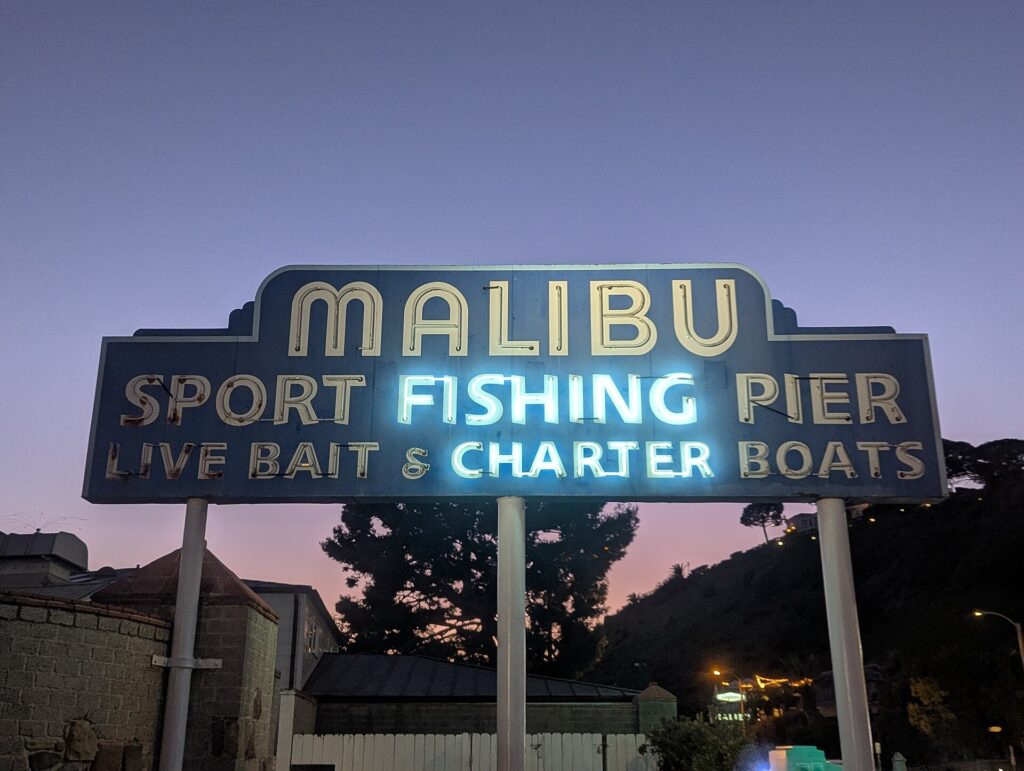
According to the pier, catches include surfperch, croakers, corbina, halibut, rays, mackerel, sardines and seabass. Ranch at the Pier rents rods (currently $30 for two hours) and sells bait and tackle. The pier’s own rules are worth knowing before you set up: check behind you before casting, do not cut bait on the railings or stick knives into the wood, do not block walkways, no open flames or grills, and no battery-powered bait tanks.
Malibu Lagoon State Beach
West of the pier, Malibu Creek meets the ocean in Malibu Lagoon, a tidal wetland with short nature trails, lagoon views and a path out to the beach. It sits on the Pacific Flyway, so it is one of the best easy birdwatching stops in Los Angeles County: herons, egrets, pelicans, gulls and shorebirds are common, especially in fall and winter. Western snowy plovers, a protected shorebird, use the beach here, so respect any fenced areas. State Parks runs occasional bird walks with the Audubon Society; one is scheduled for December 27, 2026.
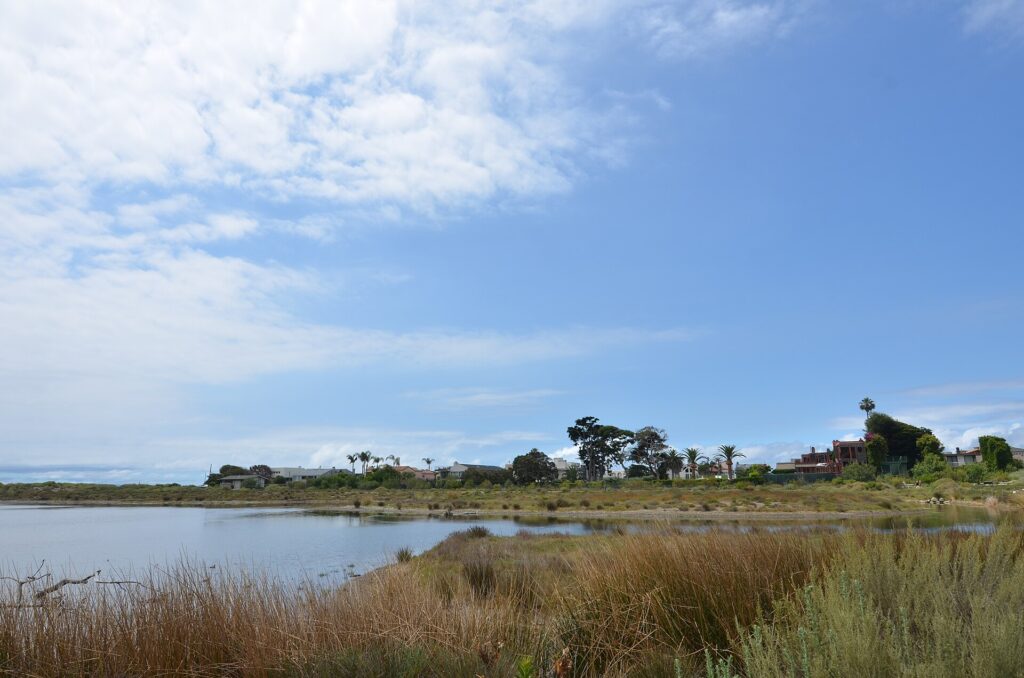
Dogs are not allowed on the lagoon trails or the beach. Leashed dogs are allowed on the Adamson House grounds.
Adamson House and the Malibu Lagoon Museum
Between the lagoon and the pier stands the Adamson House, designed in 1929 by architect Stiles O. Clements for Merritt Huntley Adamson and Rhoda Rindge Adamson, the daughter of Frederick and May Rindge. It is a white Spanish Colonial Revival house with a red tile roof, and inside and out it holds the best surviving examples of decorative tile made by Malibu Potteries, the Rindge family’s own tile works. It is a California Historical Landmark.
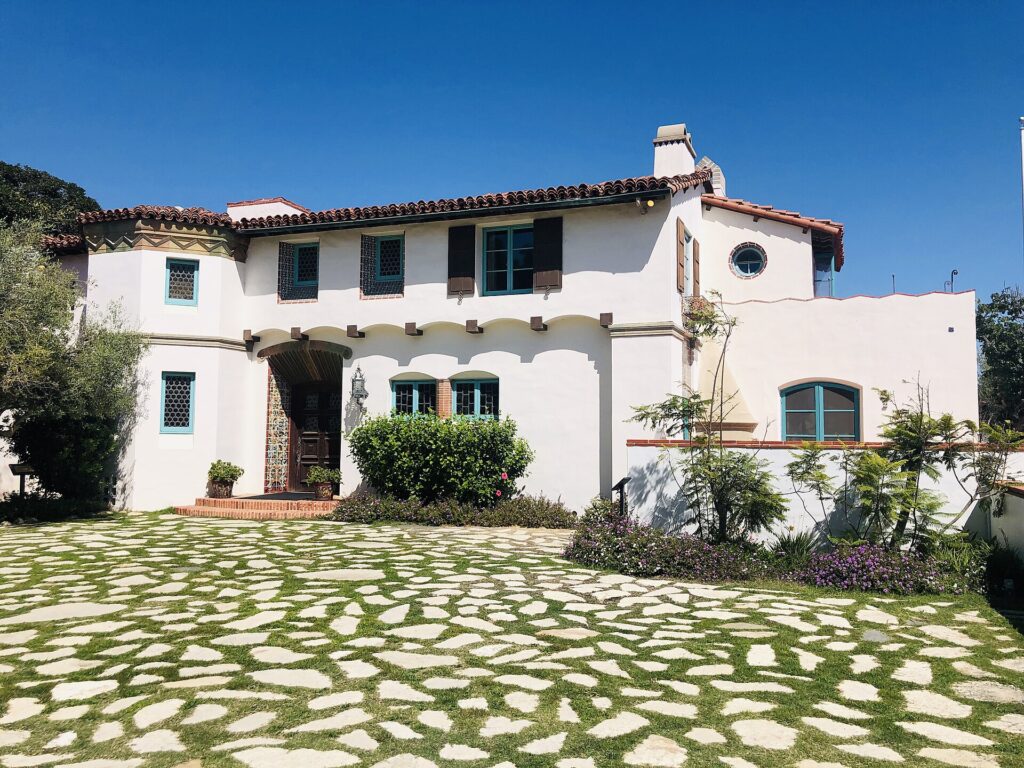
- House tours: docent-led, Wednesday to Saturday, on the hour from 11 a.m., last tour at 2 p.m. First come, first served; about 45 minutes to an hour.
- Tour prices: $7 adults, $2 ages 6 to 17, free for 5 and under.
- Malibu Lagoon Museum: a free two-room museum in the old garage, open Wednesday to Saturday, 11 a.m. to 3 p.m.
- Gardens and grounds: open daily from 8 a.m. to sunset, with outdoor interpretive panels and views over Surfrider Beach.
- Weather: the house and museum close when it rains, and State Parks may close them during fire or other natural events. That matters this winter, with El Niño storms in the forecast.
The house has no parking of its own. Use the lots described below, or free parallel parking on PCH when you can find it. Groups of eight or more need to reserve at least 30 days ahead.
Parking at the Malibu Pier
Parking is the main headache on summer weekends. There are three options:
- LA County lot at Surfrider Beach: a small lot (about 90 spaces) right by the pier, run by LA County Beaches and Harbors. Pay stations take Visa and Mastercard, or cash in $1 and $5 bills only, with no change given. Rates are posted on site.
- Malibu Lagoon State Beach lot: enter at the Cross Creek Road traffic light. Day-use parking runs from 8 a.m. to sunset; State Parks lists $3 an hour or $12 for the day, with higher rates possible on peak days. It is a short walk across the bridge to the Adamson House and the pier.
- PCH street parking: free parallel parking along Pacific Coast Highway when spaces are open. Read every posted sign, pull fully off the traffic lane, and cross PCH only at a signal. It is a fast, busy highway.
Without a car, Metro bus line 534 stops at PCH and Malibu Pier.
Getting there: PCH traffic and roadwork
Almost everyone reaches the pier on Pacific Coast Highway. The stretch between Santa Monica and central Malibu went through the January 2025 Palisades Fire and is still an active Caltrans work zone. As of fall 2026, Caltrans was running weekday single-lane closures, usually 9 a.m. to 3 p.m., between Temescal Canyon Road and Carbon Beach Terrace for drainage, slope and road repairs, with reduced speed limits through the work zone (35 mph and, in places, 25 mph). Caltrans has also been reinforcing the highway against high surf and burn-area debris ahead of the El Niño winter.
Practical advice: check Caltrans QuickMap before you leave, avoid weekday midday if you can, and allow extra time on the way back toward Santa Monica in the late afternoon. Coming from the San Fernando Valley, Malibu Canyon Road reaches PCH by Pepperdine, about a mile west of the pier, and avoids the stretch of PCH under repair, though it is a winding canyon road. If you plan to continue up the coast, our Pacific Coast Highway road trip guide covers the rest of the drive.
Best times to visit
- Sunset: the classic time. Malibu faces south, so the evening light runs along the coast and lights up the pier and the hills behind it. The pier itself closes at sunset, so arrive an hour before.
- Summer and early fall for surf: Malibu is a summertime point break that works best on south swells, which are most consistent in late summer. That is also when the beach and parking are busiest.
- Weekday mornings: easiest parking, quiet pier, good light for photos, and the birds are most active at the lagoon.
- Winter: fewer people and clear days after storms, but big swells and rain can bring closures. Check the Adamson House tour status and road conditions before you go.
Nearby: Malibu Country Mart and Cross Creek
Across PCH from the lagoon, the Cross Creek area is Malibu’s small commercial center. The Malibu Country Mart (3835 Cross Creek Road), open since 1975, is an open-air collection of boutiques and places to eat. Current tenants include Alfred Coffee, Taverna Tony, Tra di Noi, Lucky’s Steakhouse and the casual Malibu Mutt’s Grill, plus shops such as Vuori, Faherty and Oliver Peoples, and The Bunker, a new local surf and skate shop. It is the easiest place near the pier for coffee or a quick lunch away from the beach crowds.
About two miles east on PCH, Duke’s Malibu reopened in March 2026 after more than a year of repairs following the Palisades Fire and mudslides, and it is again a favorite for a meal over the water. Farther east toward Pacific Palisades is the Getty Villa (see our Getty Villa guide), while Point Dume and Zuma lie up the coast to the west and Malibu’s wineries are up in the hills. Our guides to things to do in Malibu, Point Dume and Los Angeles beaches will help you build a full coastal day.
If you would rather not deal with PCH parking at all, the pier is an easy stop on a classic car tour along the coast in an open 1970 Cadillac convertible, or on a private SUV tour for larger groups. Your driver drops you at the pier and picks you up when you are done.
Malibu Pier: FAQ
Is the Malibu Pier open right now?
Yes, partly. The pier is open daily from sunrise to sunset, but the end section has been closed since January 2025. Repairs to the pilings started in October 2026 and are expected to finish by the end of January 2027; no reopening date for the end has been announced. Malibu Farm Restaurant and the beaches are open.
Do you need a fishing license to fish from the Malibu Pier?
No. California does not require a sport fishing license to fish with a line from a public pier in ocean waters. Size limits, bag limits, seasons and report-card rules still apply, and you must fish only in the posted areas.
When was the Malibu Pier built?
In 1905, to serve the Rindge family’s Malibu Rancho. It opened to the public for fishing in 1934, was rebuilt after a 1943–44 storm, was bought by the state in 1980, and was closed after storm damage in the 1990s before a long restoration.