
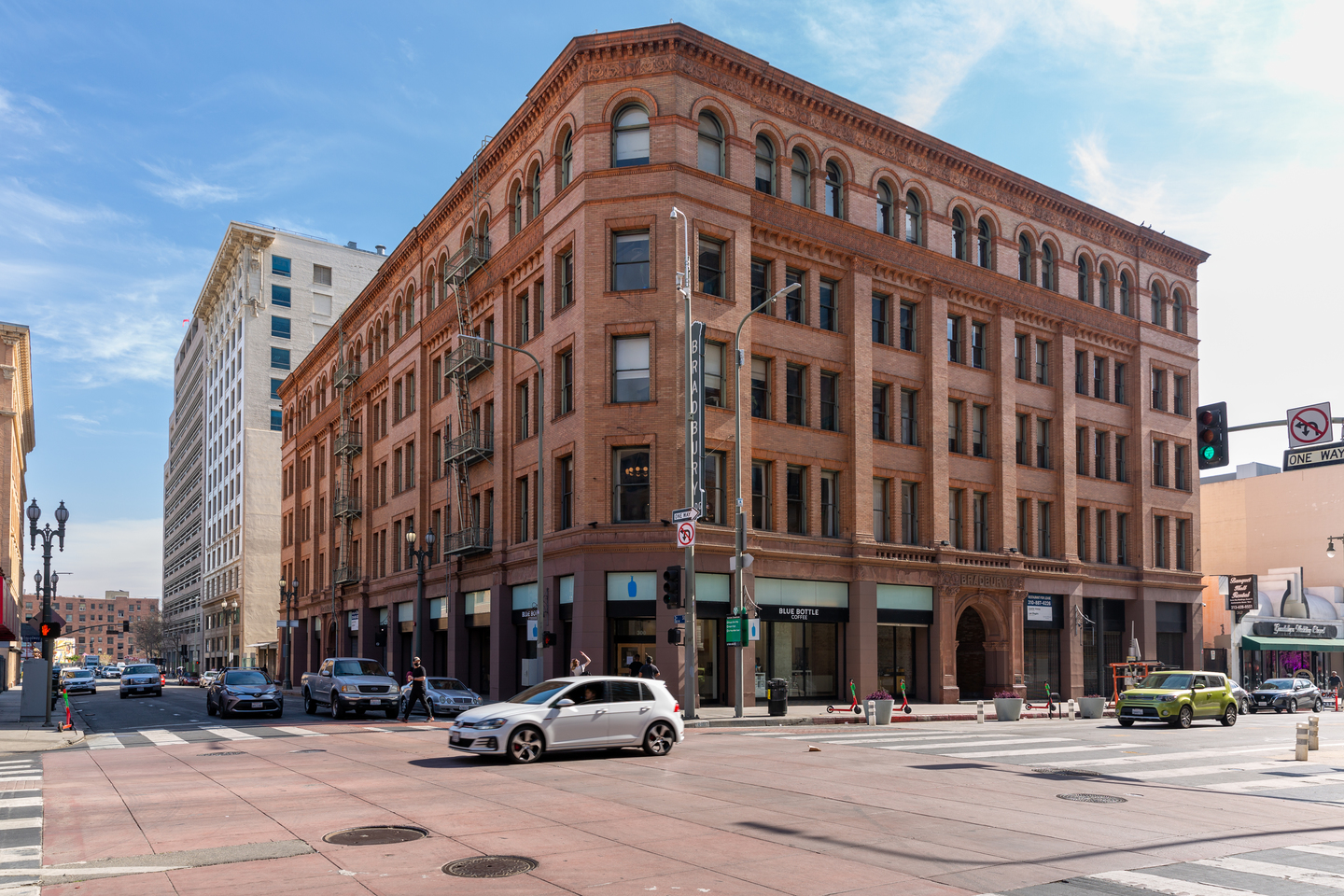
From the sidewalk, the Bradbury Building looks like a sturdy brick office block from the 1890s. Step through the arched entrance at 304 S. Broadway and the view changes completely: a five-story court filled with daylight from a glass roof, black wrought-iron railings, marble stairs and open-cage elevators that still run up the walls. Opened in 1893, it is the oldest commercial building remaining in the central city, a National Historic Landmark, and one of the most filmed interiors in Los Angeles. This guide covers the building’s history and the legend behind its design, what to look for inside, the film connections, the visiting rules (the building is a working office, so access is limited), and the downtown landmarks within a few minutes’ walk. Building access, hours and transit details can change, so check before you go.
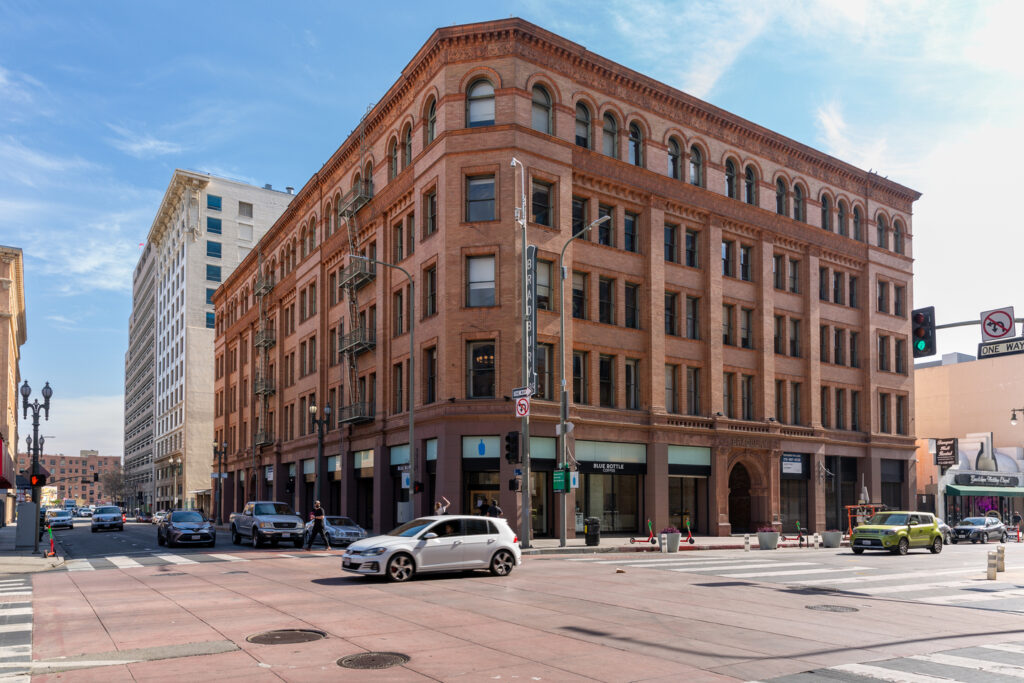
The Bradbury Building at a glance
- Address: 304 S. Broadway, Los Angeles, CA 90013, at the corner of Third Street and Broadway in the Historic Core of downtown.
- Opened: 1893.
- Admission: Free. Casual visitors may enter the ground-floor lobby and go up only as far as the first landing of the stairs.
- Status: Los Angeles Historic-Cultural Monument (1962), National Register of Historic Places (1971), National Historic Landmark (1977).
- Main phone: (213) 797-5777.
- Nearest Metro station: Historic Broadway (A and E lines), about two blocks away.
- Time to allow: 15 to 30 minutes inside; longer if you pair it with Grand Central Market across the street.
History: a millionaire’s last building
Lewis L. Bradbury made his fortune in mining, including the Tajo Mine in Sinaloa, Mexico, and later in Los Angeles real estate. By the early 1890s he was elderly and in poor health, and he wanted one more building to carry his name. The first estimate for the project was about $175,000. By the time it was finished, Bradbury’s money had paid for a building that cost around $500,000, an enormous sum for the time.
He never saw it. Bradbury died on July 15, 1892, a few months before the building opened in 1893.
Who designed it: Sumner Hunt and George Wyman
Bradbury first hired Sumner P. Hunt, an established Los Angeles architect who later designed the Southwest Museum. Hunt completed a set of plans, but Bradbury was not satisfied and turned instead to George H. Wyman, a 32-year-old draftsman in Hunt’s office who had no formal architectural training and, by most accounts, earned about $5 a week.
Wyman supervised construction, and the building is usually credited to him. Historians have pointed out, though, that there is no firm evidence he changed Hunt’s plans, so who deserves credit for the design is still debated. The Los Angeles Conservancy describes Wyman as the man who took over and saw the project through, and leaves the question of final authorship open.
The legend: a message from a dead brother
The building’s most repeated story is best treated as legend. Wyman was reportedly unsure whether to accept the job. According to the account the building itself tells, he consulted a Ouija board, and a message came through from his late brother, Mark: “Take Bradbury Building. It will make you famous.” Wyman took the commission.
The second part of the legend is literary. Wyman is said to have drawn inspiration from Edward Bellamy’s utopian novel Looking Backward (published in 1888), in which a Boston man falls asleep and wakes in the year 2000. The building’s own history quotes the novel’s description of a “vast hall full of light,” and the Bradbury’s skylit court is often read as Wyman’s version of that idea. Neither story can be proven, but both are part of why the building is remembered as a piece of 19th-century futurism.
Decline, restoration and landmark status
The Bradbury was named a Los Angeles Historic-Cultural Monument in 1962, added to the National Register of Historic Places in 1971, and designated a National Historic Landmark in 1977, one of only a handful of Los Angeles office buildings to hold that status. It is also part of the Broadway Theater and Commercial District.
Between 1989 and 1991, developer Ira Yellin, a leading figure in the revival of the Historic Core, carried out a restoration and seismic retrofit costing about $7 million, as part of a larger project that also took in Grand Central Market. The building is also a Los Angeles Conservancy Preservation Award recipient. Today the building is owned and managed by Downtown Properties.
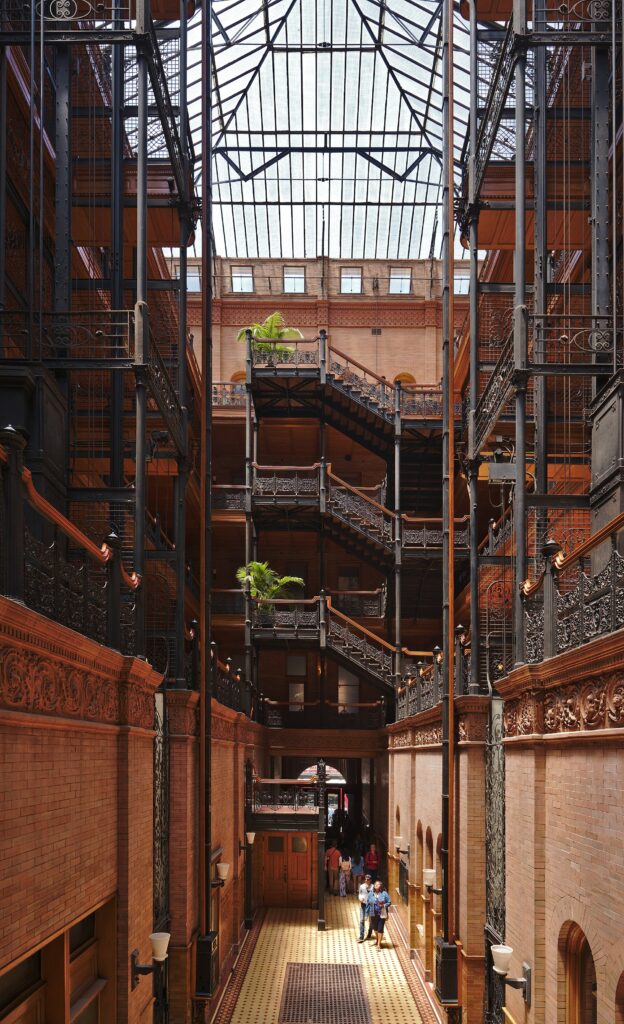
The architecture: what to look for inside
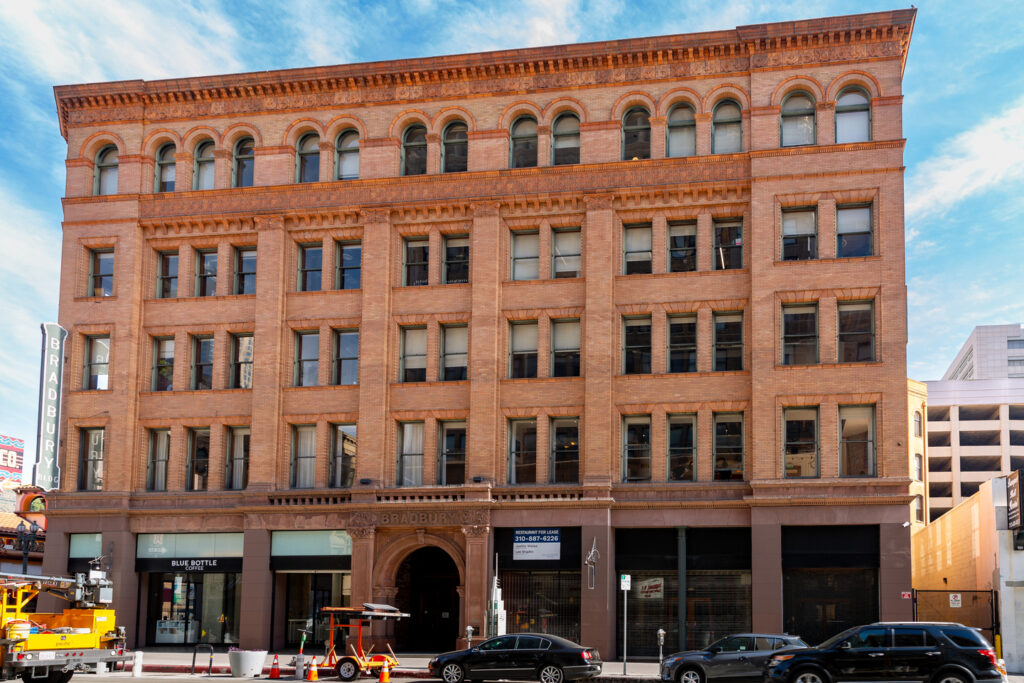
The exterior is deliberately modest: brown brick, sandstone and terracotta in a restrained Romanesque Revival style, with rows of arched windows along the top floor. Everything dramatic is saved for the interior, which is why first-time visitors so often stop just inside the door.
The skylit court
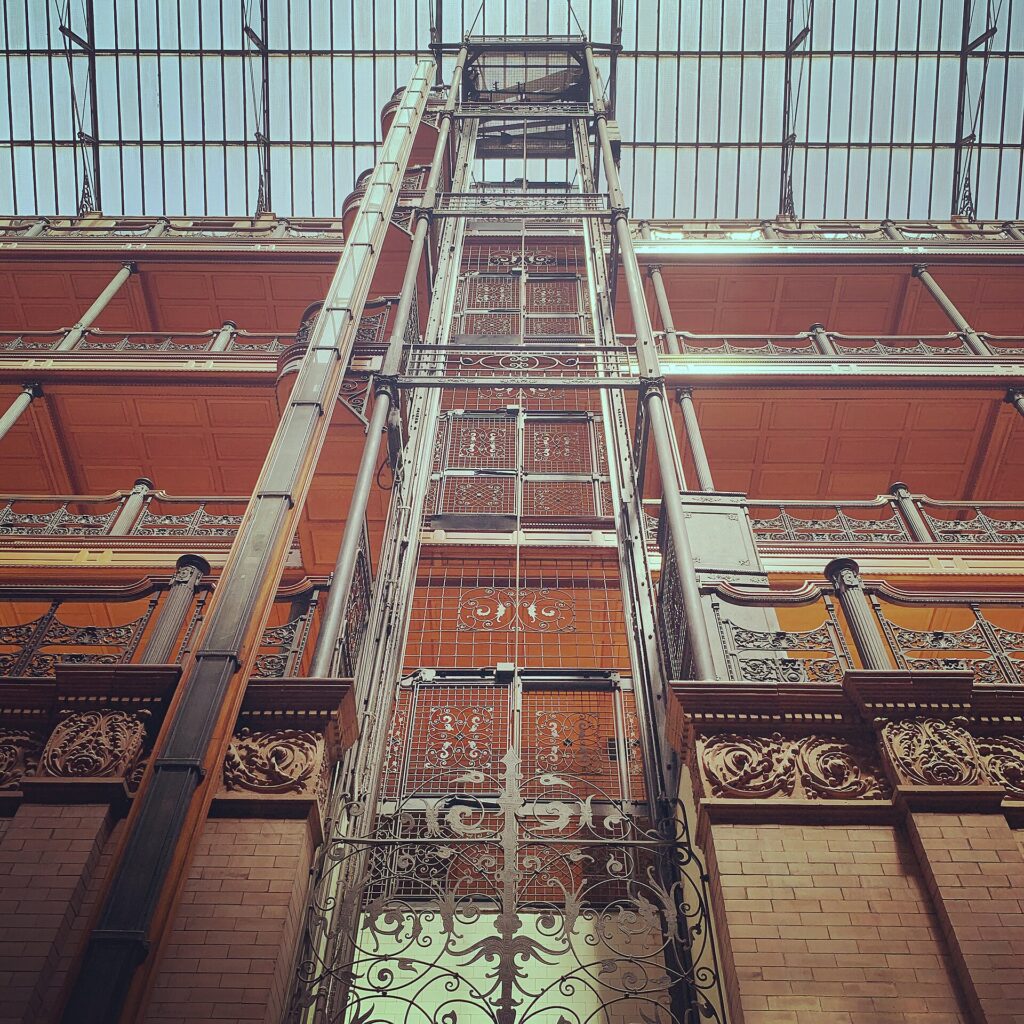
The central court rises almost 50 feet through all five floors to a glass roof. Daylight comes down through the skylight and bounces off pale brick walls, so the space feels bright even on an overcast day. Look straight up from the lobby floor to see the roof framing, then let your eye travel down the open galleries that run around each floor.
Wrought iron, marble and glazed brick
The ornamental ironwork on the railings and stair balustrades is the building’s signature. According to the building, it was made in France and shown at the 1893 Chicago World’s Fair before being installed here; its looping patterns are designed to read almost like hanging vines. Other materials to notice:
- Brick: glazed and unglazed brick in warm yellow and pink tones lines the walls of the court.
- Marble: the stair treads are Italian marble.
- Tile: Mexican tile and decorative tiling add color underfoot and around the court.
- Wood and terracotta: polished wood trim and decorative terracotta panels soften all that iron and brick.
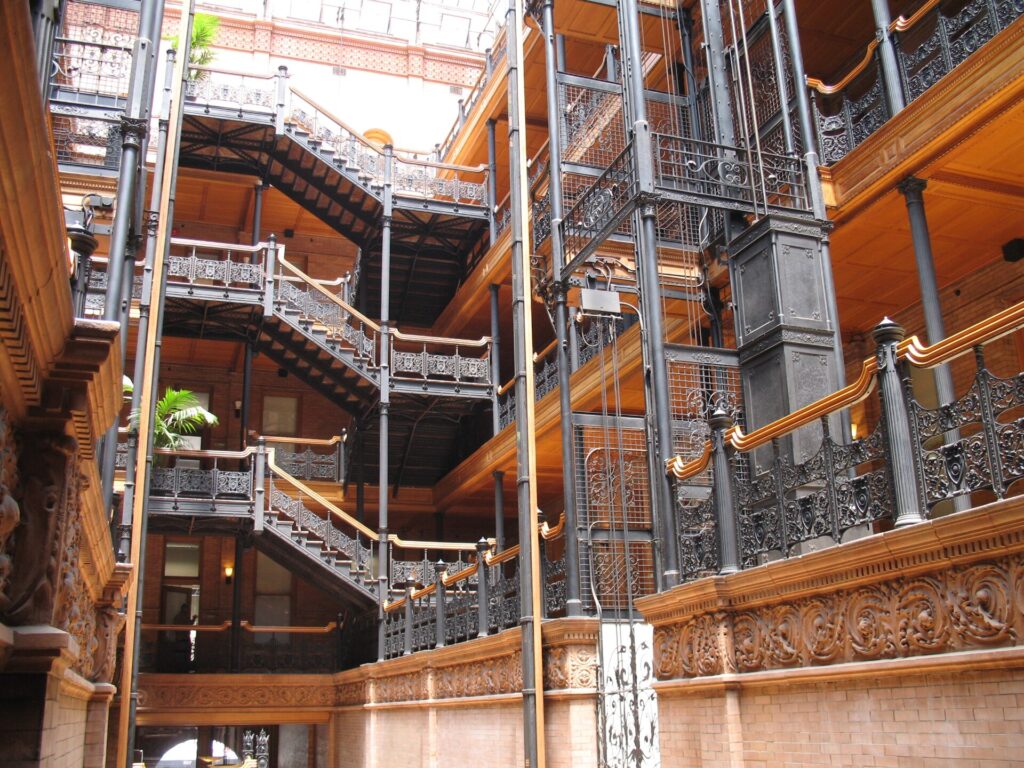
The open-cage elevators
The open “birdcage” elevators, wrapped in wrought-iron grillwork, rise through the court to the fifth floor. Their shafts are open, so you can watch the cars move up and down. They serve the building’s tenants; visitors cannot ride them, but the best view is from the lobby floor anyway, looking up the shaft toward the skylight.
The Bradbury Building on screen
Film crews have been working here since 1942, and the building counts more than 100 productions across feature films, television, music videos and commercials. A few of the best known:
- Blade Runner (1982): Ridley Scott used the court as the home of the toymaker J.F. Sebastian and staged the film’s climax here. It is the role that made the building famous with a global audience.
- Film noir: Double Indemnity (1944) and D.O.A. (1950) both used the building, and it turns up in Chinatown (1974).
- (500) Days of Summer (2009) and The Artist (2011), the silent-film homage that won the Academy Award for Best Picture.
- Television: Pushing Daisies, and Bosch, in which the building appears as itself.
- Music videos: Janet Jackson’s “Rhythm Nation” and Justin Timberlake’s “Say Something.”
Productions book the building well in advance, and the building’s own events and filming page lists the atrium among its rentable spaces. If seeing the interior is the main reason for your trip, calling ahead is worthwhile.
Visiting the Bradbury Building in 2027
The most important thing to know is that the Bradbury is a working office building, not a museum. There is no ticket desk and no guided tour run by the building itself. Visitors are welcome to look, but within clear limits.
Where you can go
- The ground-floor lobby and court: open to the public, free of charge.
- The first landing of the main stairs: casual visitors may climb half a flight to this landing, which gives a slightly higher view across the court.
- Everything above: the upper floors, galleries and elevators are private, for tenants and their guests only.
The building does not publish public visiting hours on its website, and the hours listed by travel sites do not agree with one another. In practice it keeps daytime office hours. If you are planning around a specific day, especially a weekend or holiday, call the building’s main line at (213) 797-5777 to confirm.
Photography
The building does not post a public photography policy online. Visitors routinely take personal photos from the lobby and first landing, but visitor reports differ on whether larger cameras are welcome. Filming and photo shoots, including any shoot with tripods, lights, models or crew, must be arranged in advance with building management, which books the space for productions. A few courtesies go a long way:
- Keep the stairs and doorways clear; people who work here are coming and going all day.
- Keep your voice down. The court carries sound up to the offices above.
- Do not go past the first landing for a better angle, and follow any instructions from security staff.
Who works here now
The Bradbury has housed a mix of private offices, studios and public agencies over the years. Los Angeles Police Department offices moved into the building in the 1990s. The second floor is now Studio Bradbury, a members’ coworking space with its own Wyman Bar, named after the building’s architect. On the ground floor, a Blue Bottle Coffee shop opens onto Broadway.
Guided walking tours
For the history in context, the Los Angeles Conservancy’s Historic Downtown walking tour includes the Bradbury Building and runs on Saturdays at 10 a.m.; registration is through the Conservancy’s website. The Conservancy does not own or operate the building, so the tour follows the same lobby-only rules as everyone else.
Getting there: Metro and parking
- Metro: Historic Broadway station on the A and E lines is about two blocks away. Pershing Square station (B and D lines) is also within walking distance.
- Parking: the building has no visitor parking. The closest options are the Grand Central Market garage at 308 S. Hill St., pay lots on Spring Street, and street meters.
- By car with a driver: Broadway is busy and parking takes time, so many visitors combine the Bradbury with other downtown stops on a guided day out, such as the One Day in LA tour.
What is near the Bradbury Building
The Bradbury sits on one of the densest historic blocks in Los Angeles. Four landmarks are close enough to fit into the same hour, and several more are a short walk or ride away. For a wider list, see our guide to things to do in downtown Los Angeles.
Grand Central Market
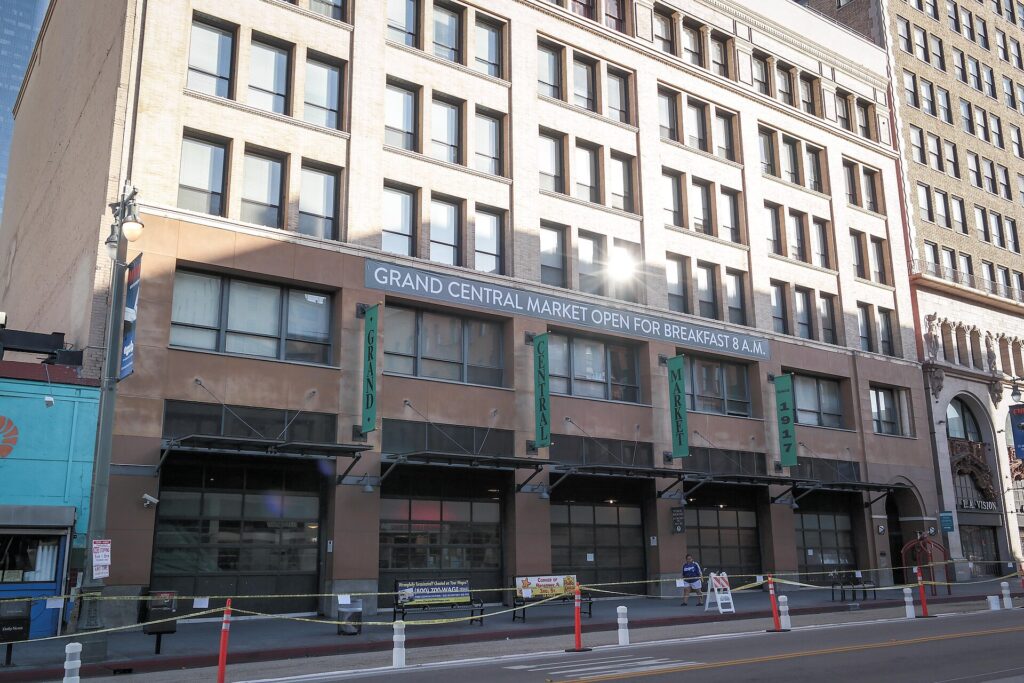
Directly across Broadway at 317 S. Broadway, Grand Central Market has been a downtown landmark since 1917. The long hall runs through the block from Broadway to Hill Street and is lined with food stalls, from tacos and pupusas to oysters and coffee. The market is open daily from 8 a.m. to 9 p.m., though individual vendors set their own hours. It is the natural place to eat before or after your visit.
Million Dollar Theatre
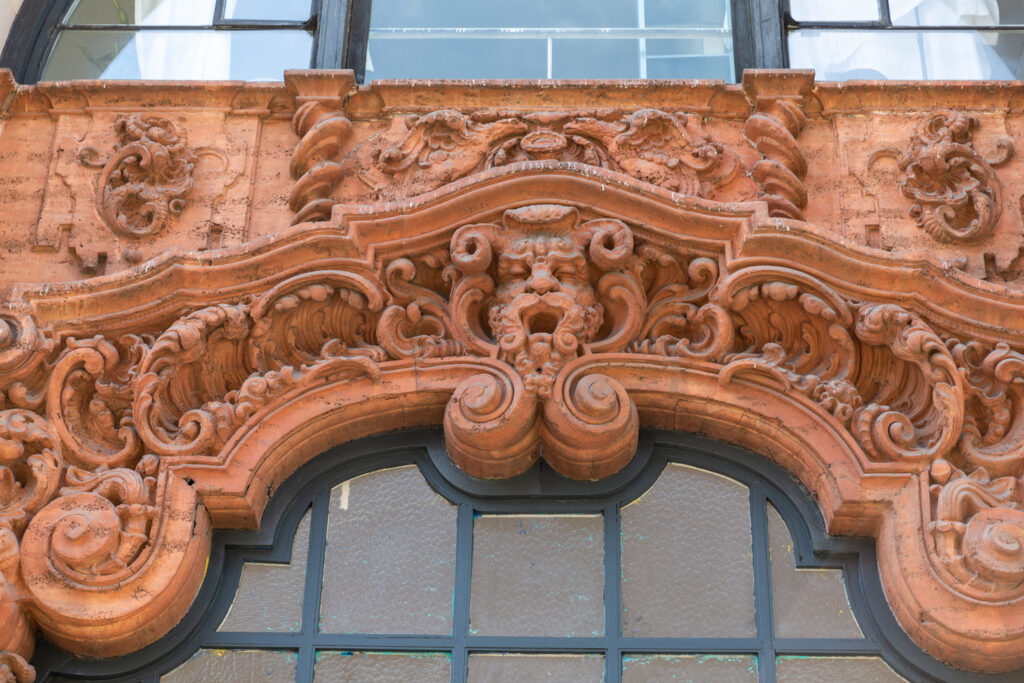
Next to the market at 307 S. Broadway, the Million Dollar Theatre opened on February 1, 1918, as showman Sid Grauman’s first Los Angeles movie palace, years before his Chinese and Egyptian theatres in Hollywood. Look up at the façade designed by Joseph Mora: bison heads, longhorn steer skulls, allegorical figures of the arts and musicians perched on the ledges. The theatre reopened to the public in 2018 and hosts events such as the Conservancy’s Last Remaining Seats classic film screenings. Our guide to historic theaters in Los Angeles covers the rest of the Broadway theatre row to the south.
Angels Flight
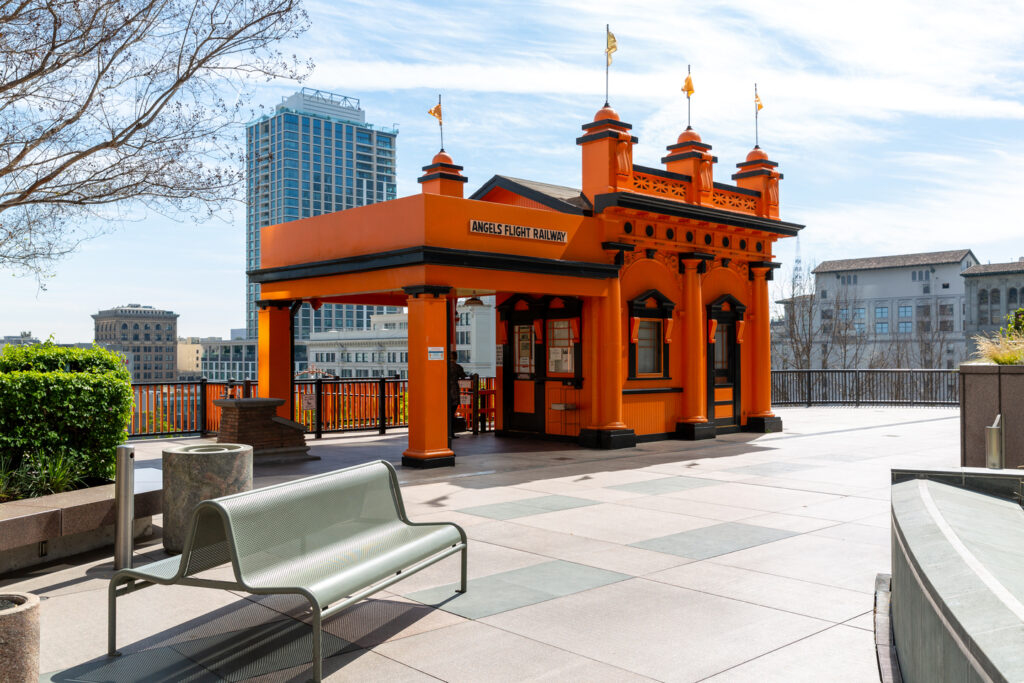
Walk through Grand Central Market to Hill Street and you will find the lower station of Angels Flight at 351 S. Hill St. The little funicular railway first opened in 1901 and carries passengers up the slope to California Plaza at the top of Bunker Hill. It runs daily from 6:45 a.m. to 10 p.m., and a one-way ride costs $1.50, or 75 cents with a Metro TAP card. At the top, the Broad, MOCA and Walt Disney Concert Hall are a few minutes’ walk away.
The Last Bookstore
A short walk south at 453 S. Spring St., at the corner of Fifth Street, The Last Bookstore fills the ground floor and mezzanine of a former bank with new and used books, records and its well-known tunnel of books. It makes an easy second stop for anyone who enjoys historic interiors. See our full guide to The Last Bookstore.
A little farther: Olvera Street and Little Tokyo
Within a short ride or a longer walk north and east, two of the city’s oldest neighborhoods round out a downtown day. Olvera Street is the historic heart of the original Pueblo de Los Angeles, and Little Tokyo has shops, restaurants and the Japanese American National Museum.
Tips for a good visit
- Go in daylight. The skylight is the point. Midday light fills the court best, and the building keeps office hours anyway.
- Pair it with lunch. Grand Central Market is across the street, so the Bradbury and a meal fit comfortably into an hour and a half.
- Keep expectations right. You will see the court from the bottom, not walk the galleries. For most people that is enough; the view up from the lobby is the famous one.
- Look at the outside too. Step back across Broadway or to the corner of Third Street to take in the full brick façade and its arched top-floor windows.
- Plan the rest of the day. The Bradbury is a short stop, so it works best as part of a wider loop of downtown, or a day that also takes in Hollywood and the Westside on a private SUV tour.
Bradbury Building: FAQ
Can you go inside the Bradbury Building?
Yes. Entry to the ground-floor lobby is free, and casual visitors may climb to the first landing of the stairs. The upper floors and the elevators are private office space for tenants only.
Who designed the Bradbury Building?
George H. Wyman, a draftsman without formal architectural training, supervised the construction and is usually credited. Lewis Bradbury had first hired architect Sumner P. Hunt, and historians still debate how much of the final design was Hunt’s.
What movies were filmed at the Bradbury Building?
More than 100 productions have filmed here since 1942. The best known are Blade Runner (1982), Double Indemnity (1944), D.O.A. (1950), Chinatown (1974), (500) Days of Summer (2009) and The Artist (2011).
Is the Bradbury Building a National Historic Landmark?
Yes. It was designated a National Historic Landmark in 1977, after being named a Los Angeles Historic-Cultural Monument in 1962 and listed on the National Register of Historic Places in 1971.