
Los Angeles built more grand theaters in the 1910s, ’20s and early ’30s than almost any city in the country, and a surprising number of them are still standing. Some still show movies, some stage Broadway musicals and rock concerts, one sells iPhones, and a few open their doors only a handful of times a year. This guide covers the historic theaters Los Angeles visitors can actually see today, grouped by neighborhood: Hollywood Boulevard, downtown’s Broadway, and the stretch of Wilshire Boulevard and the Westside in between.
For each theater you will find when it opened, who designed it, what it is used for now and how to get inside. Programs, tour schedules and ticket prices change, so check the venue’s or organizer’s website before you go.
Why Los Angeles Has So Many Historic Theaters
Before Hollywood became the center of the film business, downtown’s Broadway was the city’s entertainment street. Vaudeville houses and early movie theaters went up there from 1910 on, and by 1931 the street had a dozen movie palaces in a row. Showman Sid Grauman opened his first Los Angeles house, the Million Dollar Theatre, on Broadway in 1918.
As the studios settled in Hollywood, the premieres followed. Grauman and developer Charles E. Toberman opened the Egyptian in 1922, the El Capitan in 1926 and the Chinese in 1927, all on Hollywood Boulevard. The Pantages joined them in 1930, and on the Westside, Fox and Warner Bros. built neighborhood palaces along Wilshire Boulevard and in Westwood. When the Depression and then television arrived, many of these buildings were divided up, turned into churches or stores, or simply closed. The ones that survived have been restored over the last three decades by studios, nonprofits, concert promoters and, in a few cases, film directors.
Hollywood Boulevard Theaters
Four of the best-known theaters in the world sit within about a mile and a half of each other on Hollywood Boulevard. They are easy to combine with the Walk of Fame and the other sights in our guide to things to do in Hollywood.
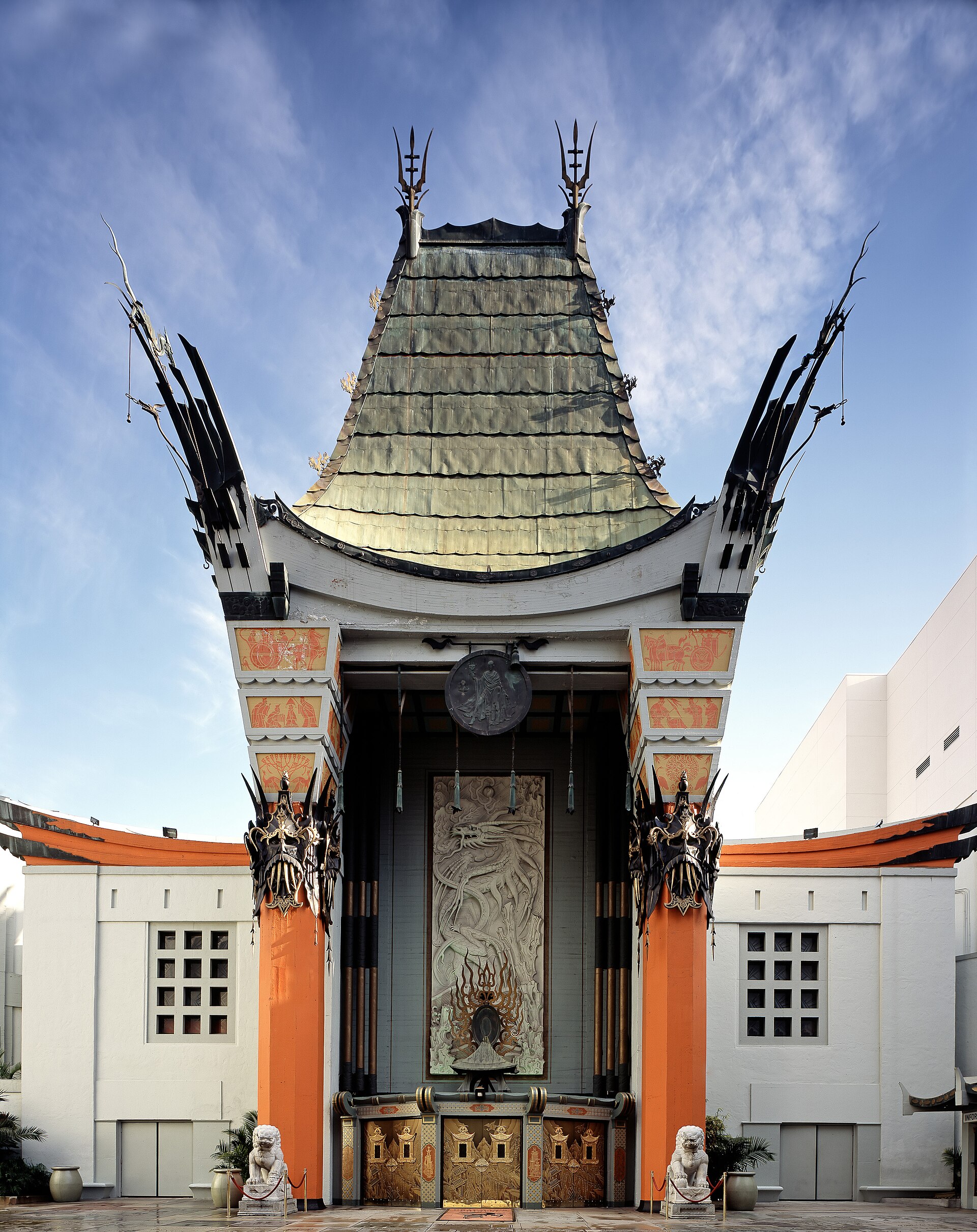
TCL Chinese Theatre (Grauman’s Chinese)
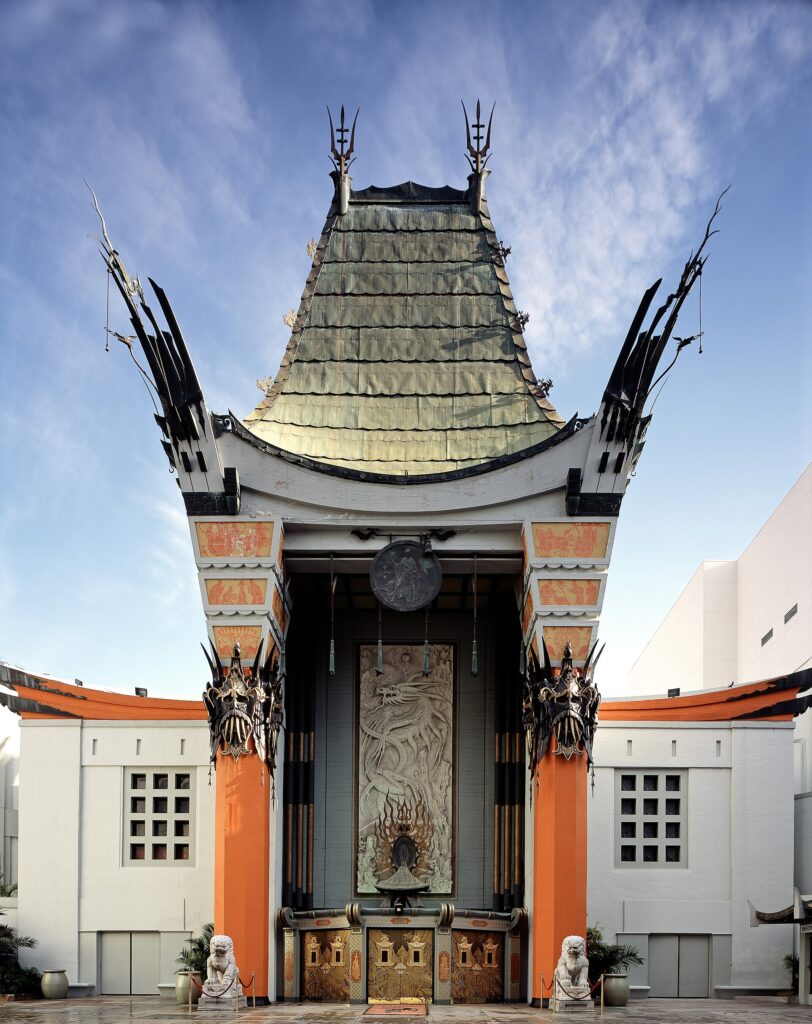
Opened: May 18, 1927, with the premiere of Cecil B. DeMille’s The King of Kings. Design: Raymond Kennedy of the firm Meyer & Holler. Address: 6925 Hollywood Blvd.
Sid Grauman’s pagoda-style palace draws crowds mostly because of its forecourt. Nearly 200 stars have pressed their handprints, footprints and signatures into the concrete here, and Grauman’s own 1927 handprint is still among them. Who started the tradition is disputed: the theater credits actress Norma Talmadge stepping into wet cement, while Grauman later claimed the idea as his own.
Electronics maker TCL bought the naming rights in 2013, and the same year the main auditorium was rebuilt as an IMAX theater. It reopened on September 20, 2013, with The Wizard of Oz in IMAX 3D, and it is the largest IMAX auditorium in the world by seating capacity.
How to get inside: buy a ticket to a regular screening, or take the theater’s own 30-minute guided tour, which runs daily except during special events. The forecourt is free to visit at any time.
Egyptian Theatre
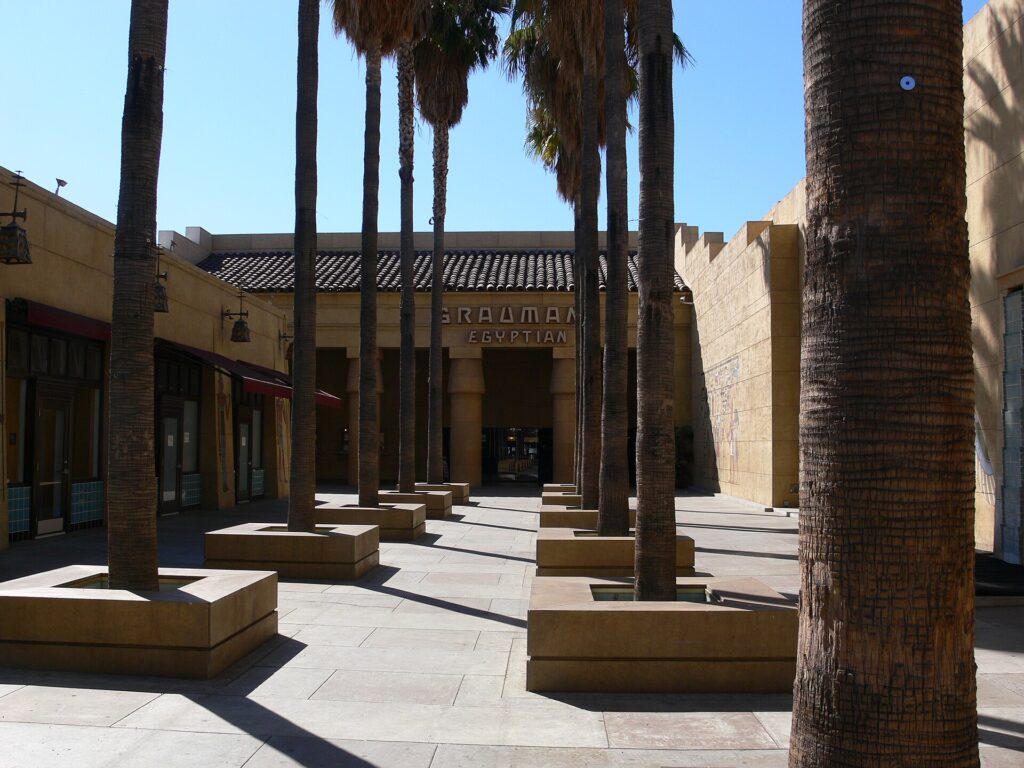
Opened: 1922, by Sid Grauman. Now: owned by Netflix and programmed together with the nonprofit American Cinematheque.
The Egyptian is where the Hollywood movie premiere began: it opened in 1922 with Douglas Fairbanks in Robin Hood, the first Hollywood premiere. It is approached from the boulevard through a long forecourt lined with palms.
The American Cinematheque owned and ran the theater from 1998 until 2020, when Netflix bought it. After a restoration by the two partners, the Egyptian reopened on November 9, 2023. The two share the calendar: Netflix uses it for premieres and its own screenings early in the week, while the American Cinematheque programs the remaining days, with films shown in 35mm, 70mm and digital.
How to get inside: buy a ticket to an American Cinematheque screening; the schedule is posted on the Cinematheque’s website.
El Capitan Theatre
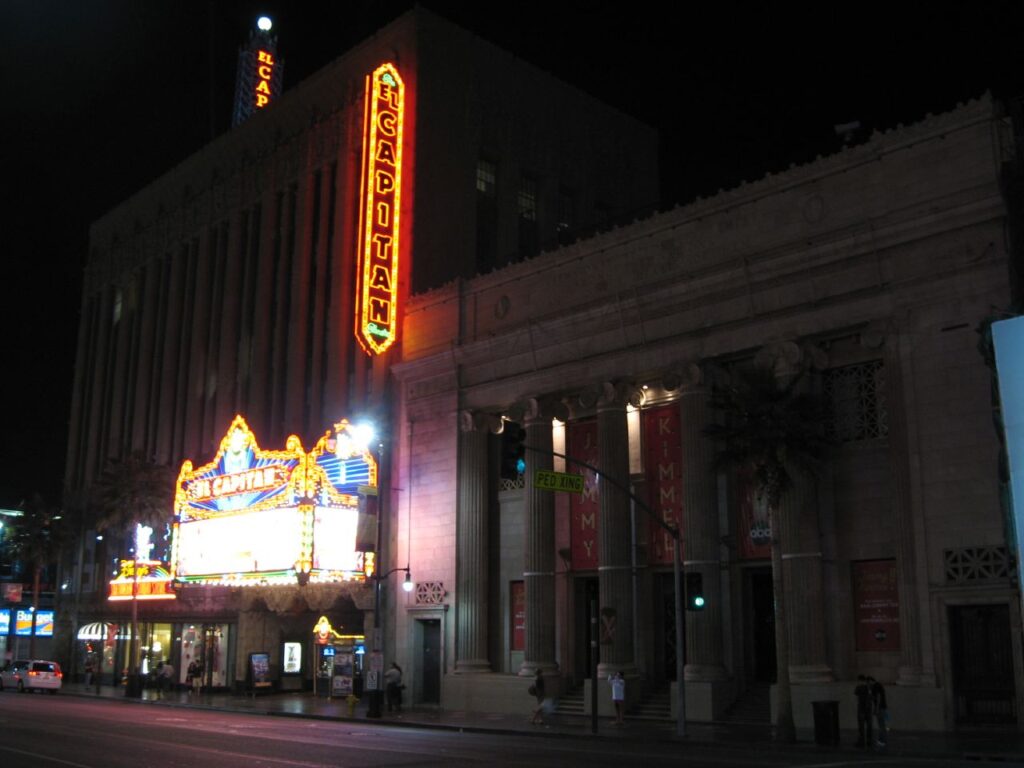
Opened: May 3, 1926, as a live playhouse, with Charlot’s Revue. Design: exterior by Stiles O. Clements, interior by G. Albert Lansburgh. Now: Disney’s first-run movie house.
The El Capitan began life as a stage theater, not a cinema. In the early 1940s it was converted to show films and given a streamlined modern makeover that hid much of the original interior. The Walt Disney Company bought it in 1989 and, with Pacific Theatres, spent two years restoring the ornate Spanish-style decoration. It reopened on June 19, 1991, with The Rocketeer.
How to get inside: the El Capitan is an exclusive first-run theater for Disney releases and also hosts live stage shows, world premieres and screenings of classic Disney films, so a regular movie ticket is the way in.
Hollywood Pantages Theatre
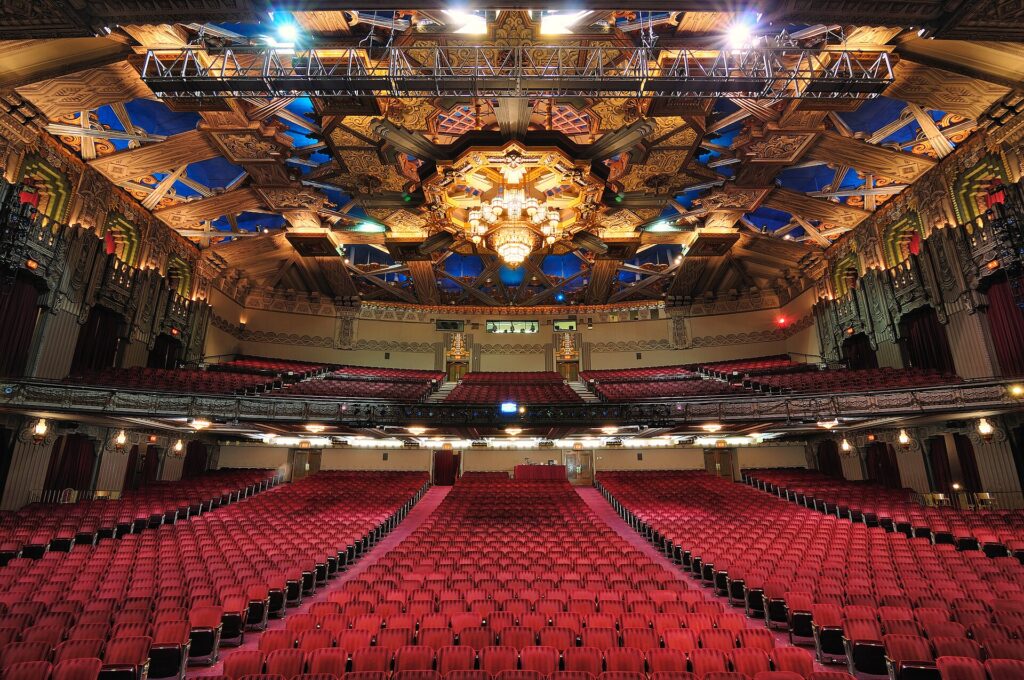
Opened: June 4, 1930. Design: B. Marcus Priteca, Art Deco. Address: 6233 Hollywood Blvd., near Hollywood and Vine.
The Pantages was the last theater built by vaudeville circuit owner Alexander Pantages for his chain. Its Art Deco auditorium, with gold and bronze ornament and huge chandeliers, is one of the most striking interiors in the city. Under owner Howard Hughes it hosted the Academy Awards for eleven years, from 1950 to 1960, including the first televised ceremony in 1953.
How to get inside: today the Pantages is run by a subsidiary of the Nederlander Organization as the Hollywood home of touring Broadway productions. Buying a ticket to a show is the only way to see the auditorium.
Theatre Row on Santa Monica Boulevard
Hollywood’s live stage scene lives a few blocks south of the boulevard. Theatre Row is a mile-long stretch of small live-performance venues along Santa Monica Boulevard between McCadden Place and El Centro Avenue. In 2019 it offered around 400 shows on more than 20 stages. Venues include the Hudson Theatres, The Blank’s 2nd Stage Theatre, and the Broadwater complex, home of the Sacred Fools theater company. The theaters are known for working as a community rather than as rivals. It is a very different experience from the movie palaces: small rooms, close to the stage.
Downtown’s Broadway Theatre District
For sheer concentration, nothing in Los Angeles matches the stretch of South Broadway between roughly Third Street and Olympic Boulevard. The National Park Service listed the Broadway Theater and Commercial District on the National Register of Historic Places in 1979 and expanded it in 2002. Twelve movie palaces built between 1910 and 1931 remain, now used as event venues, filming locations and shops. From 1926 to 1936 the street was also the western end of Route 66. Our guide to things to do in downtown Los Angeles covers the rest of the neighborhood.
The theaters below run north to south, the order you would pass them on foot.
Million Dollar Theatre
Opened: February 1, 1918. Design: building by Albert C. Martin Sr., interior by William Lee Woollett, Spanish Churrigueresque style. Address: 307 S. Broadway.
Sid Grauman’s first Los Angeles theater was one of the earliest and largest movie palaces in the country, with 2,345 seats. Its balcony rests on what the Los Angeles Conservancy describes as the world’s first reinforced-concrete girder, developed during a steel shortage in World War I. In the 1950s it became the first Broadway theater to stage Spanish-language variety shows and stayed a center of Latino entertainment for decades. After years as a church and then closed, it reopened under new owners in 2018 and now hosts special events and Conservancy screenings.
Los Angeles Theatre
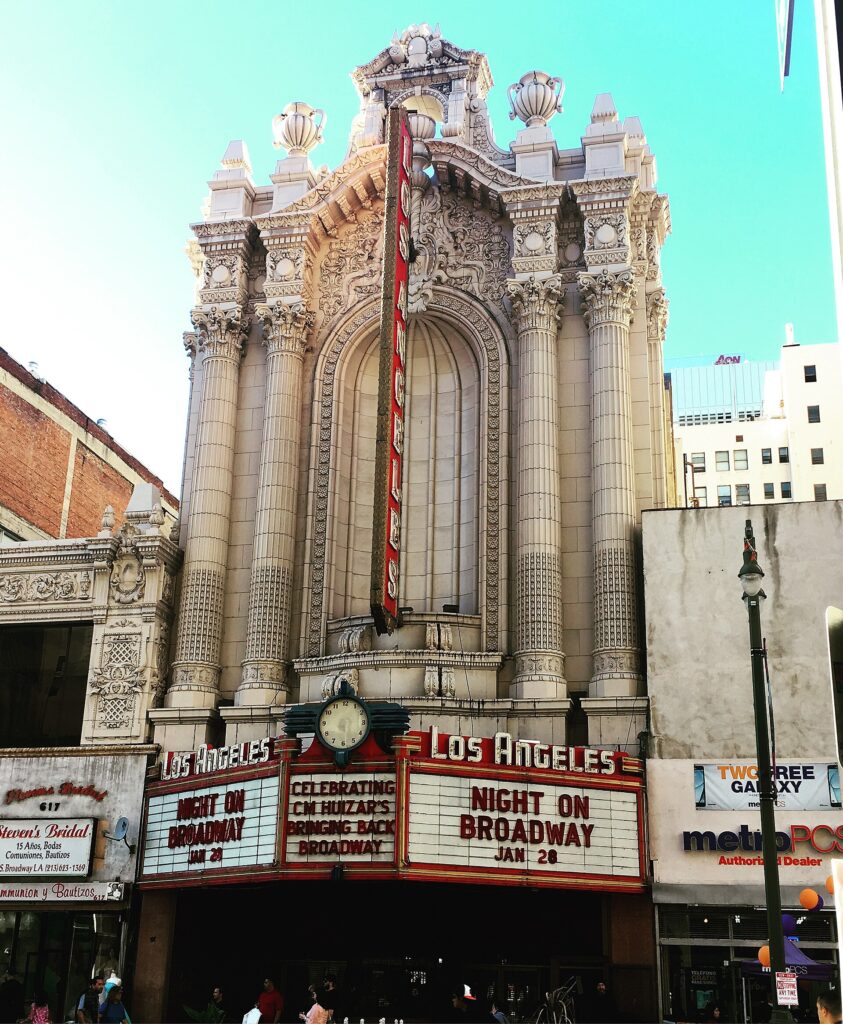
Opened: 1931. Design: S. Charles Lee, in a style recalling French Baroque. Address: 615 S. Broadway.
The Los Angeles Conservancy calls it the most lavish and the last built of Broadway’s great movie palaces. It was commissioned by H. L. Gumbiner, who had built the Tower Theatre a few blocks south. The theater has no regular programming; it is used as a filming location and for special events. The best chance to sit in its auditorium is a Last Remaining Seats screening (see below).
Palace Theatre
Opened: 1911. Design: G. Albert Lansburgh, Renaissance Revival. Address: 630 S. Broadway.
Across the street from the Los Angeles Theatre stands one of the oldest theaters in the city. It opened as a vaudeville house on the Orpheum circuit and is the oldest remaining original Orpheum theater in the United States. Today it is rented for special events and filming rather than open on a regular schedule.
Tower Theatre (Apple Tower Theatre)
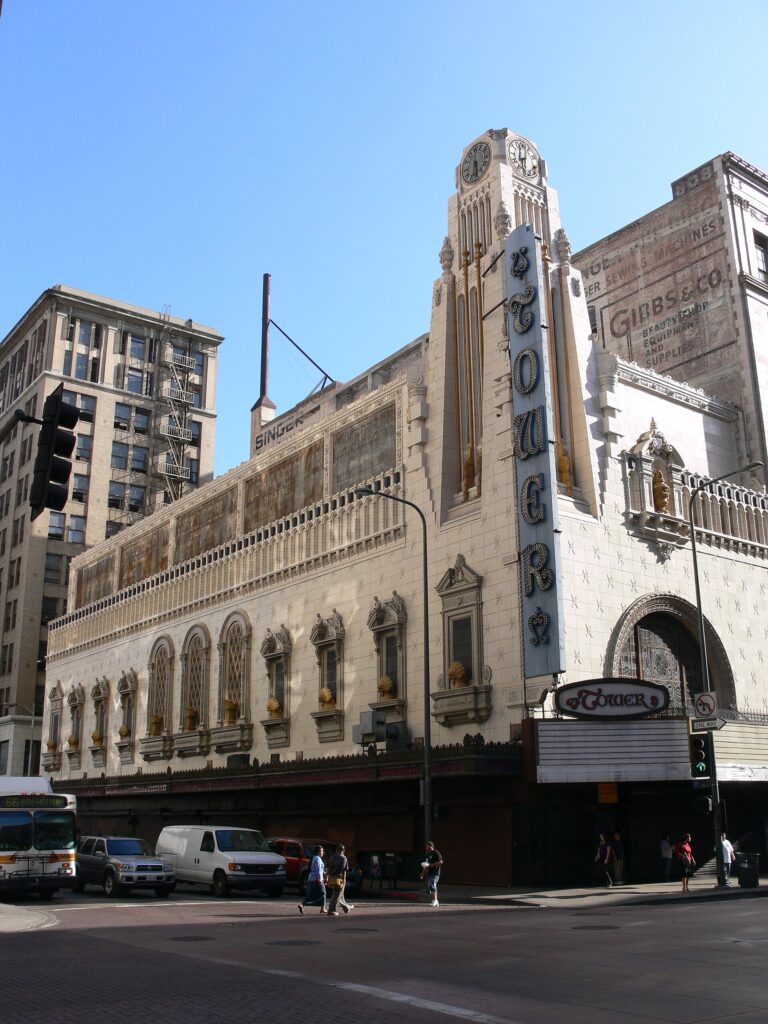
Opened: 1927. Design: S. Charles Lee, Renaissance Revival. Address: 800 S. Broadway, at Eighth Street.
The Tower was the first theater designed by S. Charles Lee, who went on to design the Los Angeles Theatre a few years later. Its clock tower is a landmark at Eighth and Broadway. After sitting vacant for years, the building was restored and opened as an Apple store in June 2021.
How to get inside: walk in during store hours. It is the easiest historic theater interior in Los Angeles to see, and it costs nothing.
Orpheum Theatre
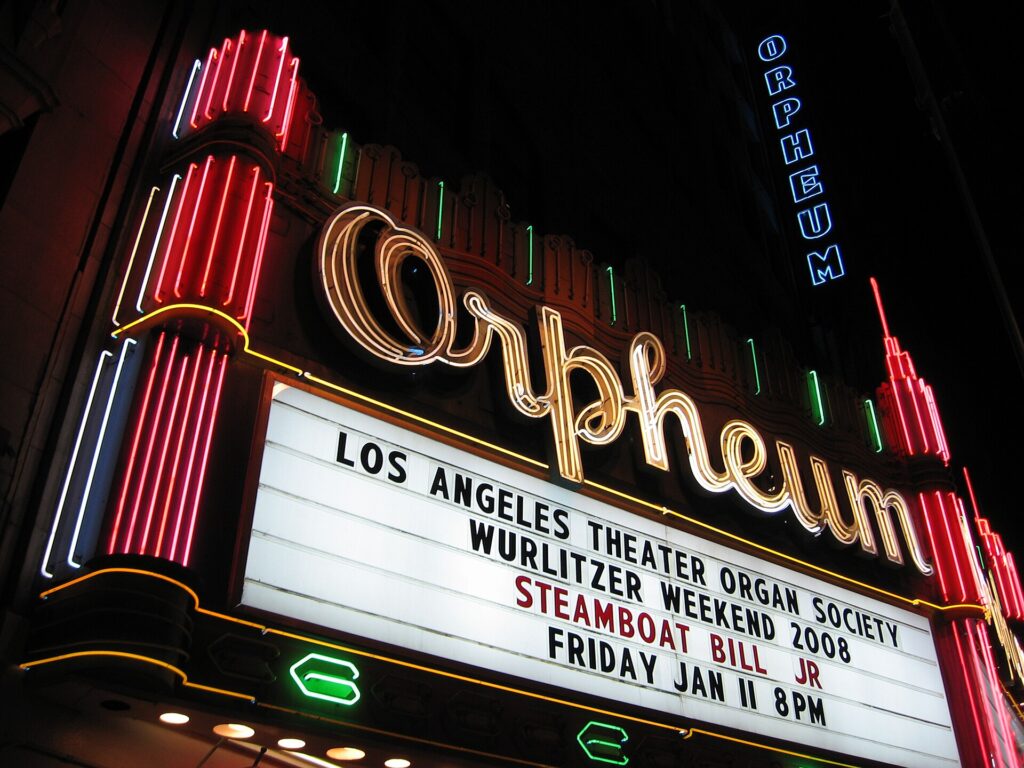
Opened: 1926. Design: G. Albert Lansburgh, Beaux Arts. Address: 842 S. Broadway.
Built to be the grandest theater in the Orpheum vaudeville chain, the Orpheum quickly became a leading live-entertainment venue. It is still a working theater, hosting live performances, silent film screenings and Conservancy film nights, and its neon marquee lights up the south end of Broadway. The upper floors of the building have been converted to live/work lofts.
How to get inside: buy a ticket to a show; the Orpheum books concerts and events throughout the year.
The United Theater on Broadway
Opened: December 26, 1927, as the United Artists Theatre, with Mary Pickford in My Best Girl.
Built for United Artists, the studio founded by Pickford, Charlie Chaplin, Douglas Fairbanks and D.W. Griffith, this theater at the south end of the district has had several lives. It was a church from 1990 to 2011, then reopened in 2014 as the Theatre at Ace Hotel. When Ace left the building in early 2024, the venue took the name The United Theater on Broadway. It now hosts concerts and events in a 1,600-seat house with an ornate three-story lobby. Chaplin fans should also read our piece on Charlie Chaplin in Hollywood.
Wilshire Boulevard and the Westside
As Los Angeles spread west in the late 1920s, the studio-owned theater chains followed their audiences with smaller neighborhood palaces.
The Wiltern
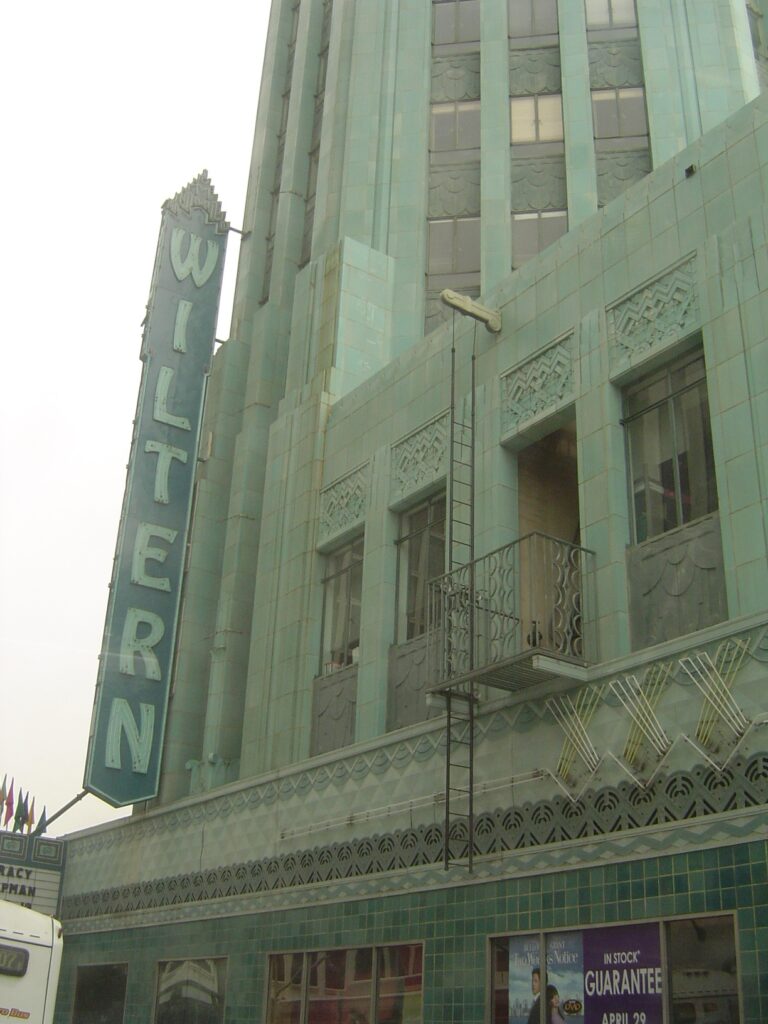
Opened: 1931, as Warner Bros.’ Western Theatre. Design: Stiles O. Clements of Morgan, Walls & Clements, Art Deco. Address: 3790 Wilshire Blvd., at Western Avenue in Koreatown.
The blue-green terra-cotta Wiltern and the 12-story Pellissier Building it belongs to are among the finest Art Deco buildings in Los Angeles; theater historian John Miller called the Wiltern a “dictionary of Art Deco style.” On opening night it hosted the premiere of Alexander Hamilton with George Arliss. Today it is one of the city’s busiest concert venues, so a ticket to a show is the way in. For other ideas after dark, see our guide to Los Angeles nightlife.
Saban Theatre (Fox Wilshire)
Opened: September 19, 1930, as the Fox Wilshire. Design: S. Charles Lee, Art Deco. Address: 8440 Wilshire Blvd., Beverly Hills.
For decades this was one of Fox’s premier movie houses on the Westside. It was converted to a stage venue in the 1980s and renamed in 2009 for Haim and Cheryl Saban after their $5 million gift. Listed on the National Register of Historic Places in 2012, it now hosts concerts and touring shows, along with religious services by its owner, Temple of the Arts.
Vista Theatre, Los Feliz
Opened: 1923. Now: owned by Quentin Tarantino.
This single-screen neighborhood house on Sunset Drive in Los Feliz has about 400 seats. It closed during the pandemic, Tarantino bought it in 2021, and after a three-year renovation it reopened in November 2023, a month after its 100th birthday, with a 35mm print of True Romance. The renovation added 70mm projection, and the theater screens on film. A ticket to any screening gets you inside.
Village Theatre, Westwood
Opened: 1931, as the Fox Village. Status: closed for restoration, with reopening planned for 2027.
The Village opened on August 14, 1931, and was run for many years by Regency Theatres until it closed in July 2024. A group of filmmakers led by director Jason Reitman, the Village Directors Circle, bought the building and has partnered with the American Cinematheque to restore and run it, with a reopening planned for 2027. Until then you can see it only from the street.
How to See Inside the Historic Theaters
Several of these buildings, especially on Broadway, have no regular box office. These are the most reliable ways in.
Last Remaining Seats
The Los Angeles Conservancy’s annual classic film series is the best way to see a downtown movie palace the way it was meant to be seen. The 2026 season ran on three Saturdays in June, with a matinee and an evening film each day: the Orpheum (a Charlie Chaplin double bill and Rebel Without a Cause), the Los Angeles Theatre (a Mary Poppins sing-along and L.A. Confidential) and the Million Dollar Theatre (9 to 5 and North by Northwest). General-public tickets were $25, with lower prices for members and youth, and the Conservancy also sold guided tours of the three theaters. A Halloween edition, Last…Remains, followed at the Million Dollar Theatre in October. The 2027 season had not been announced at the time of writing; watch the Conservancy’s website in spring.
The Conservancy’s Broadway Walking Tour
Year-round, the Conservancy runs “Curtains Up on Broadway: L.A.’s Historic Theatre District,” a docent-led walking tour every Saturday at 10 a.m. Tickets are $25 for the general public and $18 for members and youth, and you should plan to be on your feet for about two hours. Book ahead, as all sales are final.
Planning a Day Around the Old Movie Palaces
Hollywood Boulevard and downtown’s Broadway are roughly seven miles apart by road, and the Wiltern on Wilshire is an easy detour between them, so one day can cover all three. A practical order is downtown in the morning (the Saturday walking tour starts at 10 a.m.), the Wiltern on the way west, and Hollywood Boulevard in the afternoon, ending with an evening screening at the Egyptian or the Chinese. If you would rather someone else handle the driving and parking, our Hollywood tour covers the boulevard’s theaters and the stories behind them, and the classic car tour lets you see the marquees from the back seat of a 1970 Cadillac convertible, which suits a street built in the same spirit. If you enjoy film history, pair the day with stops from our Los Angeles museum tour guide.
Historic Theaters in Los Angeles: FAQ
What is the oldest movie palace in Los Angeles?
The Palace Theatre on Broadway opened in 1911 as a vaudeville house and is one of the oldest theaters in the city. The Million Dollar Theatre, which opened in 1918, was one of the earliest large movie palaces in the country.
Can you tour the TCL Chinese Theatre?
Yes. The theater runs its own 30-minute guided tour every day except during special events. The forecourt with the handprints and footprints is free and open to everyone.
Is the Egyptian Theatre open again?
Yes. After a restoration by Netflix and the American Cinematheque, the Egyptian reopened on November 9, 2023. The American Cinematheque posts its public screenings on its website.