
Few streets carry as much of the city’s story as Sunset Boulevard, Los Angeles. It starts near the edge of Downtown, climbs through Echo Park and Silver Lake, runs past the studios and music halls of Hollywood, turns into the Sunset Strip in West Hollywood, slows down among the palms of Beverly Hills, curves through Bel Air and Brentwood, and ends at the Pacific Ocean in Pacific Palisades.
This guide follows the boulevard east to west, stretch by stretch, with what is open in late 2026, what is closed or rebuilding, and how to time the drive. Venues change their schedules often, so check before you go for any hours, reservations or show times mentioned here.
Sunset Boulevard at a glance
- Length: roughly 22 to 24 miles, depending on the source and where you start counting.
- East end: Figueroa Street, on the northern edge of Downtown. East of Figueroa, the old route was renamed Cesar Chavez Avenue in 1994.
- West end: Pacific Coast Highway (State Route 1) in Pacific Palisades.
- Neighborhoods, east to west: Echo Park, Silver Lake, Los Feliz, Hollywood, West Hollywood, Beverly Hills, Holmby Hills, Bel Air, Brentwood and Pacific Palisades.
- The famous part: the Sunset Strip, about 1.5 miles between Crescent Heights Boulevard and Doheny Drive in West Hollywood.
A short history of Sunset Boulevard
The boulevard follows the line of an old trail that ran from the Spanish pueblo of Los Angeles toward the ocean. In the early 1900s it was pushed east to the Plaza near Olvera Street, and from 1921 it was extended west through the canyons toward the coast. Parts of it carried other names along the way; the Beverly Hills section was once called Beverly Boulevard. In 1994 the stretch east of Figueroa Street, along with other streets, became Cesar Chavez Avenue, which is why Sunset now begins at Figueroa.
The Sunset Strip earned its reputation in the 1940s and 1950s, when nightclubs such as Ciro’s drew movie stars to the Strip. In the 1960s the Strip became the center of the Los Angeles rock scene, and in 1966 crowds of young people clashed with police near the Pandora’s Box club, an episode that inspired Buffalo Springfield’s song “For What It’s Worth.” The television series 77 Sunset Strip spread the name around the world.
The 1950 film Sunset Boulevard
Billy Wilder’s Sunset Boulevard (1950) stars Gloria Swanson as Norma Desmond, a forgotten silent-film star, with William Holden as the struggling screenwriter who gets caught in her world and Erich von Stroheim as her butler. The film received eleven Academy Award nominations and won three, including Best Story and Screenplay. Her line “I am big. It’s the pictures that got small” is still quoted today. Despite the title, the Desmond mansion seen in the film stood on Wilshire Boulevard, and it was torn down in 1957.
The story lives on in Andrew Lloyd Webber’s musical. Jamie Lloyd’s Broadway revival of Sunset Blvd. won the 2025 Tony Award for Best Revival of a Musical, and Nicole Scherzinger won Best Leading Actress in a Musical for playing Norma Desmond.
Echo Park and Silver Lake: where the boulevard begins
From Figueroa Street, Sunset heads northwest into Echo Park, a hilly neighborhood of small shops, taquerias and older apartment buildings. A few blocks south of the boulevard is Echo Park Lake, a city park built around a former reservoir. It reopened in 2013 after a major renovation that added wetlands and a boardwalk, and its lotus beds are celebrated each July at the Lotus Festival. The statue known as the “Lady of the Lake” dates from 1935.
Farther west, Sunset meets Santa Monica Boulevard at Sunset Junction in Silver Lake, where Santa Monica Boulevard ends. The area has a place in LGBTQ+ history: a protest against police raids at the Black Cat Tavern here in 1967 came more than two years before Stonewall. Today it is a walkable cluster of cafes, restaurants and boutiques.
Hollywood: music halls and a famous dome
After passing the edge of Los Feliz, Sunset runs straight through Hollywood, a few blocks south of the Walk of Fame on Hollywood Boulevard. It is busy and commercial, with a few landmarks worth slowing down for.
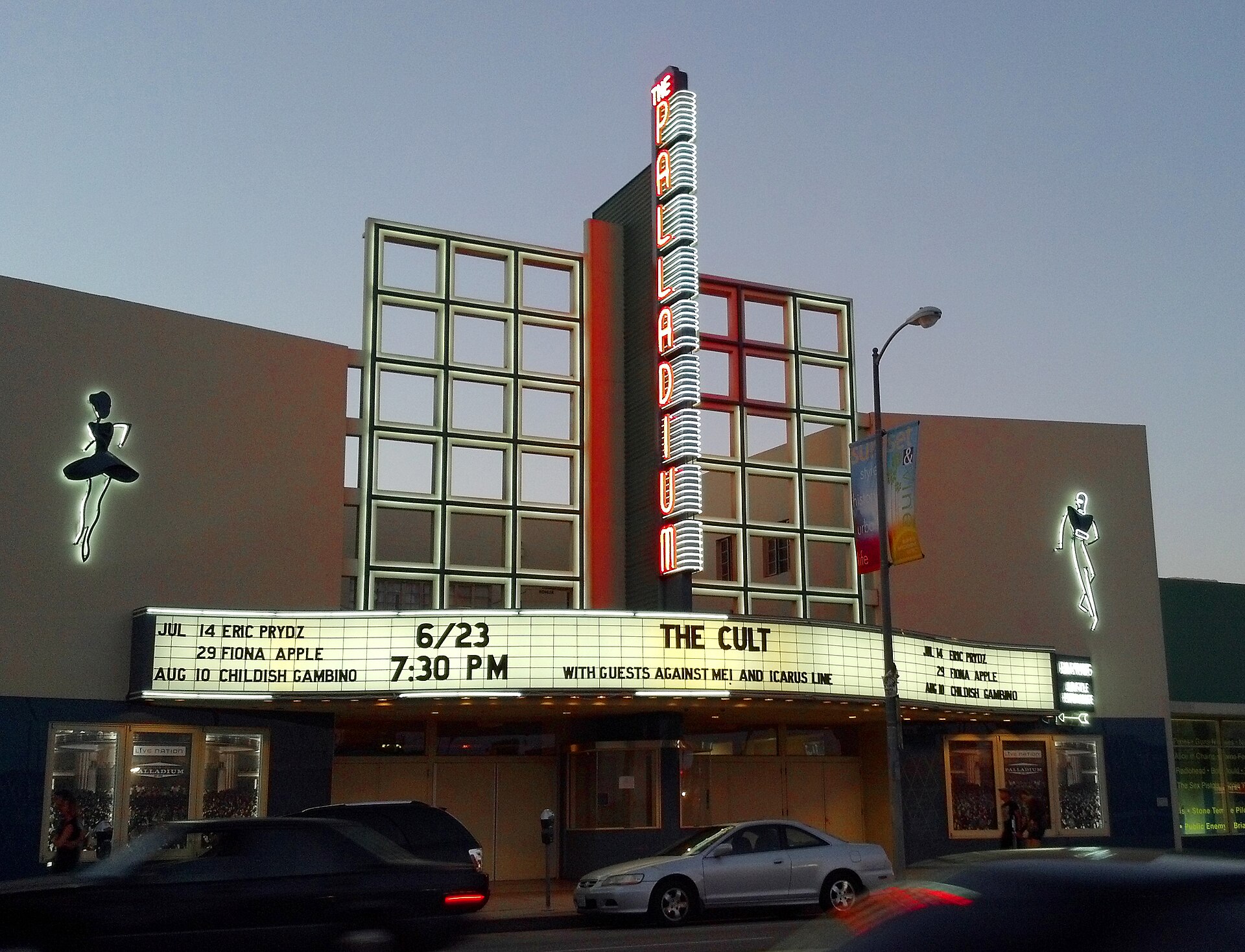
Hollywood Palladium
The Hollywood Palladium (6215 Sunset Blvd) opened in 1940 and is now a major concert venue operated by Live Nation, with shows booked into 2027. Its marquee and neon dancers are easiest to appreciate after dark.
Cinerama Dome: closed, but coming back
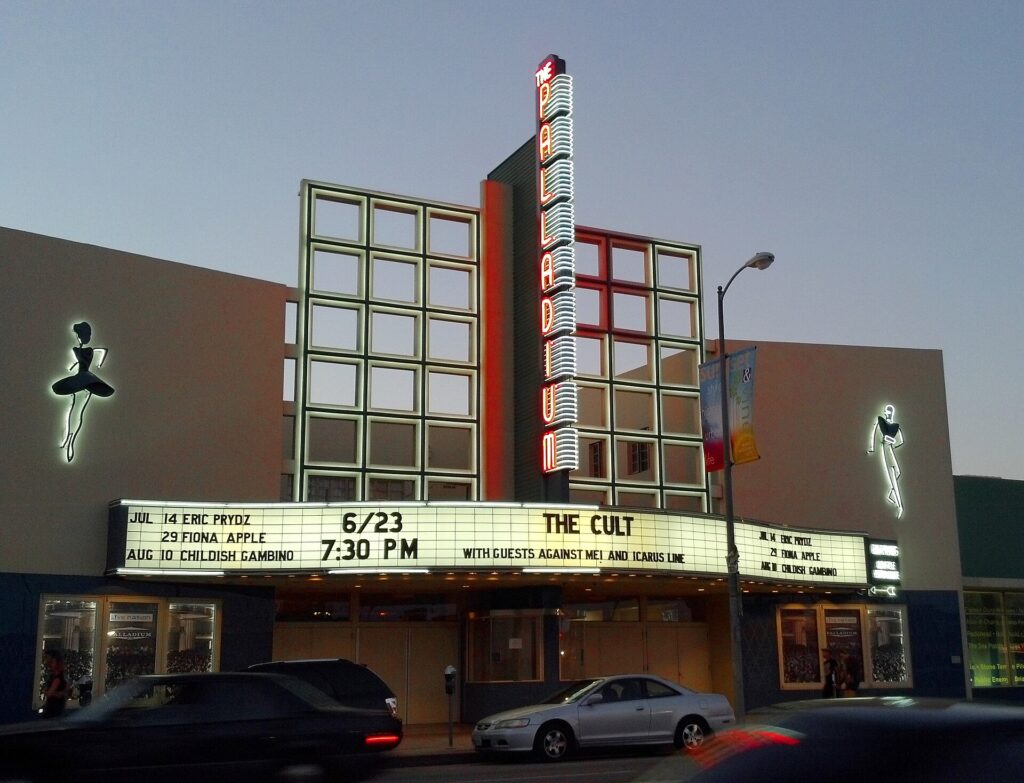
The Cinerama Dome (6360 Sunset Blvd) opened in 1963 and is described as the only concrete geodesic dome in the world. It has been closed since the pandemic; the ArcLight cinema chain that ran it shut down for good in April 2021. In July 2026, Sony Pictures announced it will reopen the Dome and the neighboring former ArcLight Hollywood multiplex with Alamo Drafthouse as the operator. Renovation work was scheduled to start in August 2026, with reopening projected for early 2028. For now you can see the dome from the sidewalk, but you cannot go inside.
Crossroads of the World
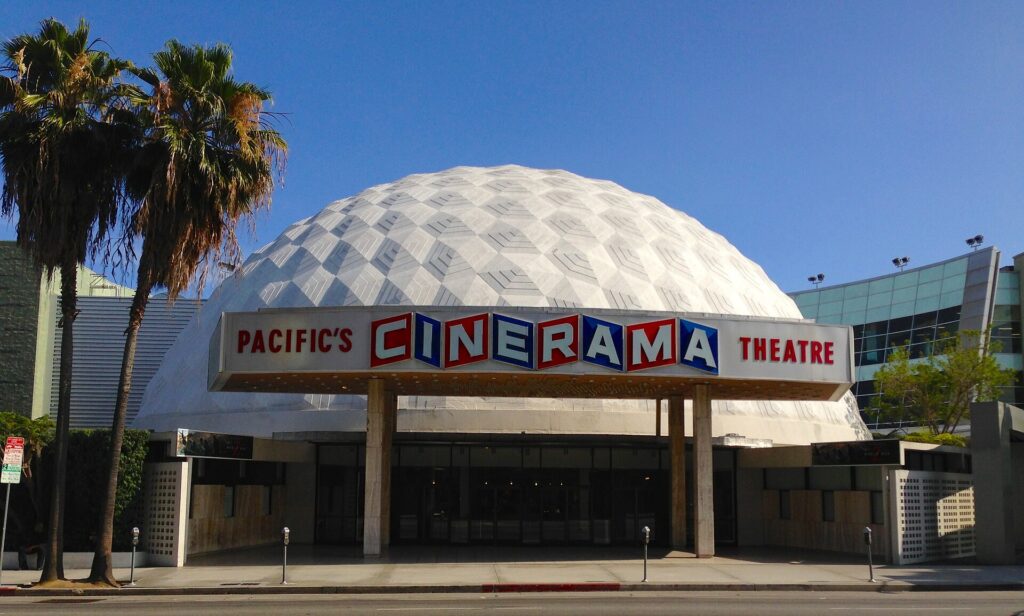
At 6671 Sunset Blvd, Crossroads of the World opened in 1936 as one of Los Angeles’s first outdoor shopping centers. The centerpiece is a Streamline Moderne building shaped like a ship, surrounded by cottage-style bungalows. It is a Los Angeles Historic-Cultural Monument and on the National Register of Historic Places. The buildings are now mostly entertainment-industry offices, so this is a look-from-the-street stop.
One correction to older guides: Amoeba Music is no longer on Sunset. Its long-running store at Sunset and Cahuenga closed in April 2020, and the shop reopened on Hollywood Boulevard at Argyle Avenue in April 2021.
The Sunset Strip in West Hollywood
At Crescent Heights Boulevard the road crosses into West Hollywood and becomes the Sunset Strip. For about a mile and a half it packs in hotels, comedy clubs, rock venues, restaurants and the city’s famous wall of billboards. Discover Los Angeles suggests driving it at night, when the lights are on, and that is good advice. For more on the neighborhood around the Strip, see our guide to things to do in West Hollywood.
Chateau Marmont
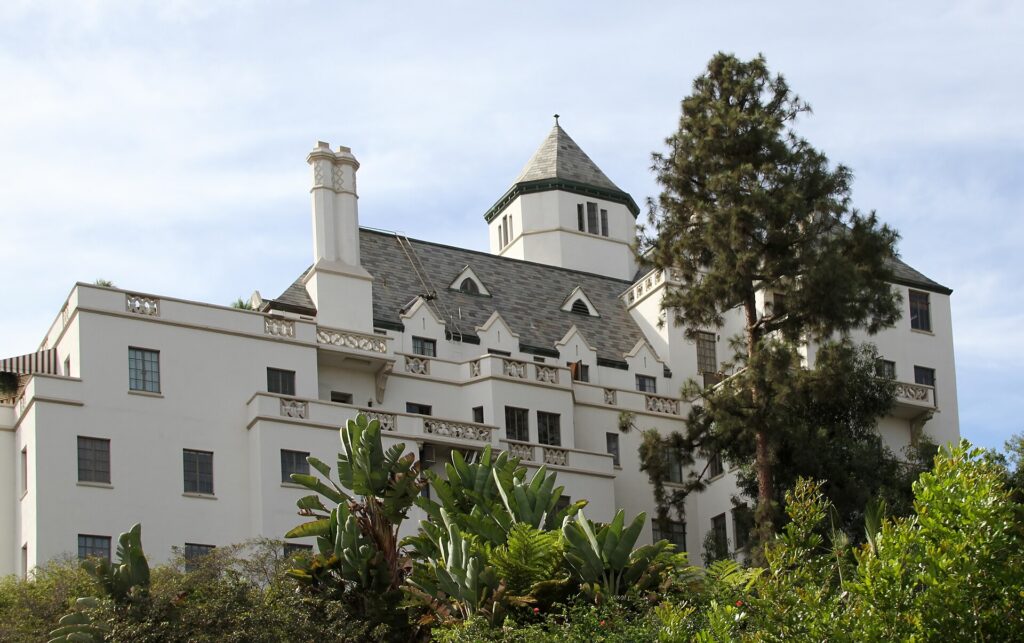
Perched above the eastern end of the Strip at 8221 Sunset Blvd, the Chateau Marmont opened on February 1, 1929, as an apartment building loosely modeled on the Château d’Amboise in France’s Loire Valley. It became a hotel in the early 1930s and has been a Hollywood hideaway ever since. It is a Los Angeles Historic-Cultural Monument. Non-guests can book the restaurant, and reservations are recommended.
Comedy on the Strip
The Comedy Store (8433 Sunset Blvd) has presented stand-up since 1972 in the building that housed the nightclub Ciro’s from 1940 to 1957. It runs shows in several rooms most nights; the club buys tickets only through its own site. The Laugh Factory, near the eastern end of the Strip, is the other well-known comedy club here. Nearby, the Sunset Tower Hotel, a former apartment building, has a well-known restaurant and bar.
Whisky a Go Go, The Roxy and The Viper Room
The western half of the Strip is music history. All three famous clubs are still booking shows in late 2026:
- Whisky a Go Go (8901 Sunset Blvd) has been on the Strip since 1964, and its calendar runs into 2027.
- The Roxy Theatre (9009 Sunset Blvd) opened on September 20, 1973, with Neil Young playing its first nights. The first American run of The Rocky Horror Show was staged here in 1974. It holds about 500 people.
- The Viper Room (8852 Sunset Blvd) is a small 21+ club that still hosts shows. Its site has been the subject of a long-planned redevelopment: a 12-story project approved in 2024 that would include a new version of the club, followed by financial trouble for the developer in 2025.
For a wider list of where to go out after dark, see our Los Angeles nightlife guide.
The billboards
West Hollywood says the Strip has the densest concentration of billboards and tall wall signs on the West Coast, and the city treats them as part of the street’s identity rather than clutter. In recent years many have been replaced by large digital screens, and the city’s Sunset arts program uses some of them to show digital artwork between the ads; a 2026 exhibition series ran from February through May.
Beverly Hills: the Pink Palace and a quiet park
Cross Doheny Drive and the boulevard changes completely. The billboards stop, the lanes are lined with tall palms and lawns, and Sunset becomes a residential parkway through Beverly Hills. The homes here are private, so enjoy the view from the road.
The Beverly Hills Hotel
The Beverly Hills Hotel (9641 Sunset Blvd) opened on May 12, 1912, before the city of Beverly Hills was incorporated. It was first painted pink in 1948, which gave it the nickname “the Pink Palace.” Its Polo Lounge is one of the best-known restaurants in Los Angeles, and stopping in for a meal or a drink is the easiest way for visitors to see the hotel.
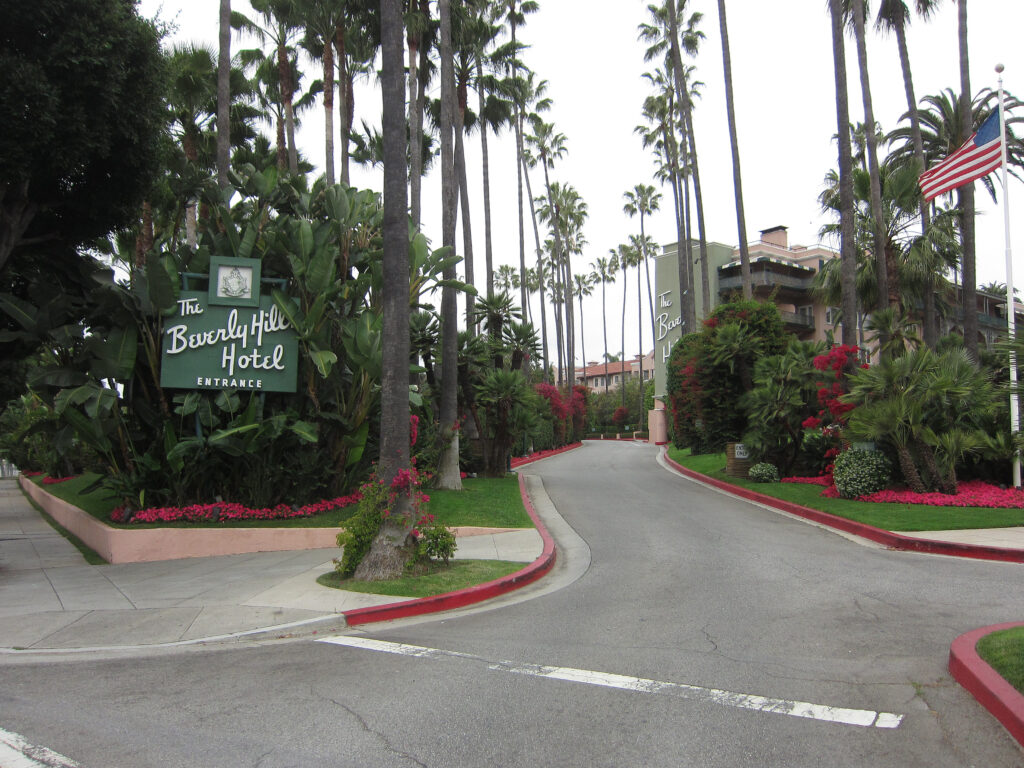
Will Rogers Memorial Park
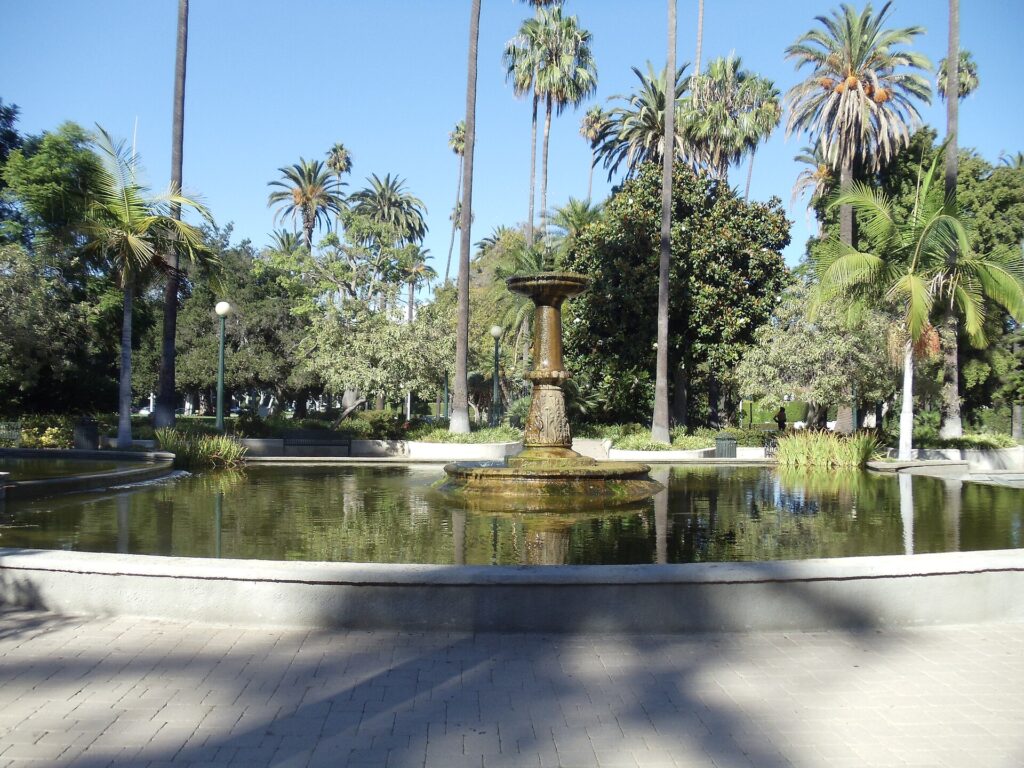
Directly across the street, Will Rogers Memorial Park (9650 Sunset Blvd) is a small triangular city park between Sunset, North Canon Drive and North Beverly Drive. It opened in 1915 as Sunset Park, the first municipal park in Beverly Hills, and was renamed in 1952 for Will Rogers, the city’s first honorary mayor. A palm-lined promenade leads to a raised fountain with koi and turtles. Do not confuse it with Will Rogers State Historic Park, which is several miles west in Pacific Palisades.
A short detour north of Sunset leads to Greystone Mansion & Gardens (905 Loma Vista Drive), a city-owned estate whose grounds are free to visit, typically 10 a.m. to 6 p.m. (5 p.m. in winter), with closures for filming and events. Our guide to things to do in Beverly Hills covers more stops nearby.
Bel Air, UCLA and Brentwood: the curves begin
West of Beverly Hills, Sunset passes Holmby Hills and then the gates of Bel Air. The road narrows and starts to wind, with blind curves, hills and lanes that bend without much warning. The Hotel Bel-Air, a short drive up Stone Canyon Road at 701 Stone Canyon Road, has been a hotel since 1946 and is known for its Swan Lake, which guests cross on a footbridge.
The boulevard then forms the northern edge of the UCLA campus in Westwood. The bend just north of the university’s Drake Stadium is the “Dead Man’s Curve” of the Jan and Dean song; Jan Berry was badly hurt in a crash nearby in 1966. Past the campus, Sunset crosses the 405 at the Sepulveda Pass, where you can turn north for the Getty Center, then continues through the leafy, residential streets of Brentwood. If you enjoy this kind of driving, Mulholland Drive runs along the ridge just to the north.
Pacific Palisades and the ocean
The last miles of Sunset run through Pacific Palisades, which was devastated by the Palisades Fire that began on January 7, 2025. Many homes, businesses and landmarks along and around the western end of the boulevard were destroyed. Public access to the Palisades reopened in June 2025, and rebuilding is under way, so expect construction, work crews and empty lots along the way. Please drive slowly and respectfully through residential areas, and do not stop to photograph people’s properties.
Will Rogers State Historic Park
Will Rogers’ former ranch, reached from Sunset in Pacific Palisades, reopened with limited access on November 8, 2025, after about ten months closed. The fire destroyed the historic 31-room ranch house, the stables and other buildings, and damaged about 300 historic trees. The polo field, main lawn and picnic area are open daily from 8 a.m. to sunset, the Inspiration Loop Trail is partly open, and several longer trails remain closed. California State Parks expects rebuilding to take years.
Temescal Gateway Park
At 15601 Sunset Blvd, Temescal Gateway Park reopened on July 17, 2026. The rebuilt Rivas Trail, the Sunset Trail and the picnic areas are open, but the Temescal Canyon Trail to the waterfall remains closed because of fire damage. Parking is $12 per day.
Self-Realization Fellowship Lake Shrine
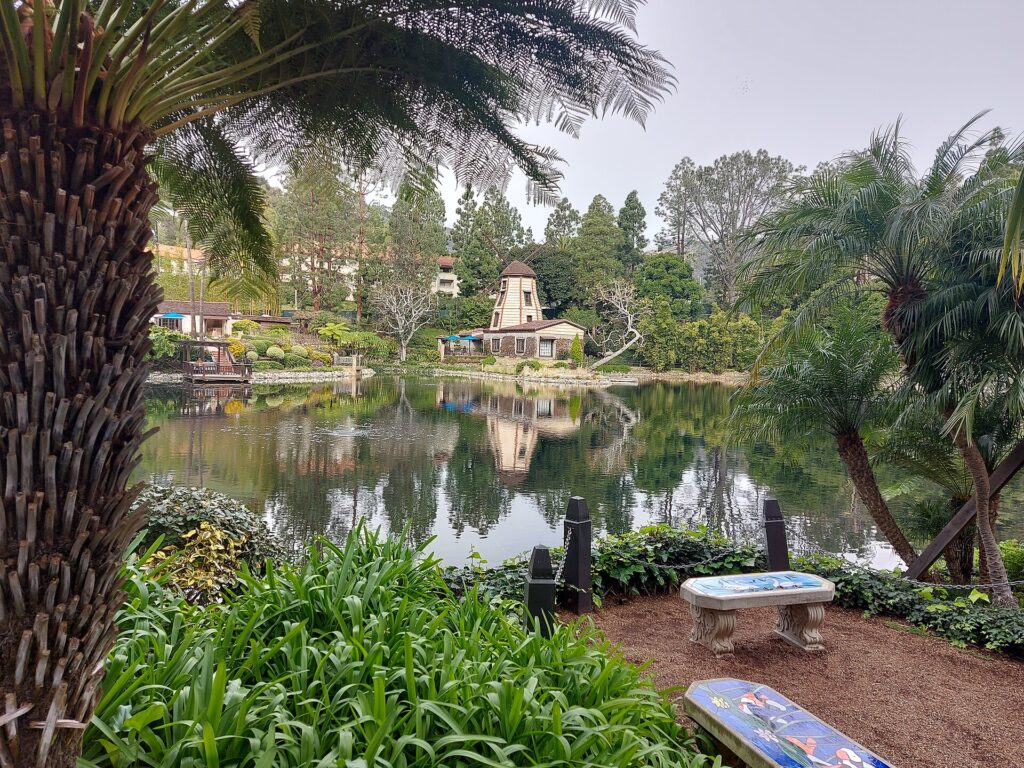
Just before the ocean, the Self-Realization Fellowship Lake Shrine (17190 Sunset Blvd; visitors enter at the temple gate at 17080 Sunset Blvd) is a lake ringed by meditation gardens, dedicated by Paramahansa Yogananda in 1950. The shrine was spared by the fire, though it closed for months afterward. The meditation gardens reopened on August 27, 2025, the Windmill Chapel reopened for meditation in early 2026, and Sunday temple services resumed in June 2026. The gardens are open Wednesday through Saturday and Sunday afternoon; visits are free but require a reservation, released each Saturday for the following week. The gift shop remains closed.
The end of the road at Pacific Coast Highway
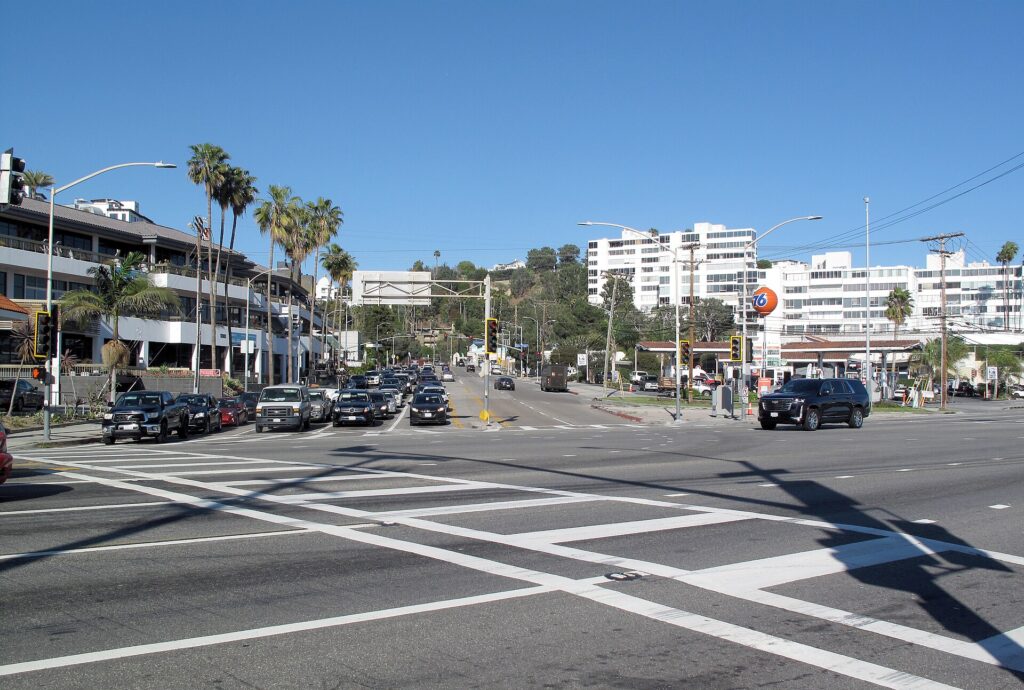
Sunset Boulevard ends at a traffic light on Pacific Coast Highway, across from the beach. Caltrans has continued fire-repair work on PCH through 2026, with a 25 mph limit and occasional single-lane closures on weekdays between Sunset and Carbon Beach Terrace in Malibu, so check Caltrans QuickMap before you continue. A short drive north on PCH, the Getty Villa reopened in June 2025; entry is free with a timed reservation, and there is a parking fee. From here you can follow the coast in either direction; our Pacific Coast Highway road trip guide picks up where Sunset leaves off.
Tips for driving Sunset Boulevard
- Allow time. With traffic lights the whole way, even an end-to-end drive without stops takes well over an hour, and much longer at rush hour. Most visitors pick two or three stretches rather than doing the full length.
- Avoid weekday rush hours. Sunset is a main commuter route between the Westside and Hollywood. Mid-morning on a weekday or early on a weekend morning is usually calmest.
- Drive west in the late afternoon. Heading toward the ocean near sunset is the classic way to finish, but the low sun is directly in your eyes on the western stretch, so keep sunglasses handy.
- Take the curves seriously. West of Beverly Hills the road is winding, narrow in places and full of joggers, cyclists and turning cars. Stay in your lane and keep to the posted speed.
Sunset is also a road made for an open-top car. Our classic car tour takes guests through Hollywood, the Strip and Beverly Hills in a 1970 Cadillac DeVille convertible. If you would rather focus on the film history, the private Hollywood tour covers the studios and landmarks around the eastern end of the boulevard.
Sunset Boulevard: FAQ
How long is Sunset Boulevard?
Roughly 22 to 24 miles, from Figueroa Street near Downtown Los Angeles to Pacific Coast Highway in Pacific Palisades. Published figures differ slightly. The Sunset Strip itself is only about 1.5 miles of that.
Is the Cinerama Dome open?
Not yet. It has been closed since the pandemic, and in July 2026 Sony Pictures announced a renovation, with reopening as an Alamo Drafthouse cinema projected for early 2028.
Can you drive Sunset to the ocean after the Palisades Fire?
Yes. Public access to Pacific Palisades reopened in June 2025, and Sunset runs through to Pacific Coast Highway. Expect rebuilding work along the way and Caltrans repair zones on PCH, and check Caltrans QuickMap before you go.