
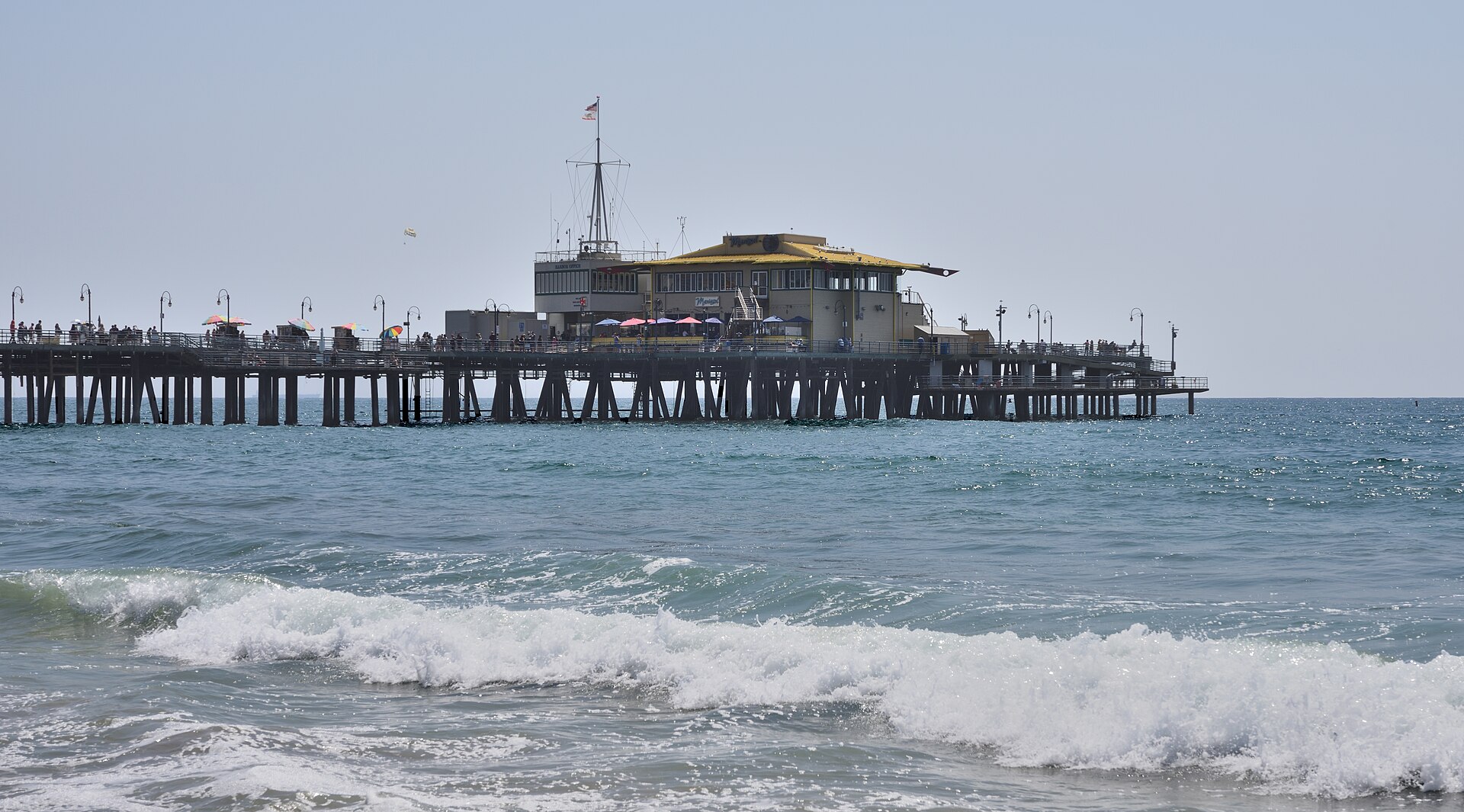
The Santa Monica Pier is the place where Los Angeles meets the Pacific in its most familiar form: a wooden pier lined with food stands, a seaside amusement park with a Ferris wheel lit up after dark, a carousel in a 1916 building, anglers at the far end and the “End of the Trail” sign for Route 66. It is free to walk onto and open every day.
This guide covers the pier itself in detail: how to get there during the current bridge construction, where to park, what each attraction is, a short history, free events and the best times to go. Hours and access details are from official sources as of November 2026 and change with the seasons and construction, so check before you go. For the rest of the city (museums, shopping streets, restaurants and neighborhoods), see our wider guide to things to do in Santa Monica.
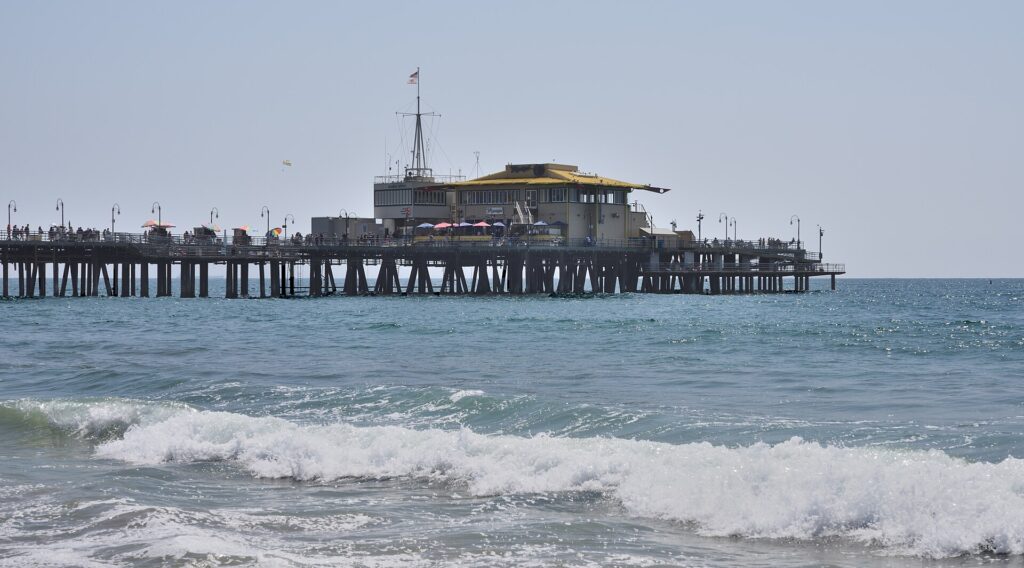
Santa Monica Pier at a glance
- Where: at the foot of Colorado Avenue, where it meets Ocean Avenue in downtown Santa Monica. The beach-level entrance and Heal the Bay Aquarium are at 1600 Ocean Front Walk.
- Pier hours: the Pier Corporation lists the pier as open daily from 6 a.m. to 10 p.m. Shops, rides and restaurants set their own hours.
- Cost: free to walk the pier. Pacific Park has no gate; you pay for rides individually or with a pass.
- Construction: the old vehicle bridge from Ocean Avenue is being replaced. The pier stays open, and pedestrians use a temporary bridge just south of the old entrance.
Getting to the pier and parking
The Pier Bridge replacement (2026–2027)
The bridge that carried cars and people from Ocean Avenue down onto the pier for almost 90 years is being torn down and rebuilt. Construction began in December 2025, and the City of Santa Monica expects the federally funded project to finish in late 2027, ahead of the 2028 Olympic and Paralympic Games. What it means for visitors:
- Walking in: since June 5, 2026, the main way onto the pier from Ocean Avenue has been a temporary pedestrian bridge about 30 feet south of the original entrance. There is also a protected walkway beside the temporary vehicle ramp in the pier parking lot.
- Driving in: the Moomat Ahiko Way ramps to and from Pacific Coast Highway were closed for about two months starting in late September 2026 for the final stage of demolition. The city suggests the California Incline or Lincoln Boulevard as detours and asks visitors to follow posted signs to parking.
- Everything on the pier stays open: the city has said restaurants, shops and attractions remain open throughout the work. The exception so far is Heal the Bay Aquarium, which paused its regular weekend hours (more on that below).
The city’s Pier Bridge Improvements page lists current detours and closures.
Parking near the pier
The parking lots closest to the pier are run by the City of Santa Monica. Rates changed in January 2026, differ by season (higher from spring through fall) and are posted at each entrance and on the city’s parking pages, so we don’t repeat them here.
- Pier Deck lot: the lot on the pier itself. The Pier Corporation currently lists it as open Monday to Thursday, 9 a.m. to 8 p.m., so don’t count on it for a weekend or evening visit.
- Beach Lot 1 North (1550 Appian Way): the big beach lot just north of the pier, reached from Pacific Coast Highway or by following Appian Way down from Ocean Avenue. Part of it is a construction staging area, but the city says about 726 spaces remain open.
- Beach Lot 4 South (Bicknell Avenue and Ocean Avenue): a beach lot south of the pier, a pleasant walk along the sand or bike path.
- Downtown public parking structures: the city’s multi-level structures between Second and Fourth Streets are a few blocks inland and work well if you also plan to visit the Third Street Promenade.
By Metro E Line
The Metro E Line (the former Expo Line) runs from downtown Los Angeles to its western end at Downtown Santa Monica Station, at Fourth Street and Colorado Avenue. The ride from 7th Street/Metro Center takes about 46 minutes, per the Pier Corporation. From the station, walk west on Colorado Avenue, cross Ocean Avenue and head down to the pier, about 10 minutes on foot.
By bike or on foot
Bikes are allowed on the pier, the beach bike path runs right past it at sand level, and the Pier Corporation lists bike rentals on the pier, including Blazing Saddles.
What to see and do on the pier
Pacific Park
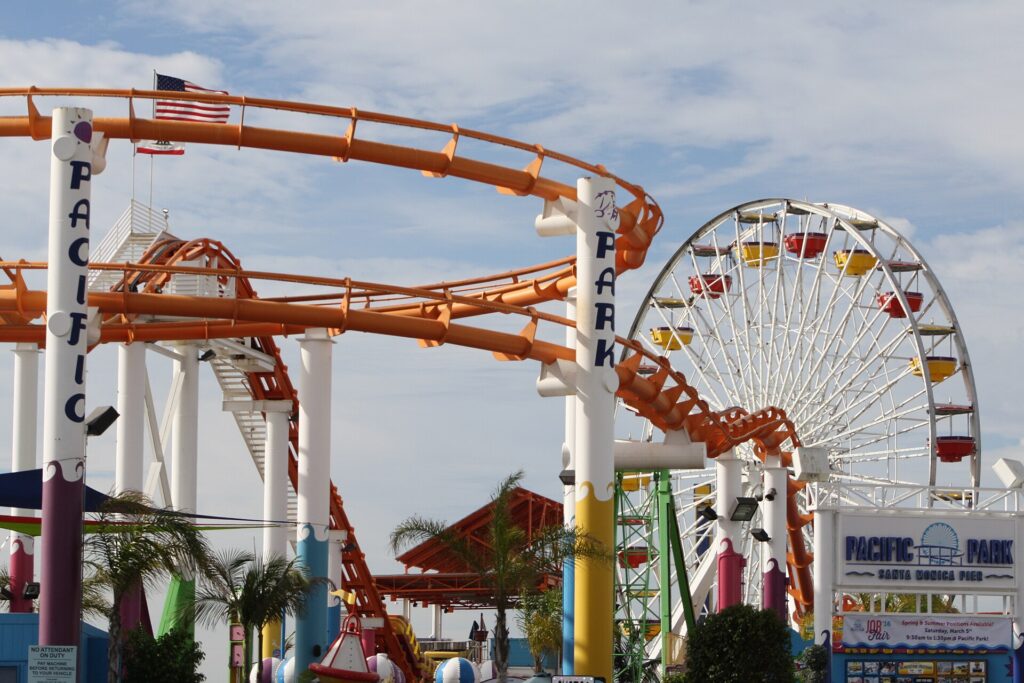
Pacific Park is the amusement park that fills about two acres of the pier, with 12 rides plus midway games and food stands. It opened in May 1996 as the pier’s first major new attraction in decades. There is no entry gate: you can walk through for free and pay only for the rides you take, either per ride or with a pass.
Pacific Park’s hours change by week and season; in late November 2026, for example, rides ran from 11 a.m. to 9 or 10 p.m., and the park sometimes closes for bad weather. Check its calendar on the day.
The Pacific Wheel
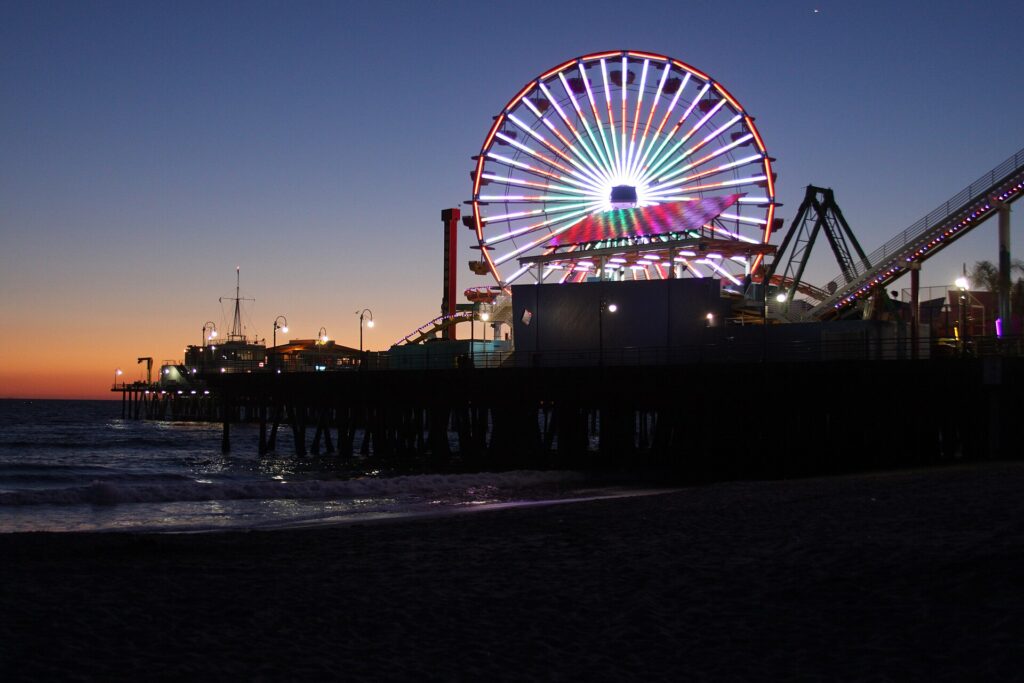
Pacific Park bills the Pacific Wheel as the world’s first solar-powered Ferris wheel; according to the park, it measures 85 feet across, rises more than 130 feet and carries more than 174,000 LED lights. The lights run color shows after dark, often themed for holidays and events.
From the top you get a wide view of Santa Monica Bay, the beach curving north toward Malibu and the Santa Monica Mountains on a clear day.
The West Coaster
The orange-and-white steel roller coaster that loops around the park is the West Coaster. Pacific Park describes it as the only steel coaster over the Pacific Ocean in the western United States.
The Looff Hippodrome and carousel
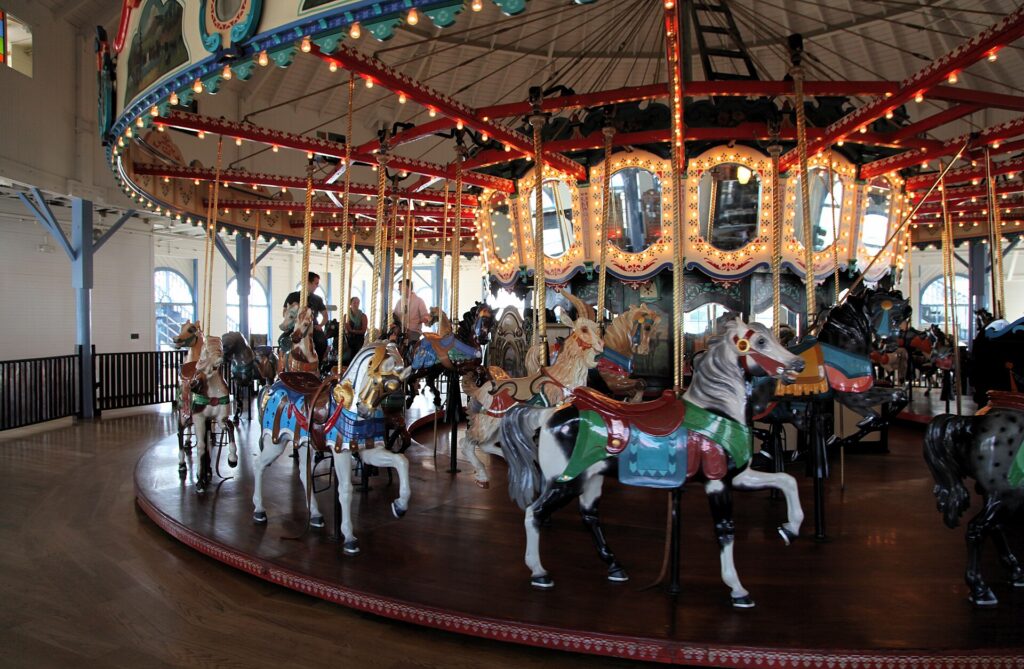
Near the pier entrance stands the oldest building on the pier, the Looff Hippodrome. Carousel builder Charles I. D. Looff and his son Arthur built it in 1916 to house one of their carousels, and it opened on June 12 that year. Its mix of Byzantine, Moorish and California styles, with arched windows and a cupola, is easy to spot. The Hippodrome was designated a National Historic Landmark in 1987.
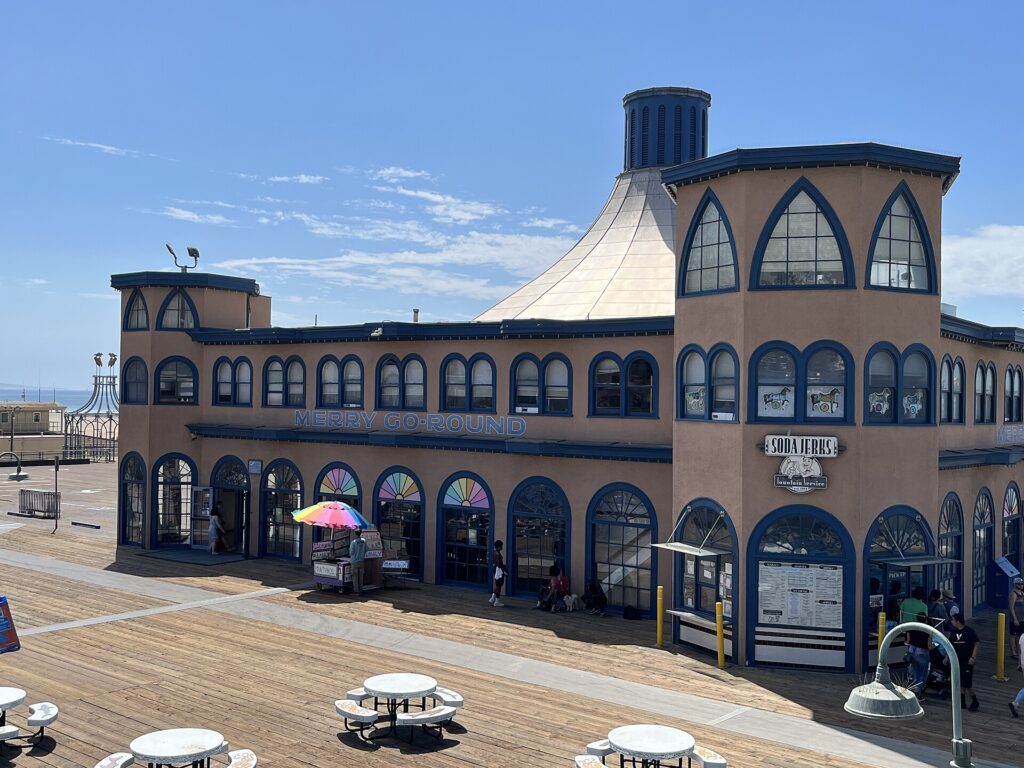
The carousel turning inside today is not the original Looff machine, which was sold in 1939. It is a 1922 Philadelphia Toboggan Company carousel that was moved into the Hippodrome in 1947, with 44 hand-carved wooden horses. The Pier Corporation lists the carousel as open Monday and Thursday through Sunday, 11 a.m. to 7 p.m. A ride takes only a few minutes, and it is one of the few things on the pier that has barely changed in decades.
Heal the Bay Aquarium
Under the pier at beach level, below the carousel, is Heal the Bay Aquarium (1600 Ocean Front Walk), a small aquarium run by the environmental nonprofit Heal the Bay. Its tanks focus on local Southern California sea life, such as garibaldi and California moray eels, alongside education and conservation programs.
Plan around its current schedule. Heal the Bay says that as of October 19, 2026, it has temporarily paused its regular weekend public hours and birthday parties while the Pier Bridge is under construction, and is hosting special events and open houses instead. If the aquarium is the main reason for your visit, check Heal the Bay’s aquarium page or contact the aquarium before you go.
Fishing at the end of the pier
At the quieter west end, anglers line the rails. Fishing is allowed on the pier, and under California rules you don’t need a sport fishing license to fish from a public pier in ocean waters. Other state rules still apply, including size and bag limits, seasons and a limit of two rods per person. If you plan to keep your catch, read the state’s (OEHHA) advice on which local fish are safe to eat.
The Route 66 “End of the Trail” sign
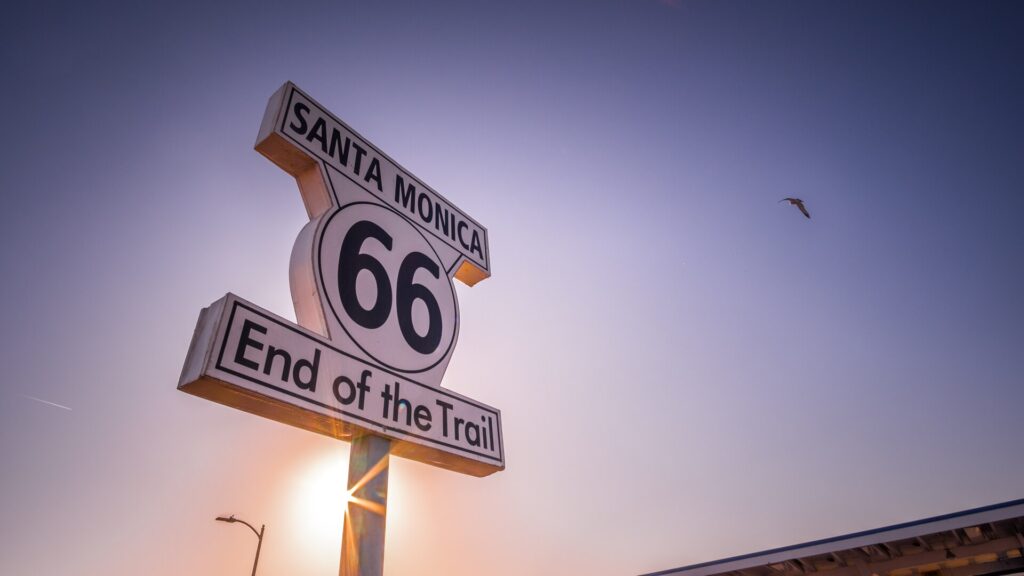
Midway along the pier is the “Santa Monica 66 – End of the Trail” sign, one of the most photographed spots in Los Angeles. It is worth knowing what it marks. Route 66 was created in 1926 and originally ended in downtown Los Angeles; in the 1930s it was extended to Santa Monica, where its official end was the intersection of Lincoln Boulevard and Olympic Boulevard, inland from the beach. The pier sign is a symbolic marker: it was unveiled in November 2009, when the pier was dedicated as the road’s traditional western end. Either way, it is where many cross-country Route 66 drivers finish their trip, and in 2026 it was part of Santa Monica’s Route 66 centennial celebrations.
A short history of the Santa Monica Pier
The pier is really two piers side by side. The long, narrow Municipal Pier opened on September 9, 1909. It was built for a practical purpose, to carry sewer pipes out past the breaking waves, and had no amusements at all.
In 1916 Charles Looff built the shorter, wider Pleasure Pier just to the south, with the Hippodrome and its carousel as the centerpiece. It later changed owners and names and was long known as Newcomb Pier.
The pier came close to disappearing. Plans in the late 1960s and early 1970s would have replaced it with an artificial island and a hotel. Residents organized against the plan, and in 1973 the city council revoked its order to tear the pier down. A decade later, storms in early 1983 wrecked the lower deck, and a later storm that year destroyed about a third of the pier. The rebuilding that followed strengthened the structure and led, in 1996, to the opening of Pacific Park. The pier is now managed by the nonprofit Santa Monica Pier Corporation for the city.
Free events and tours on the pier
If you remember the pier’s free Thursday-night Twilight Concerts, note that the Pier Corporation says the series is not currently scheduled to return. The Pier Corporation’s current calendar includes:
- Locals’ Night: a free community evening on the third Thursday of each month from September to May, 3:30 to 7:30 p.m.
- A Talk Through Pier History: a free one-hour storytelling session on the last Thursday of the month, 6 to 7 p.m.
- Walking tours: a pier history walking tour on weekend mornings at 10 a.m., and a sunset tour on Mondays. Check the Pier Corporation’s events page for current times and booking details.
- Seasonal events: holiday programming in December, a free “Save the Pier!” live reenactment planned for April 2027, and Pier 360, planned for June 2027.
Best time to visit
- Weekday mornings are the quietest, and the best time to photograph the Route 66 sign without a line. Pacific Park’s rides usually don’t open until late morning.
- Sunset is the classic time: the sun drops into the ocean and the Pacific Wheel lights come on. Arrive 30 to 45 minutes early to find a spot along the rail, or watch from Palisades Park on the bluff above. It also makes a good end to an evening out; see our date ideas in Los Angeles.
- Summer weekends and holidays are the busiest, with long lines for rides and the Route 66 sign and full parking lots. If those are your only days, come early or use the Metro.
Practical tips for your visit
- No smoking: smoking is not allowed on the pier, partly to protect its wooden structure.
- Dogs: leashed dogs are fine on the pier but not on the beach below it.
- Bring a layer: it is often cooler and windier at the end of the pier than on Ocean Avenue, especially after sunset.
- Mind the bike path: the beach path at the foot of the pier is busy with cyclists and skaters. Look both ways before crossing it with children.
- Swim near a lifeguard tower: if you go into the water, stay in front of a staffed lifeguard tower and follow the flags and the lifeguards’ directions.
- Keep belongings close in crowds, as you would at any busy attraction, and agree on a meeting point with children (the carousel building is easy to find).
What is near the Santa Monica Pier
Santa Monica State Beach
The pier sits in the middle of Santa Monica State Beach, a wide sandy beach that stretches north and south. Stairs and ramps lead from the pier down to the sand on both sides. For more beaches along the coast, from Malibu to the South Bay, see our guide to Los Angeles beaches.
The Marvin Braude Bike Trail
The paved beach path that passes under the pier is the Marvin Braude Bike Trail, often called the Strand. LA County describes it as a 22-mile path running from Will Rogers State Beach in Pacific Palisades to Torrance County Beach. From the pier, a ride north reaches the Annenberg Community Beach House area and Will Rogers; a ride south takes you to Venice and Marina del Rey.
Palisades Park and the Third Street Promenade
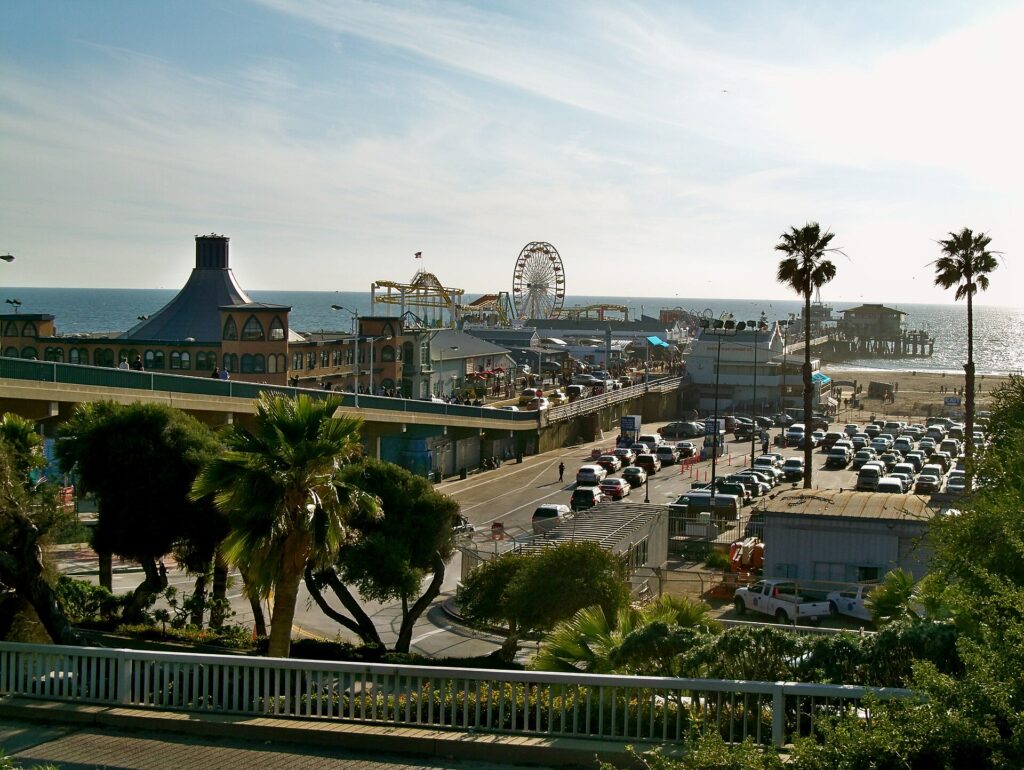
Palisades Park runs along the bluffs on Ocean Avenue right above the pier, with palm trees, benches and the best views down onto the pier. Two blocks inland, the Third Street Promenade is a pedestrian street of shops, restaurants and street performers, with Santa Monica Place at its south end.
Venice Beach
Venice is a few miles south along the beach, an easy bike ride or a long, flat walk on the Strand. The Venice Boardwalk, Muscle Beach and the skate park have a looser feel than the pier. See our guide to things to do in Venice Beach for what to see there.
Seeing the pier as part of a coastal drive
The pier also works well as one stop on a longer day along the coast, for example combined with a drive up Pacific Coast Highway toward Malibu (our Pacific Coast Highway road trip guide covers the route). If you would rather leave the driving and parking to someone else, our classic car tour takes you along the coast in an open-top 1970 Cadillac DeVille convertible, and a custom route can include a stop at the Santa Monica Pier. For families or small groups, the private SUV tour in a Cadillac Escalade can also be planned around the beach cities, with hotel pickup.
Santa Monica Pier: FAQ
Is the Santa Monica Pier free?
Yes. Walking onto the pier is free, and Pacific Park has no entry gate. You pay only for rides, games, food, parking and paid attractions.
Is the Santa Monica Pier open during the bridge construction?
Yes. The city says the pier and its businesses stay open while the Pier Bridge is replaced (expected to finish in late 2027). Pedestrians use a temporary bridge just south of the old Ocean Avenue entrance.
Is the Santa Monica Pier really the end of Route 66?
Symbolically, yes. The official end of Route 66 was the intersection of Lincoln and Olympic Boulevards in Santa Monica. The “End of the Trail” sign on the pier was unveiled in 2009, when the pier was dedicated as the route’s traditional western end.
Do you need a license to fish off the Santa Monica Pier?
No. California does not require a sport fishing license to fish from a public pier in ocean waters, though size limits, bag limits, seasons and the two-rod limit still apply. A license is required if you fish from the beach or rocks.