
The La Brea Tar Pits are one of the strangest sights in any big city: pools of natural asphalt bubbling up in a public park on Wilshire Boulevard, a few steps from art museums, office towers and a subway station. For more than a century, scientists have pulled Ice Age fossils out of this ground, and they are still digging today.
There is one big change for 2027 visitors. The museum building at the tar pits (the George C. Page Museum) closed after July 6, 2026 for a two-year renovation, with the full campus expected to reopen in 2028. The good news is that Hancock Park, the outdoor pits and the active excavations stay open. This guide covers what you can see right now, the science and history behind the place, how to get there and park, tips for families, and the museums next door on Museum Row. Hours, prices and open areas change during construction, so check the official sites before you go.
La Brea Tar Pits in 2027: What Is Open and What Is Closed
The Natural History Museums of Los Angeles County, which runs the site, describes the project as the first major renovation since the museum opened in 1977. Here is how things stand:
- Closed: the museum building. Indoor exhibitions, ticketed museum experiences and general museum admission are paused until the reopening, expected in 2028.
- Open: Hancock Park, which the museum says stays open throughout the transformation, including the Lake Pit on Wilshire Boulevard and the active outdoor excavation sites.
- Changing: construction is phased, and park paths, green space and outdoor features reopen in stages. Some corners of the park may be fenced off on the day you visit.
- Research continues: excavation and fossil work go on during the closure, some of it in public view.
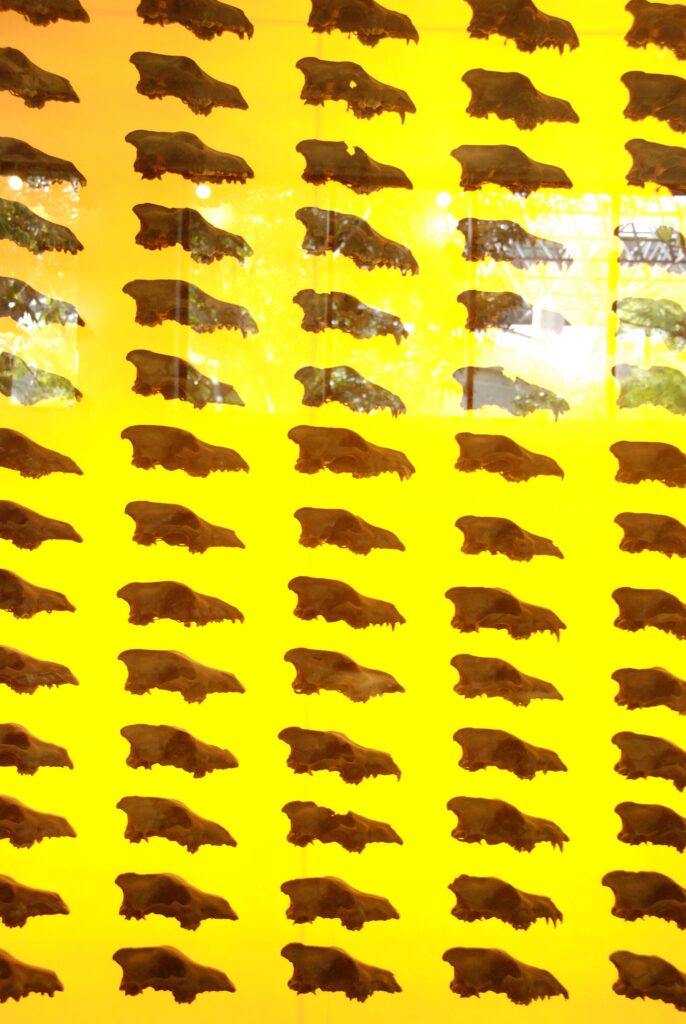
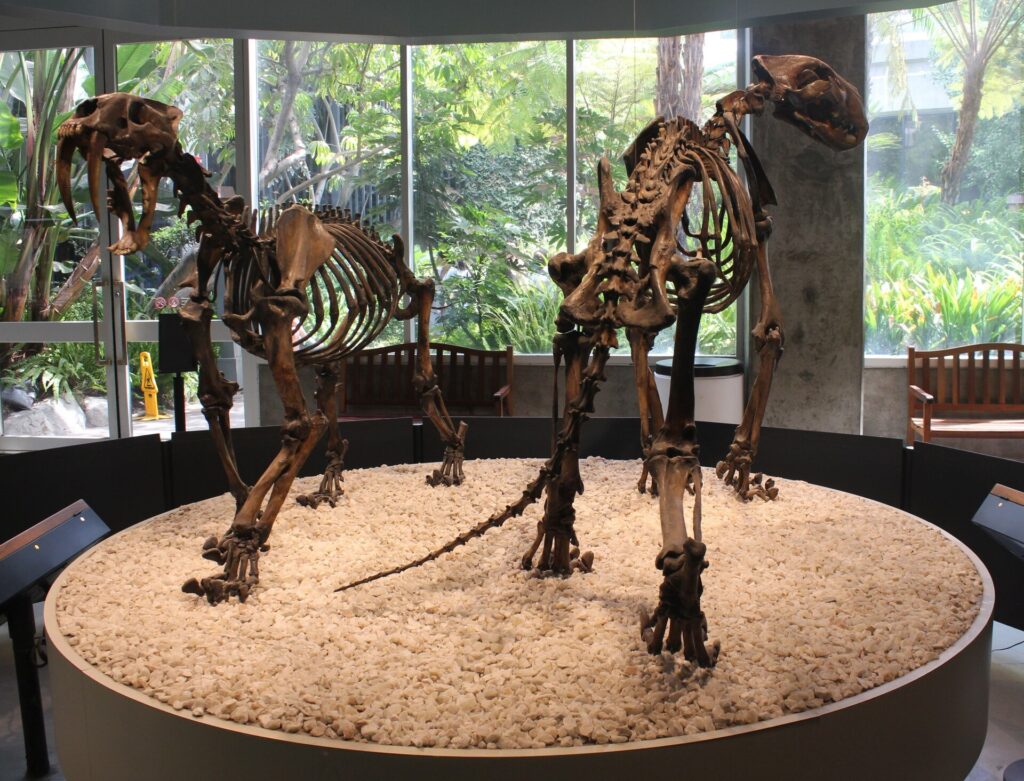
In short, you can still see bubbling asphalt and real dig sites from the park paths. What you cannot see until 2028 is the indoor collection: the mounted skeletons, the famous wall of dire wolf skulls and the glass-walled fossil lab.
What to See at Hancock Park Right Now
The tar pits campus covers 13 acres of Hancock Park, the green block on Wilshire Boulevard that it shares with LACMA. The outdoor pits are fenced for safety, but you can look into most of them from the paths. According to the museum, five fenced areas hold the Lake Pit (along with Pits 17, 50 and the Academy Pit) and Pits 3, 4, 9, 10, 13, 61, 67 and 91.
The Lake Pit
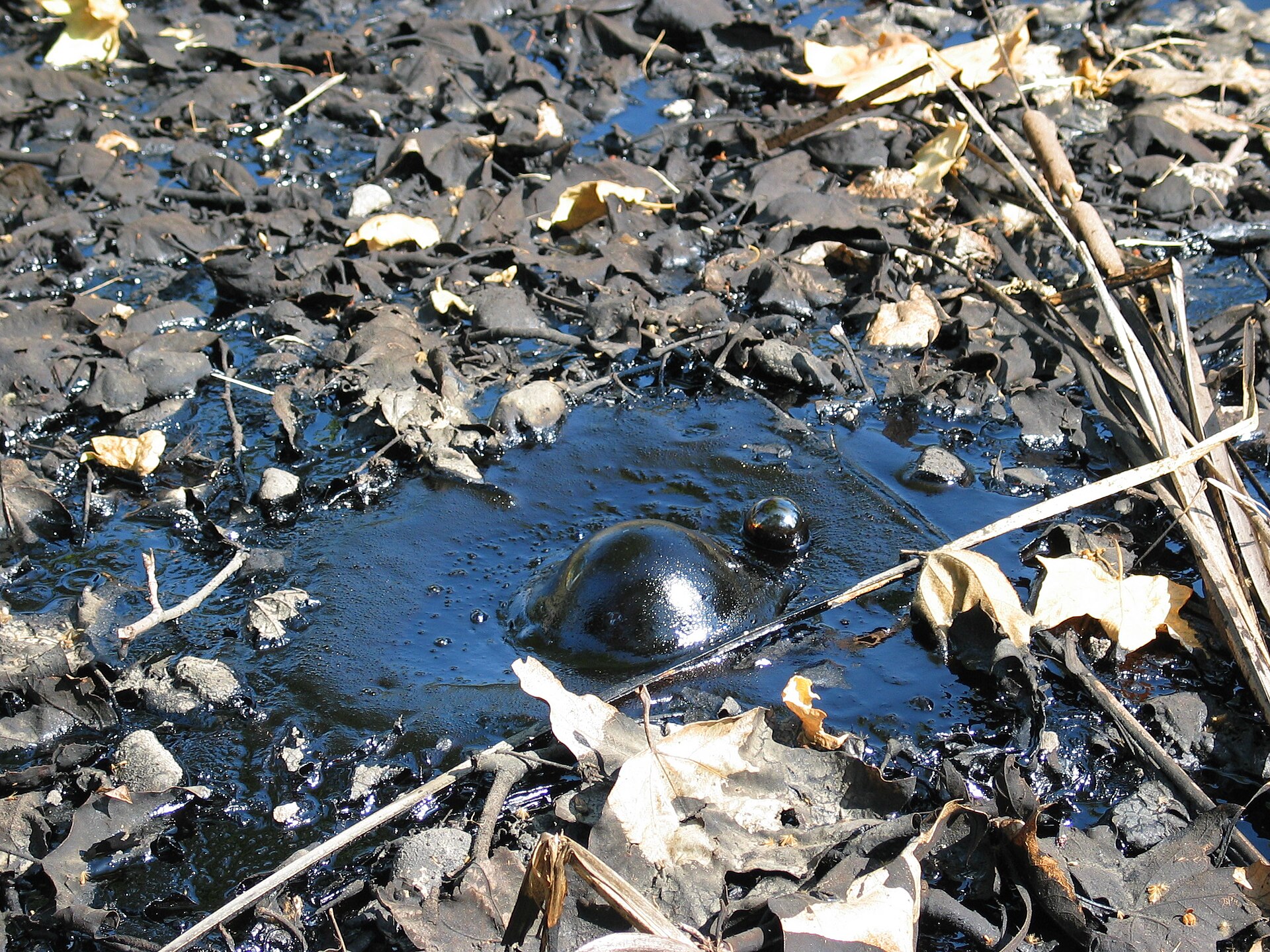
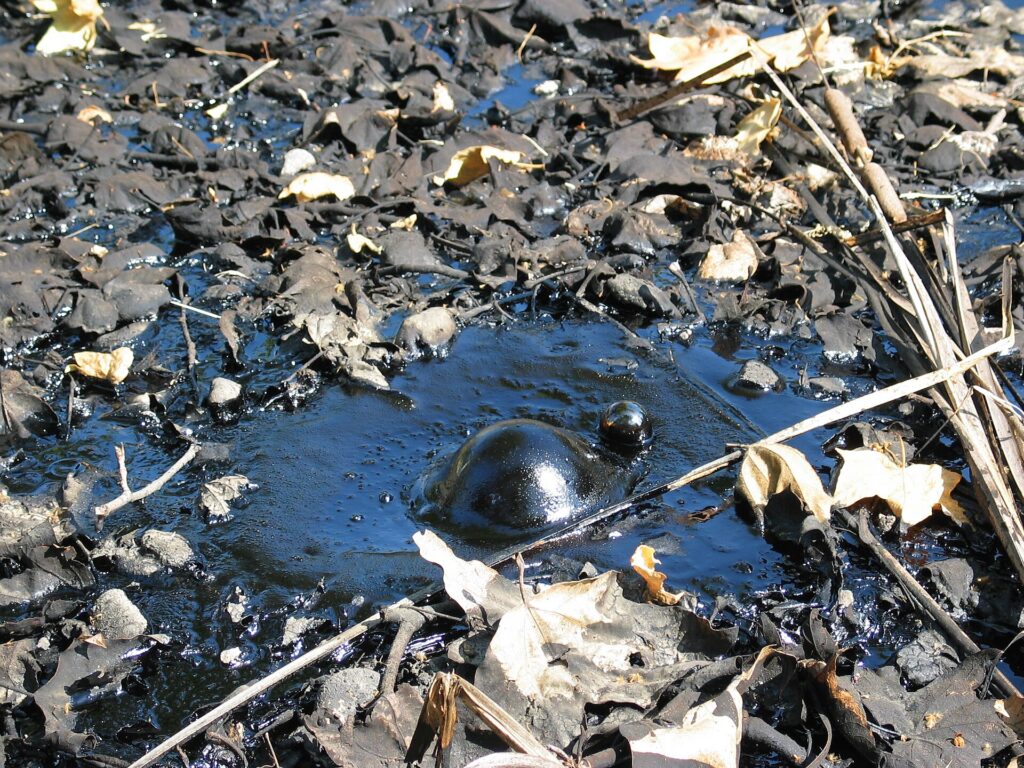
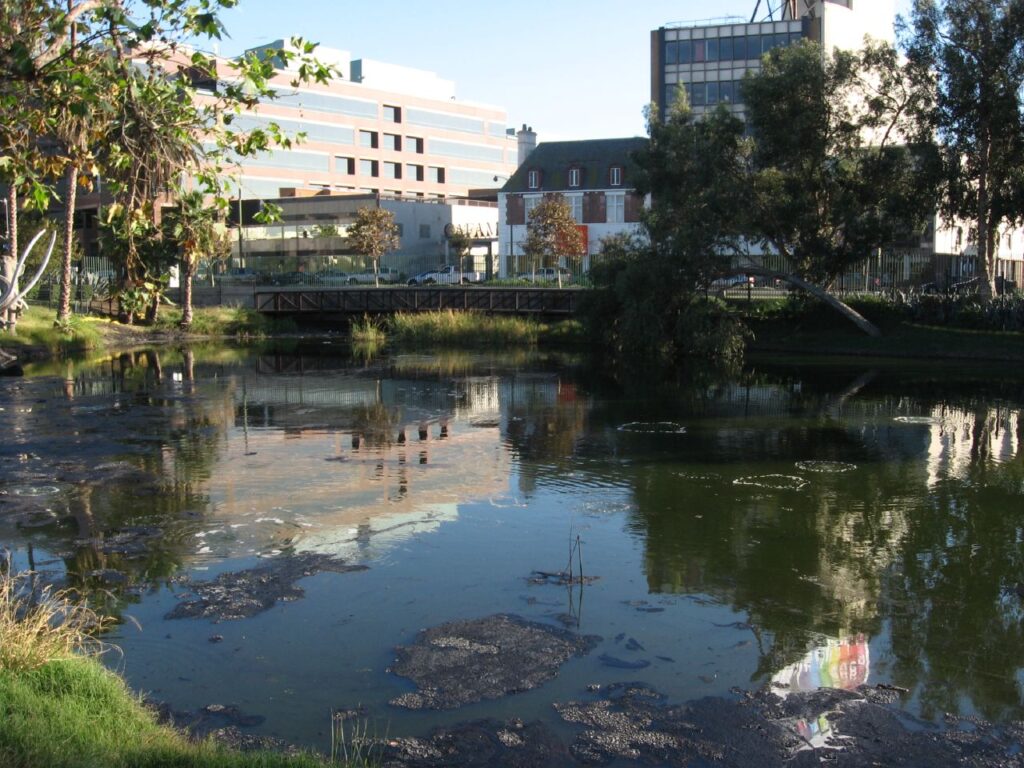
The Lake Pit is the large, dark pond in front of the museum, right on Wilshire Boulevard. It is not a natural lake. It is left over from asphalt mining in the late 1800s; rain and groundwater have since collected on top of the asphalt. Look closely and you will see rainbow sheens, black patches and rings of bubbles rising to the surface. The bubbles are mostly methane, which has no smell of its own. The “rotten egg” smell on warm days is hydrogen sulfide, another natural byproduct. The Lake Pit is also where the well-known mammoth family sculptures stand, so it is the spot most people recognize from photos.
Pit 91 and Project 23
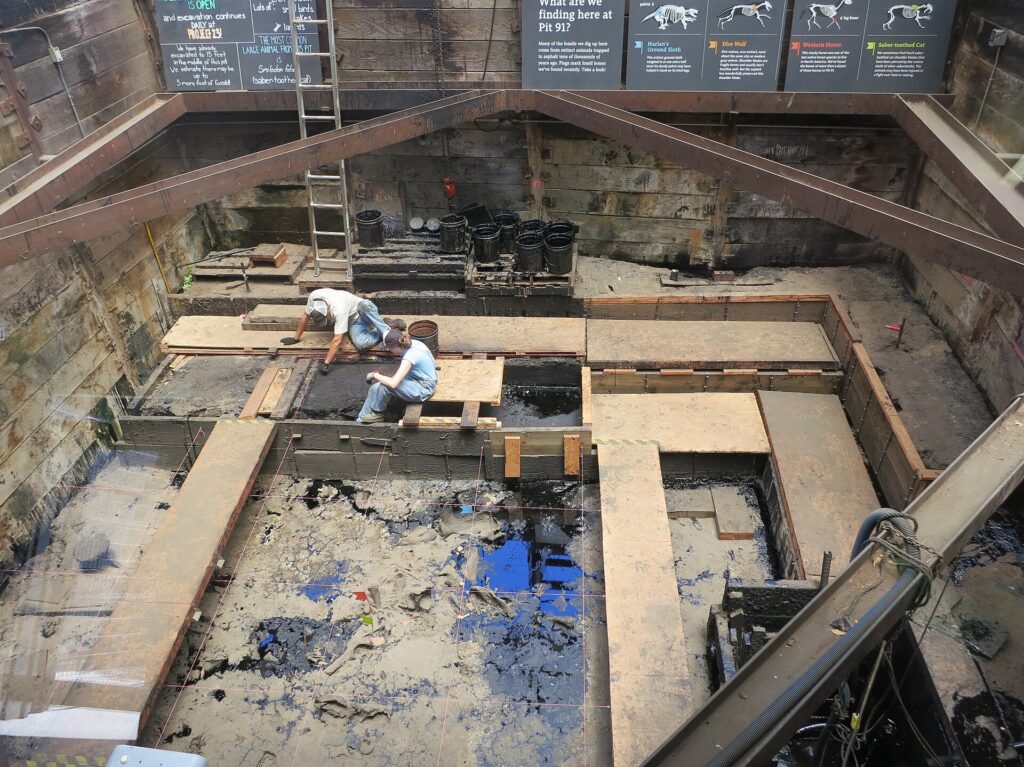
The museum lists two active excavation sites in the park. Pit 91 was first found in 1915 and left at about 10 feet deep; scientists reopened it on June 13, 1969 and sampled it intensively until 2007. It is designed to be viewed from above, so you can look down into the timber-lined pit and see the asphalt-soaked sediment and the grid used to map every bone.
Project 23 is the newer story. In 2006, crews building LACMA’s underground parking garage hit 16 fossil-rich asphalt deposits, plus a nearly complete Columbian mammoth skeleton. The deposits were boxed up in 23 large wooden crates, and excavation of those “tree boxes” began in 2008. The museum says this salvage dig could double the size of its collections. Because paths open and close in stages during construction, check tarpits.org for which viewing areas are accessible on your date.
Bubbling Asphalt in the Grass
Some of the most memorable sights are small: fresh asphalt oozing up through lawns and around tree roots, often marked off with cones or little fences. The seeps move and new ones appear, which is a reminder that this is a living geological site. Stay on the paths, keep children away from soft black patches, and expect sticky shoes if you ignore the barriers.
The La Brea Tar Pits Insider Tour
For a closer look during the closure, the museum runs a ticketed, fully outdoor Insider Tour. It goes behind the fences to see bubbling tar up close, includes time sorting real microfossils (at least 10,000 years old) with tar pits scientists, and explains the century of excavation and current research. At the time of writing it runs on weekends (Saturday at 11 am, Sunday at 11 am and 2:30 pm), costs $125 for adults and $105 for children (less for members), and is open to ages 7 and up. Tour guests get reserved parking at the museum’s lot at 725 South Curson Avenue. Wear sturdy closed-toe shoes and bring a hat, sunscreen and water.
The Science: Why Animals Got Stuck
Despite the name, the black substance is not tar. It is asphalt, the heaviest and lowest grade of crude oil. It seeps up from the Salt Lake Oil Field, a petroleum reservoir just north of Hancock Park, and the oil itself formed from marine plankton during the Miocene, roughly 5 to 25 million years ago.
At the surface, the asphalt forms sticky traps, often hidden under leaves, dust or water. Over roughly the last 50,000 years, and mostly between 11,000 and 50,000 years ago, animals walked in and could not get out. Predators that came to feed on them were trapped too, which is why meat-eaters are so common in the record. The asphalt then preserved bones, teeth, insects, seeds and even pollen in remarkable detail.
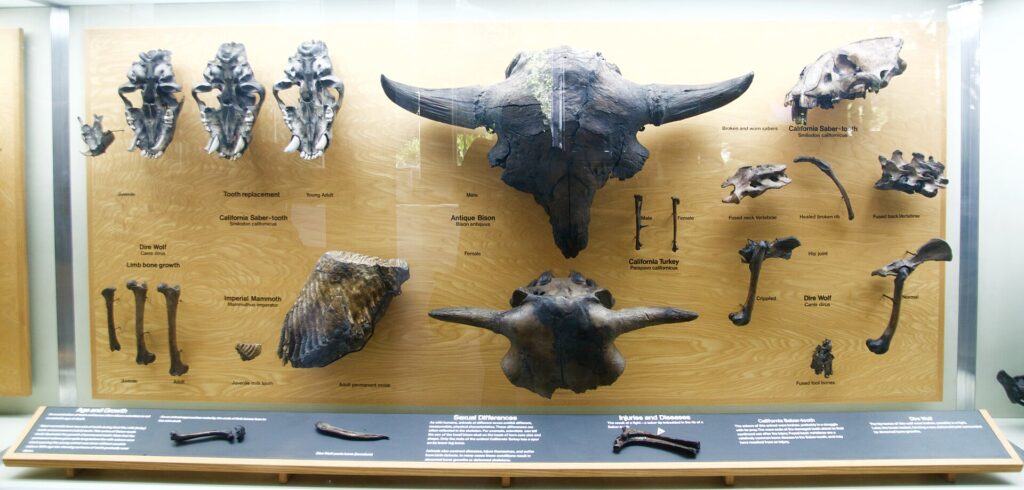
The numbers are staggering. The museum reports more than one million bones recovered since 1906, from more than 231 vertebrate species, plus 159 plant species and 234 invertebrate species. Its collections hold about three million items, and over 3.5 million fossils have been excavated in total. Dire wolves are the most common large mammal, with about 4,000 individuals, followed by saber-toothed cats with more than 2,000.
Ice Age Animals Found Here
- Dire wolves: the most common large mammal in the deposits, with about 4,000 individuals.
- Saber-toothed cats (Smilodon fatalis): the second most common large mammal, with more than 2,000 individuals.
- American lions, Columbian mammoths, ancient bison and ground sloths: all represented in the collections, along with western horses.
- Tiny fossils: insects, snails, seeds and plant remains that help scientists rebuild the climate and landscape of Ice Age Los Angeles.
History: From Rancho La Brea to Hancock Park
The seeps were noted long before anyone dug for fossils. In 1769, Franciscan friar Juan Crespí wrote about “springs of pitch” in his diary of the Portolá expedition, the earliest known written mention. In 1828, Antonio José Rocha received Rancho La Brea, a Mexican land grant of more than 4,400 acres, on the condition that residents of the pueblo could take asphalt for their own use. “Brea” is Spanish for tar, so “the La Brea Tar Pits” literally means “the the tar tar pits.”
For decades, the bones that turned up in the asphalt were assumed to be from cattle and other local animals. William Denton published the first mention of extinct animal remains in 1875, and in 1901 oil geologist W. W. Orcutt recognized the bones as fossils of extinct species. University of California scientists became involved soon after, and from 1907 J. Z. Gilbert brought Los Angeles High School students to dig.
The 1913–1915 Excavations
The turning point came in 1913, when landowner G. Allan Hancock gave Los Angeles County exclusive excavation rights for two years. Between July 1913 and September 1915, the Los Angeles Museum excavated 96 sites and recovered well over 750,000 specimens, the foundation of today’s collection. In 1924, Hancock donated 23 acres of the ranch to the county, creating Hancock Park.
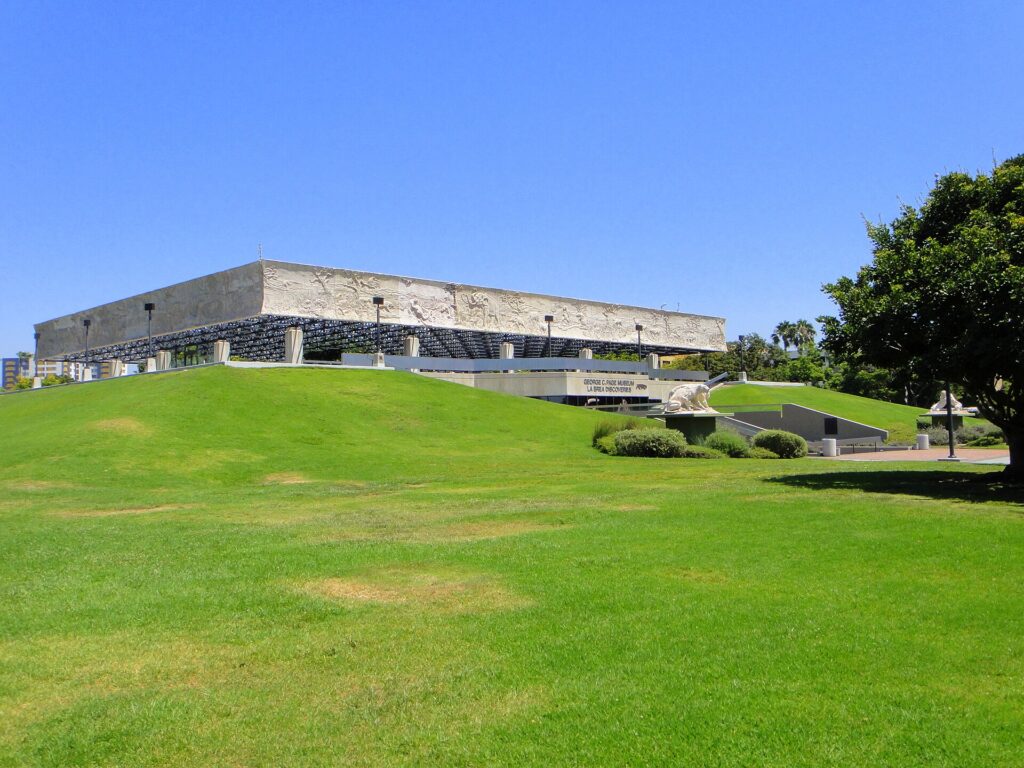
Construction of the George C. Page Museum, funded by philanthropist George C. Page, began in 1975, and it opened in 1977 with its distinctive sloped grassy berms and sculpted frieze. Pit 91 was reopened in 1969 and Project 23 began in 2008, so the site has been an active dig for most of the last 60 years.
The Renovation: What Opens in 2028
The redesign is led by WEISS/MANFREDI, the design lead for both the museum and the park, with Gruen Associates as executive architect and landscape architect and Kossmanndejong handling exhibition design. The fundraising goal is $240 million. Construction was scheduled to start in late 2026, and the official phasing map runs from August 2026 through summer 2028. Planned features include:
- The Samuel Oschin Global Center for Ice Age Research, a new research hub founded in 2026 and described as the intellectual core of the campus.
- A new entry on Wilshire Boulevard and an expansive glass-fronted gallery facing the park.
- Visible labs and collection areas that show how fossils are prepared and stored, with room for more than two million specimens.
- A 1-kilometer walking loop linking the excavation sites, labs, museum and a new Central Lawn.
- An outdoor amphitheater, an education grove where visitors can watch excavation, a larger theater and indoor and outdoor classrooms.
The historic frieze on the 1977 building is being kept, and access to the sloped grassy hills is being improved.
Getting There and Parking
The official address is 5801 Wilshire Blvd., Los Angeles, CA 90036, in the Miracle Mile district between Fairfax Avenue and Curson Avenue.
- Metro: the D Line subway extension opened on May 8, 2026, and the new Wilshire/Fairfax station puts you at the western edge of Museum Row, a short walk from the park.
- Museum lot: the tar pits’ own lot on South Curson Avenue is closed to the general public during construction and reserved for Insider Tour ticket holders.
- Garages: the museum points visitors to the structures at LACMA, the SAG-AFTRA building and the Petersen Automotive Museum. LACMA’s Pritzker Parking Garage is entered from 6th Street just east of Fairfax Avenue and is open daily from 5 am to 10 pm; the Petersen garage is entered from Fairfax Avenue.
- Street parking: avoid Wilshire Boulevard from 7 to 9 am and 4 to 7 pm on weekdays, when cars are ticketed and towed even at meters.
If you would rather skip the parking question entirely, the tar pits are an easy stop on a classic car tour of Los Angeles in a 1970 Cadillac DeVille convertible, with hotel pickup and a driver who knows where to pull over on Wilshire.
Visiting the Tar Pits with Kids
Even without the museum, the park works well for children. They can watch bubbles rise in the Lake Pit, spot fresh asphalt in the grass and look down into Pit 91 to see where real fossils come from. A few tips:
- Plan 45 to 90 minutes in the park, then pair it with a museum next door so the day does not hinge on the outdoor areas that happen to be open.
- Bring wipes and old shoes. Asphalt sticks to soles and is hard to clean.
- For children 7 and older who love fossils, the Insider Tour is the only way to sort real microfossils with scientists during the closure. Each minor needs a waiver signed by a parent or guardian.
- For a full indoor Ice Age fix, head to the Natural History Museum in Exposition Park (below).
For lunch, The Grove and the Original Farmers Market are a short drive north; see our guide to The Grove Los Angeles and our list of the best family restaurants in Los Angeles.
The Sister Museum: Natural History Museum in Exposition Park
The tar pits are part of the Natural History Museums of Los Angeles County, and during the closure the organization is moving public and educator programs to its main museum at 900 Exposition Blvd. in Exposition Park. The Natural History Museum is open daily from 9:30 am to 5 pm, closed the first Tuesday of each month and on select holidays. Los Angeles County residents get free admission from 3 to 5 pm on weekdays (onsite only). The museum also runs a La Brea Tar Pits Mobile Museum, a converted trailer that visits schools and free community events around the county.
Museum Row: What Else Is Next Door
The tar pits sit at the heart of Museum Row, the stretch of Wilshire Boulevard on the Miracle Mile. Three major museums are within a few minutes’ walk:
- LACMA (5905 Wilshire Blvd.): the county art museum shares Hancock Park with the tar pits. Its Peter Zumthor-designed David Geffen Galleries opened on April 19, 2026. Open every day except Wednesday. See our LACMA guide.
- Academy Museum of Motion Pictures (6067 Wilshire Blvd.): film history on the corner of Fairfax, open 10 am to 6 pm, closed Tuesdays. Fanny’s restaurant and the store are open without a museum ticket. Read our Academy Museum guide.
- Petersen Automotive Museum (6060 Wilshire Blvd.): car culture plus the Vault collection, open daily 10 am to 6 pm. Our Petersen Automotive Museum guide has the details.
To string several of these together with other collections across the city, see our Los Angeles museum tour guide.
La Brea Tar Pits: FAQ
Are the La Brea Tar Pits open right now?
The outdoor park is. The George C. Page Museum closed after July 6, 2026 for a two-year renovation, but Hancock Park, the Lake Pit and the active excavation sites stay open. Some areas open and close in stages during construction.
When will the La Brea Tar Pits museum reopen?
The museum expects the full campus, including the Page Museum, to reopen in 2028.
Is it real tar?
No. It is asphalt, the lowest grade of crude oil, seeping up from the Salt Lake Oil Field. The bubbles are mostly methane gas.
Where do you park for the La Brea Tar Pits?
The on-site lot is reserved for Insider Tour guests during construction. Use the garages at LACMA (entrance on 6th Street east of Fairfax), the Petersen (entrance on Fairfax) or the SAG-AFTRA building, or take the Metro D Line to Wilshire/Fairfax.