
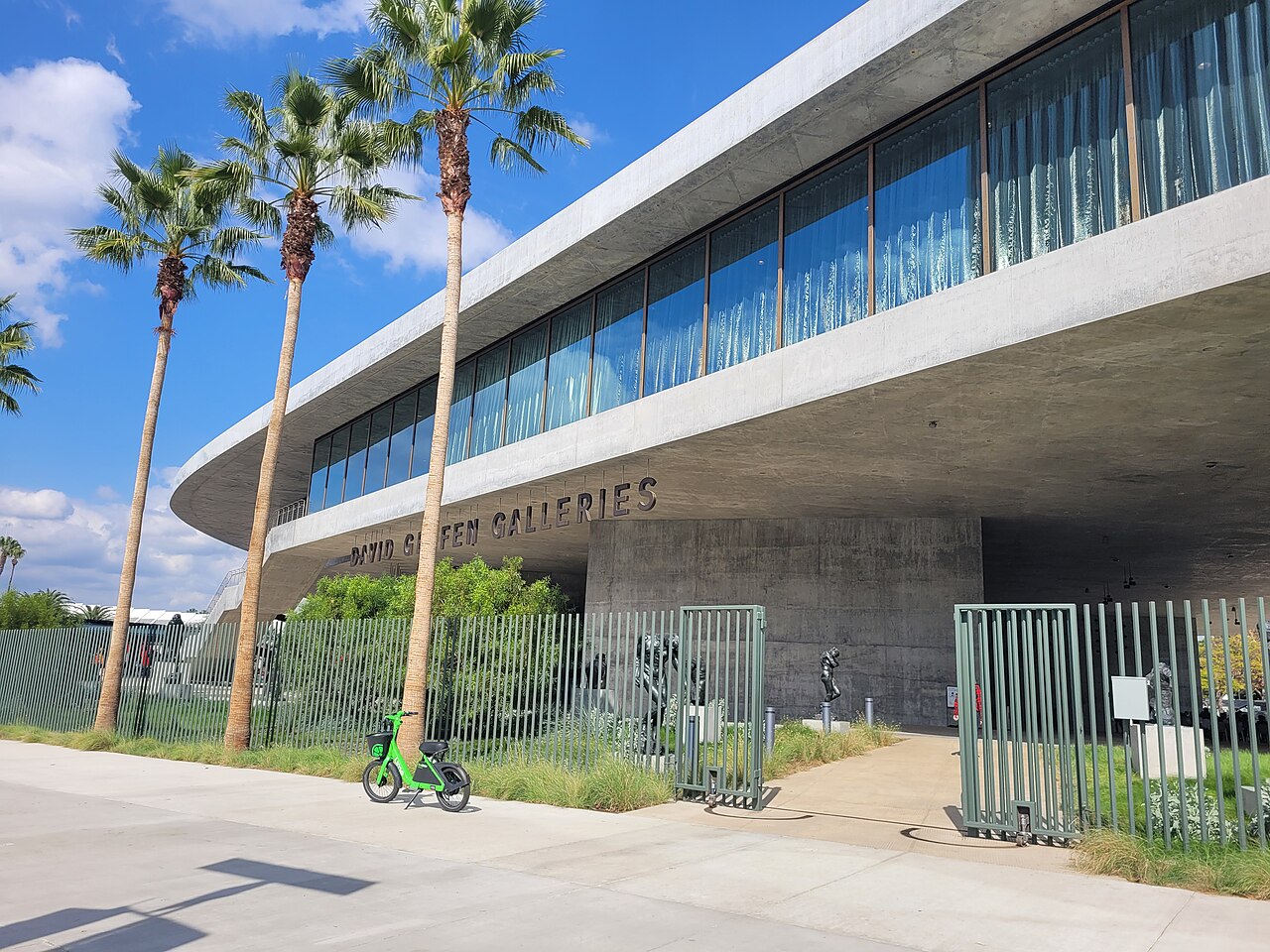
LACMA, the Los Angeles County Museum of Art, is the largest art museum in the western United States, and 2026 has been its biggest year in decades. In April the museum opened the David Geffen Galleries, Peter Zumthor’s long concrete-and-glass building that stretches across Wilshire Boulevard. A month later the Metro D Line finally reached the Miracle Mile, with a station right at the museum’s doorstep. This guide covers what LACMA is, how the campus now fits together, current hours and ticket prices, the free ways in, what’s on view from December 2026 into early 2027, parking, the subway, and the other museums on Museum Row. Hours, prices and exhibition dates change, so check lacma.org before you go.
LACMA at a glance
- Address: 5905 Wilshire Blvd., Los Angeles, CA 90036, on the Miracle Mile stretch of Wilshire known as Museum Row.
- Hours: Monday, Tuesday and Thursday 11 am–6 pm; Friday 11 am–8 pm; Saturday and Sunday 10 am–7 pm. Closed Wednesdays.
- General admission: $25 for adults who live in LA County, $30 for everyone else. Kids 17 and under who live in LA County get in free.
- Tickets: timed entry. Every visitor needs a ticket, including members, and LACMA strongly recommends booking ahead.
- Collection: more than 150,000 objects covering about 6,000 years of art from around the world.
- Metro: D Line to Wilshire/Fairfax, open since May 8, 2026.
- Parking: Pritzker Parking Garage on 6th St., just east of Fairfax Ave. The flat rate is $24, or $16 if you enter after 8 pm.
What LACMA is, and why 2026 changed it
LACMA’s roots go back to a museum of history, science and art in Exposition Park. It became a separate art museum in 1961 and moved to its current site on Wilshire Boulevard in 1965, next to the La Brea Tar Pits in Hancock Park. Over the decades the campus grew in pieces: the Pavilion for Japanese Art in 1988, then two Renzo Piano buildings, the Broad Contemporary Art Museum (BCAM) in 2008 and the Resnick Pavilion in 2010.
The collection is famously wide, with art from every continent and era. The museum’s stated aim is to show many art histories side by side rather than ranking one above the others, and the new building was designed around that idea.
The David Geffen Galleries: Peter Zumthor’s building over Wilshire
The David Geffen Galleries are LACMA’s new home for its permanent collection. They opened with a ribbon cutting on April 19, 2026, and members had two weeks of priority access through May 3. The Swiss architect Peter Zumthor, a winner of the Pritzker Prize, designed the building. It is the final step in a campus overhaul that took about two decades.
What the building looks like
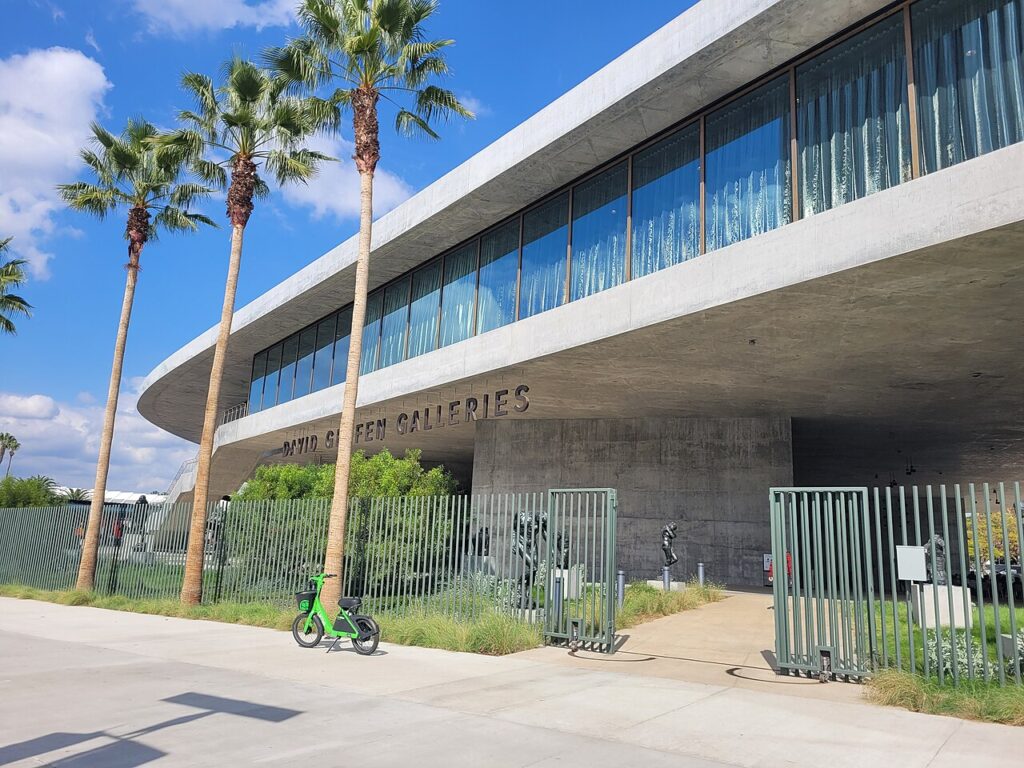
From the street, what you notice is the length. The building is a single horizontal form about 900 feet long, and it bridges Wilshire Boulevard, so you can see art on both sides of the street without going outside. The galleries sit on one raised exhibition level of about 110,000 square feet. Floor-to-ceiling glass along the curving edge lets daylight into some rooms and gives views out over the city. Other rooms are enclosed to protect light-sensitive work. The structure is architectural concrete, which gives the building its gray, solid look under a bright LA sky.
Down at street level, a set of pavilions under the gallery floor was designed to hold cafés and restaurants, the LACMA Store, a 300-seat theater and the W.M. Keck Education Center. The design also opened about 3.5 acres of new outdoor space linked to Hancock Park. LACMA reported a building cost of $715 million, paid through its Building LACMA campaign. That figure includes a $150 million gift from David Geffen and $125 million from Los Angeles County, and the County owns the building.
How the collection is arranged
The first installation inside the Geffen Galleries does not walk you through art history by country or by century. It is organized around the world’s oceans: the Pacific, Indian and Atlantic, plus the Mediterranean Sea. Works from different cultures and eras share the same rooms. Give yourself at least two hours here. Leave the rest of the campus for later or for a second visit.
The rest of the campus: Resnick Pavilion and BCAM
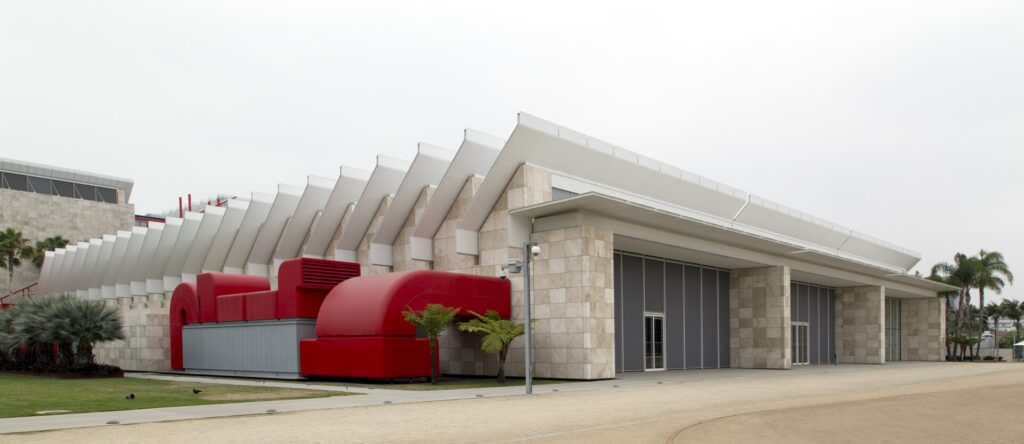
The two Renzo Piano buildings west of the Geffen Galleries now hold most of LACMA’s temporary exhibitions. Together they added about 100,000 square feet of gallery space, which let the museum keep showing art during the years of construction.
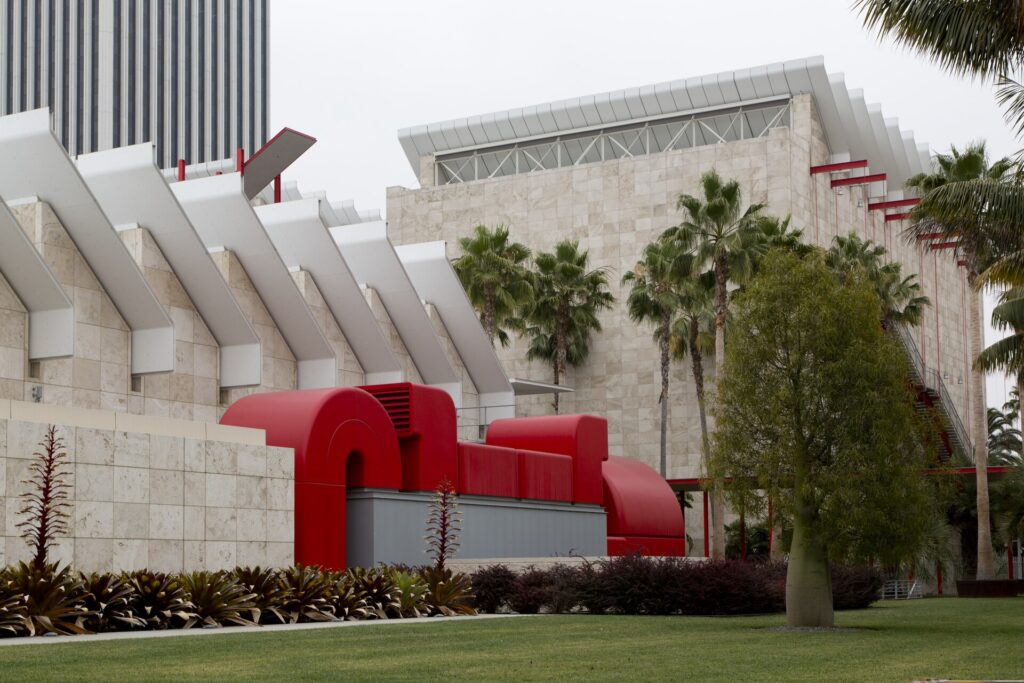
- Resnick Pavilion (2010): a single-story exhibition hall under a distinctive sawtooth roof. Most of the big ticketed shows go here, and there is a second LACMA Store inside.
- Broad Contemporary Art Museum, BCAM (2008): three gallery levels, easy to spot by the bright red exterior stair and escalator. BCAM rotates collection displays and smaller exhibitions.
- Pavilion for Japanese Art (1988): the curving building on the edge of the park, closest to the Tar Pits’ Lake Pit.
For food, Erewhon at LACMA is on campus and open every day except Wednesday, which is also the day the museum is closed.
LACMA hours and ticket prices
LACMA is open Monday, Tuesday and Thursday from 11 am to 6 pm, Friday from 11 am to 8 pm, and Saturday and Sunday from 10 am to 7 pm. It is closed on Wednesdays, so don’t plan a midweek visit around that day. All entry is by timed ticket. Walk-up tickets are sold, but time slots can sell out, especially on weekends and holidays. You can book online, at the Ticket Office, or by phone at 323-857-6010 (10 am–5 pm, Monday through Friday).
General admission prices depend on whether you live in Los Angeles County. LA County residents need a valid ID to get the resident price.
- Adults: $25 for LA County residents, $30 for non-residents.
- Seniors (65+), students (18+ with ID) and visitors with a disability: $21 for residents, $26 for non-residents.
- Kids and teens (3–17): free for LA County residents, $15 for non-residents.
- Children 2 and under: free for everyone.
- Discounts: $2 off general admission for Metro pass holders, and 25% off for KCRW and KJAZZ members.
Free ways to visit LACMA
- LA County residents, weekdays after 3 pm: free general admission Monday through Friday after 3 pm, with valid ID. On Fridays that gives you five hours, because the museum stays open until 8 pm.
- Second Tuesday of every month: free for all visitors.
- NexGenLA: a free youth membership for kids who live in LA County. A member plus one adult guest get in free.
- Bank of America cardholders: free on the first full weekend of each month.
- Military families: free for active-duty service members and their families from Memorial Day through Labor Day, through the Blue Star Museums program.
Even when entry is free, you still need a timed ticket, and the free slots go fast.
What’s on at LACMA: December 2026 to early 2027
These exhibitions appear on LACMA’s current exhibitions list with dates that run through the holiday season and into the new year.
- Paul R. Williams: Architect for Living, Resnick Pavilion, November 15, 2026 – May 31, 2027. A look at one of the best-known architects in Los Angeles history.
- Home of the Future, 1925–1985: Designing Domestic Utopias and The Kitchen and Its Discontents, Resnick Pavilion, September 27, 2026 – March 14, 2027.
- Textile Alchemy: The Art of Reiko Sudo & NUNO, Resnick Pavilion, September 20, 2026 – March 7, 2027.
- Collecting Impressionism at LACMA, Resnick Pavilion, through January 3, 2027.
- The Brockman Gallery: Los Angeles, 1967–1990, BCAM Level 1, October 18, 2026 – January 24, 2027.
- Eileen Cowin: Between Panic and Paradise, BCAM Level 2, through January 3, 2027.
- john gerrard: SPIRITS, through December 20, 2026.
- Last chance: Pablo Picasso—Portraits in Disguise and Danse Macabre: Death in Print from Dürer to Dix are both on BCAM Level 3 and close December 6, 2026.
Design and architecture fans have an unusually strong season. The Paul R. Williams, Home of the Future and Kitchen shows are all in the Resnick Pavilion, so one ticket and one building cover all three.
Parking at LACMA
- Pritzker Parking Garage: the museum’s main garage, on 6th St. just east of Fairfax Ave. It is open daily from 5 am to 10 pm. The charge is $24, or $16 if you enter after 8 pm, and you can prepay at the pay stations. Height clearance is 6’10”. Free EV chargers are on level P1, first come, first served. At busy times, staff may valet-stack cars at no extra cost.
- Spaulding lot: 5900 Wilshire Blvd., entered from Spaulding Ave. south of Wilshire. LACMA lists it as an extra option but doesn’t publish a separate rate, so check the posted price at the entrance.
- Other options: the Petersen Automotive Museum garage, entered from Orange Grove Ave., and the Museum Square garage on Curson Ave. There is also metered parking on 6th St. and Wilshire Blvd.
Parking spaces are first come, first served, and LACMA does not take parking reservations. On free days and holiday weekends, the subway or a drop-off is usually easier.
Getting there on the Metro D Line
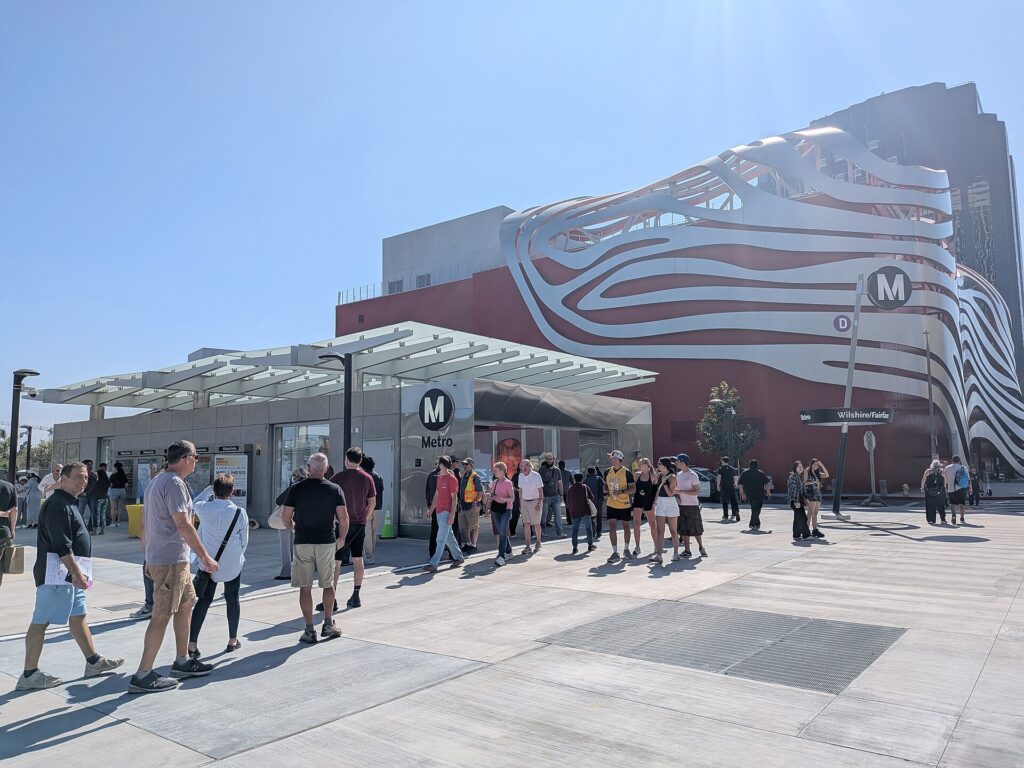
For decades, getting to LACMA without a car meant taking the bus along Wilshire. That changed on May 8, 2026, when Metro opened the first section of the D Line subway extension. It added three stations: Wilshire/La Brea, Wilshire/Fairfax and Wilshire/La Cienega. Trains run from Union Station in downtown LA with no transfers, and the whole ride to the new end of the line at La Cienega takes about 20 minutes.
- Wilshire/Fairfax (6026 Wilshire Blvd.) is the stop for LACMA. The entrance is on the Petersen Automotive Museum corner, across the street from the Academy Museum and the LACMA campus.
- Wilshire/La Brea is one stop east. It works if you are starting from the eastern Miracle Mile, but from there it’s a longer walk west along Wilshire to the museums.
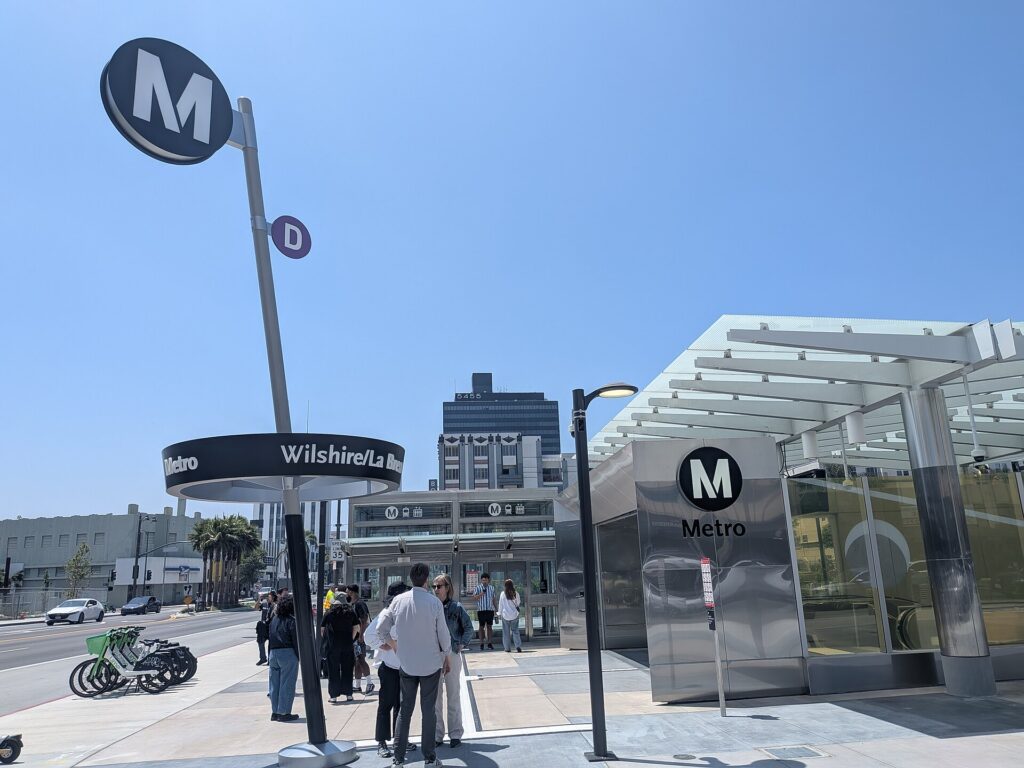
Metro is building the next section of the extension west toward Beverly Hills and Century City, with a tentative opening in spring 2027. Metro pass holders also get $2 off LACMA general admission.
Nearby on Museum Row
LACMA anchors a few blocks of Wilshire that hold several major museums, so it’s easy to plan a full day here.
La Brea Tar Pits and Hancock Park
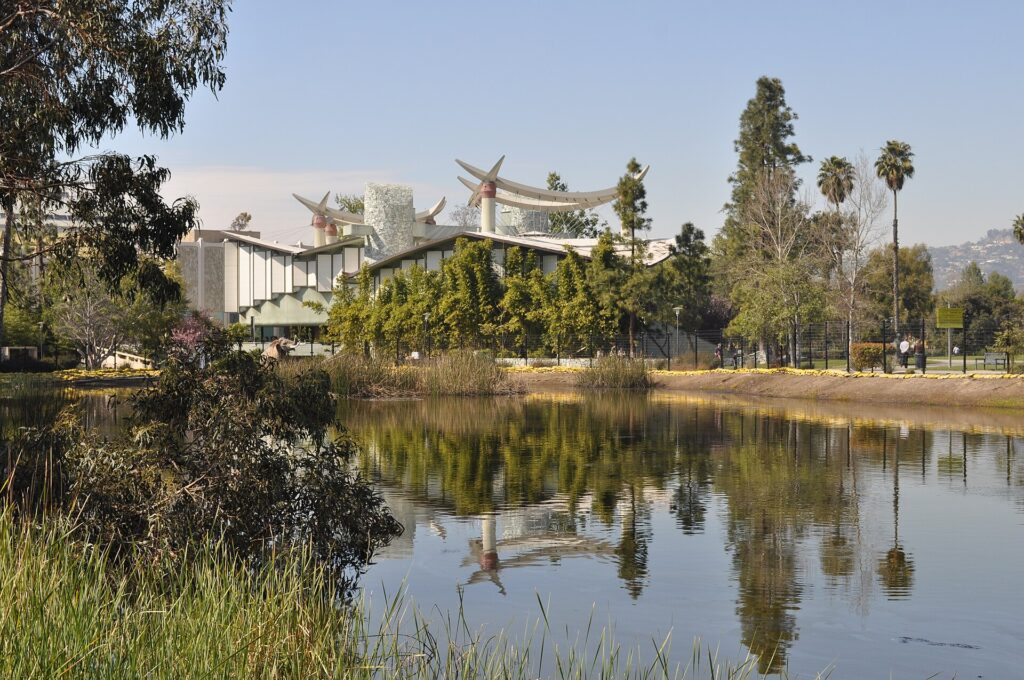
The La Brea Tar Pits (5801 Wilshire Blvd.) share Hancock Park with LACMA. Asphalt still seeps up from the ground here, and scientists have pulled Ice Age fossils out of these pits for more than a century. The indoor museum at La Brea Tar Pits has been closed for a major renovation since July 2026, and the full reopening of the campus is expected in 2028. Many outdoor areas of Hancock Park are still open, so you can walk the park and see the Lake Pit on the way to or from LACMA.
Academy Museum of Motion Pictures
Across the LACMA campus at Wilshire and Fairfax (6067 Wilshire Blvd.), the Academy Museum is the film industry’s own museum. It is open Wednesday through Monday from 10 am to 6 pm and is closed Tuesdays. Its schedule is close to the opposite of LACMA’s, which helps if you are in town midweek. Adult admission is $25, and kids 17 and under get in free. Our Academy Museum guide has the details.
Petersen Automotive Museum
The Petersen (6060 Wilshire Blvd.) is the building wrapped in red and stainless-steel ribbons on the corner above the Wilshire/Fairfax station. It is open every day from 10 am to 6 pm, except Thanksgiving and Christmas Day, and its garage is a handy second parking option for LACMA. Car lovers should read our Petersen Automotive Museum guide, which covers the Vault tour.
Planning a Miracle Mile day
- Morning: start at the Geffen Galleries when the doors open. Weekend opening is 10 am, and the galleries are calmer before lunch.
- Midday: eat on campus, then walk through Hancock Park past the Lake Pit.
- Afternoon: pick a temporary show in the Resnick Pavilion or BCAM. You could also cross to the Academy Museum or the Petersen, but not on a Tuesday, when the Academy Museum is closed.
- Evening: The Grove and the Original Farmers Market are less than a mile north on Fairfax. See our guide to The Grove. For more shopping, Melrose Avenue is just beyond it, and Koreatown is a short drive east for dinner.
If you want to see more of the city’s collections, our Los Angeles museum tour guide rounds up the city’s other major collections. Some visitors would rather skip driving and parking altogether. Our classic car tour shows the city from an open 1970 Cadillac DeVille convertible, and the One Day in LA tour covers more ground in a single day with hotel pickup.
LACMA: FAQ
Is LACMA free?
Not usually, but there are several free options. Everyone gets in free on the second Tuesday of each month. LA County residents get in free on weekdays after 3 pm with ID, and kids 17 and under who live in LA County are always free. NexGenLA youth members and one adult guest are also free. You still need a timed ticket.
What day is LACMA closed?
Wednesday. LACMA is open Monday, Tuesday and Thursday from 11 am to 6 pm, Friday from 11 am to 8 pm, and Saturday and Sunday from 10 am to 7 pm.
Are the David Geffen Galleries open?
Yes. Peter Zumthor’s building opened on April 19, 2026, with a members’ preview through May 3. It is now LACMA’s permanent home for its collection, and general admission covers it.
Which Metro station is closest to LACMA?
Wilshire/Fairfax on the D Line, which opened on May 8, 2026. It is across the street from the LACMA campus and the Academy Museum, and about 20 minutes or less from Union Station.