
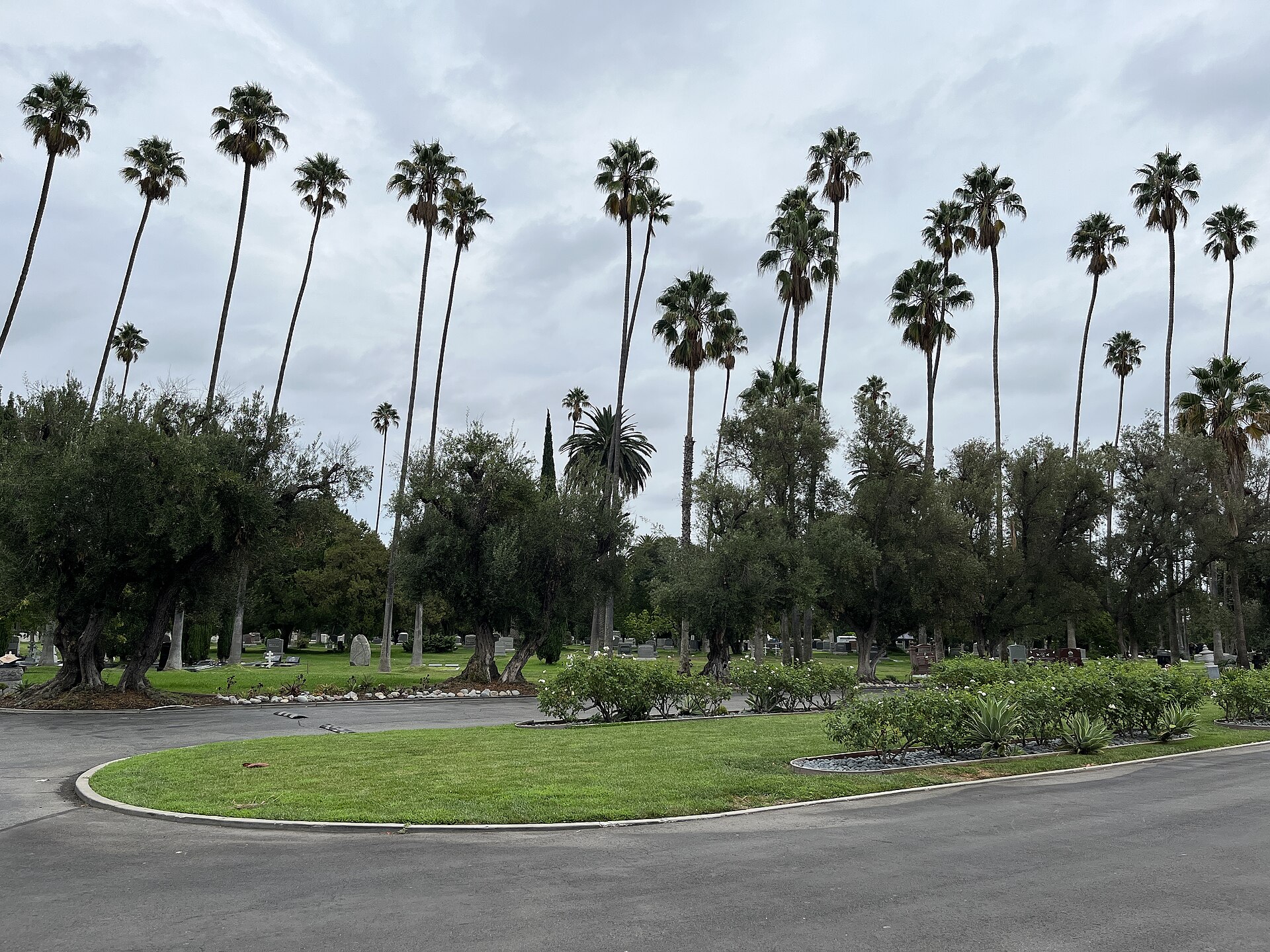
Of all the places to see in Hollywood, Hollywood Forever Cemetery may be the most surprising. Founded in 1899, before the film industry arrived, it sits on Santa Monica Boulevard right up against the back lot of Paramount Pictures, and it is the resting place of silent-era idols, studio founders, cartoon voices and punk rockers. It is also an active cemetery and funeral home where families still hold services every week. Visitors are welcome on the grounds, and on certain nights the cemetery doubles as one of LA’s best-loved places to watch a film or hear a concert. Hours, schedules and prices change, so check the official sites before you go.
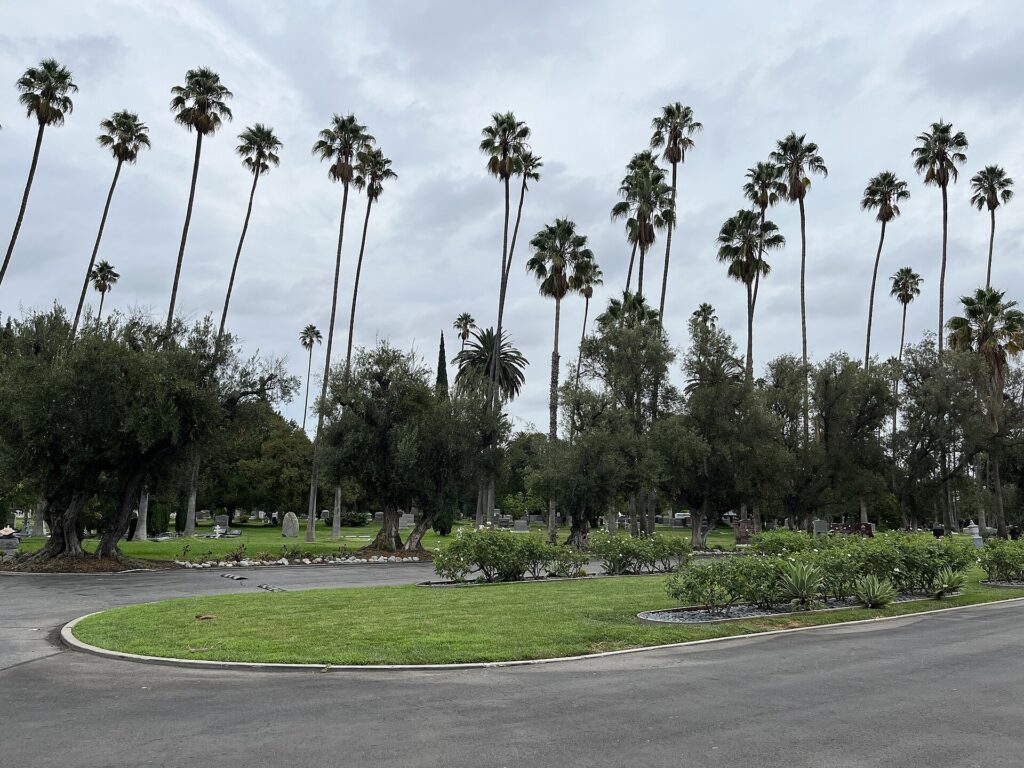
Hollywood Forever Cemetery at a glance
- Address: 6000 Santa Monica Blvd., Los Angeles, CA 90038, between Gower Street and Van Ness Avenue in Hollywood.
- Hours: open daily from dawn to dusk. The Beth Olam Jewish section, its buildings and gates are closed on Saturdays.
- Admission: the grounds are open to visitors during those hours. Cinespia screenings, Día de los Muertos, Masonic Lodge shows and guided walking tours are ticketed separately.
- Founded: 1899, as Hollywood Cemetery. It was known as Hollywood Memorial Park from 1939 and has been called Hollywood Forever since 1998.
- Size: about 53 acres, with more than 400 trees, a lake, a reflecting pool and a cluster of historic mausoleums.
- Landmark status: listed on the National Register of Historic Places in 1999 and designated a Los Angeles Historic-Cultural Monument in 2022.
A short history: from Hollywood Cemetery to Hollywood Forever
The cemetery opened to the public in 1899 as Hollywood Cemetery, laid out by landscape designer Joseph Earnshaw with curving roads and a park-like plan that was typical of the “lawn park” cemeteries of the time. When it opened, only six cemeteries served the whole of Los Angeles, and most of them were nearly full. Hollywood itself did not become part of the city until 1910.
The original grounds stretched much farther south. Between 1911 and 1915, film companies bought the southern part of the property, and that land is now part of Paramount Studios. That is why the studio wall and its famous water tower rise just beyond the cemetery’s southern edge, and why so many studio founders, directors and stars ended up buried next door to where they worked. In the 1920s the cemetery built its grandest structures, including the Cathedral Mausoleum (completed in two stages in 1918 and 1922) and the island tomb of William Andrews Clark Jr. on Sylvan Lake (1921). In 1927 a section was set aside for Jewish burials, today’s Beth Olam Cemetery.
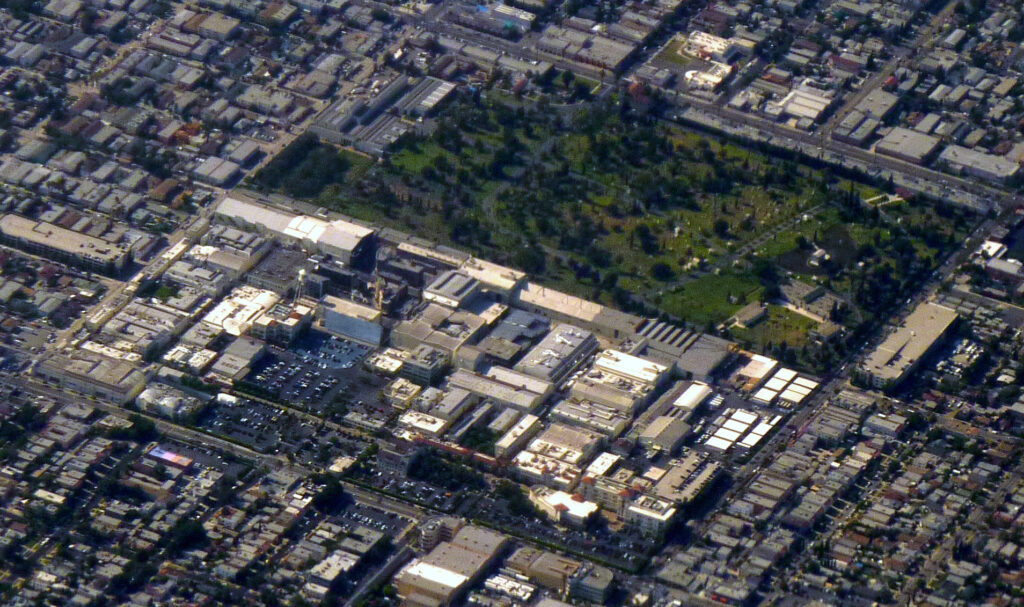
The later decades were less kind. Under longtime owner Jules Roth, who took control in 1939, maintenance slipped badly; by the 1980s families were complaining about neglect, and the 1994 Northridge earthquake damaged crypts that were never properly repaired. The cemetery’s history also includes a painful episode of segregation: in 1952 Oscar winner Hattie McDaniel asked to be buried here and was refused, because the cemetery did not desegregate until 1959. After Roth died in 1998, brothers Tyler and Brent Cassity bought the run-down property, renamed it Hollywood Forever and restored the grounds. In 1999 the new owners dedicated a cenotaph to McDaniel south of Sylvan Lake. The outdoor movie nights that began in 2002 brought a new generation through the gates.
Visiting hours and visitor rules
Hollywood Forever is open every day from dawn to dusk, and many spots on the grounds have a view of the Hollywood Sign in the distance. Keep in mind that this is private property and a working cemetery, with funerals and burials happening most days. The cemetery asks all visitors to respect the privacy of the families, and its posted rules are short and sensible:
- Photography: photos and video for personal use are fine without permission. Photography or filming for commercials, films, ads, publications, websites or any other non-personal use needs prior written approval from cemetery management.
- Services: do not walk into an active funeral, burial, open grave or other work area, and be quiet and respectful when a service is going on nearby. Follow staff instructions.
- Conduct: the rules ban disruptive behavior, loitering, soliciting, unauthorized vending and recreational sports on the grounds.
- Cars: vehicles must stay on the cemetery roads and in designated parking areas, never on the lawns.
- Flowers: fresh-cut flowers are allowed outdoors year-round in a cemetery-provided vase. Artificial, silk, plastic or dried flowers are not permitted, and flowers and decorations are cleared every Thursday from 6 a.m. Do not leave valuables at a grave.
The cemetery’s flower shop is in the Bell Tower at the front gates and sells fresh seasonal flowers and potted plants if you would like to leave something at a grave.
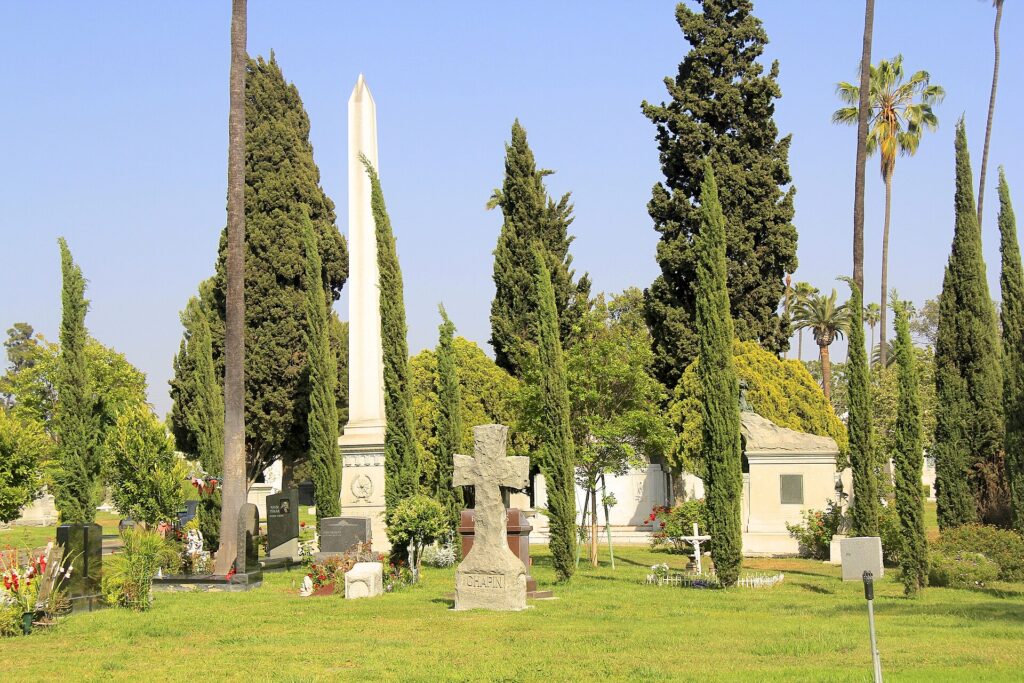
Notable people buried at Hollywood Forever, and where they rest
Hollywood Forever describes itself as the resting place of hundreds of Hollywood luminaries. Below are some of the best-known names, with locations only where the cemetery or reliable reporting documents them. Please treat every grave as you would a family plot, because that is what it is.
Rudolph Valentino and the Cathedral Mausoleum
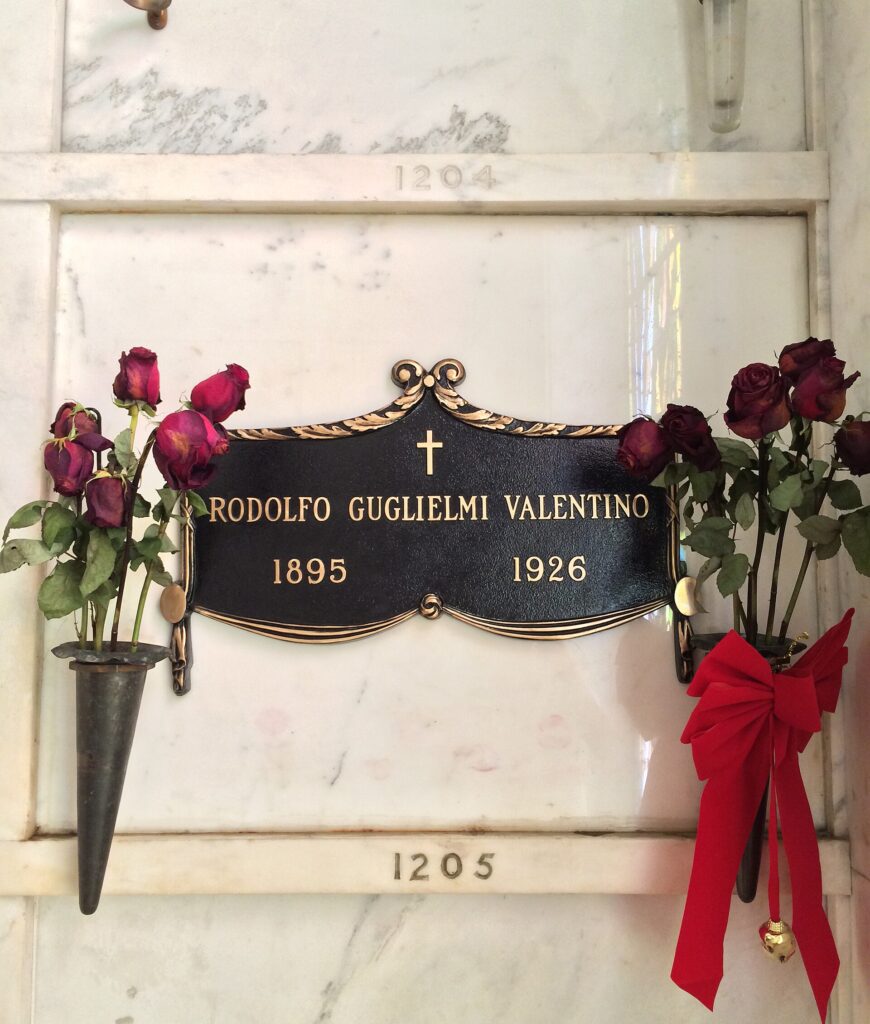
The silent-screen star Rudolph Valentino died in August 1926 at 31. He had made no burial plans, so his friend June Mathis, the screenwriter credited with discovering him, offered a crypt she had bought for herself. She died the following year and was placed in the crypt next to his, and the two still rest side by side in the Cathedral Mausoleum, crypt 1205. The Cathedral Mausoleum, in the southeastern part of the grounds, is a Neoclassical building faced in granite and marble, designed by the Pasadena firm Marston & Van Pelt.
Every August 23, on the anniversary of his death, the cemetery hosts a Valentino memorial service inside the Cathedral Mausoleum. The 2026 service marked the 100th anniversary of his death. For decades a veiled “Lady in Black” carrying a red rose came to mourn at the crypt, and the tradition continues today.
Douglas Fairbanks Sr. and Jr.
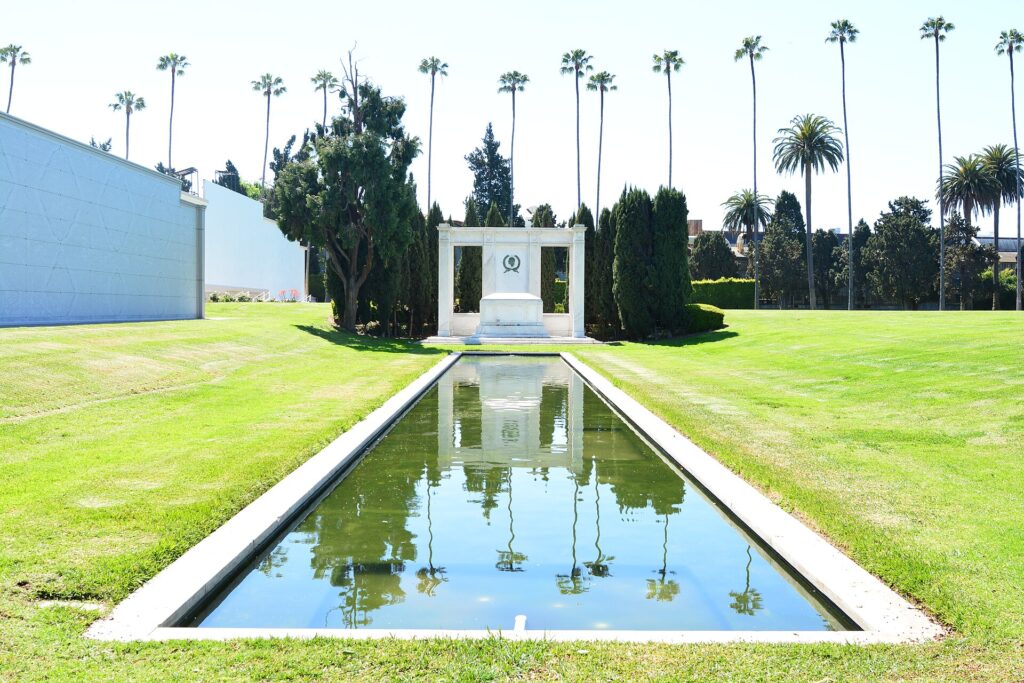
The swashbuckling star Douglas Fairbanks Sr. died in 1939 and was first placed at Forest Lawn in Glendale. His widow, Sylvia, later moved him to Hollywood Forever and commissioned the grandest private memorial on the grounds: a white Georgia marble monument with a colonnade, a carved sarcophagus and a long reflecting pool, dedicated in 1941. His son, actor Douglas Fairbanks Jr., who died in 2000, is interred in the same tomb. The monument stands in the southeastern part of the cemetery, beside the lawn that is now named after Fairbanks.
Judy Garland
Judy Garland died in 1969 and was first interred at Ferncliff Cemetery in Hartsdale, New York. At the request of her children, her remains were moved to Hollywood Forever in January 2017. She rests in a mausoleum space renamed the Judy Garland Pavilion, which has room for other members of her family.
Cecil B. DeMille, Mickey Rooney, Mel Blanc and other film names
- Cecil B. DeMille, the director of The Ten Commandments and one of the founders of the studio that became Paramount, is entombed here, just over the wall from the lot.
- Mickey Rooney, the child star who became one of MGM’s biggest names, was interred at Hollywood Forever after a private funeral in April 2014.
- Mel Blanc, the voice of Bugs Bunny, Daffy Duck and countless other cartoon characters, has a marker reading “That’s all folks,” as his will requested.
- Hattie McDaniel, the first African American to win an Academy Award, is buried elsewhere, but the cenotaph dedicated to her in 1999 stands south of Sylvan Lake.
Fans of Old Hollywood should also know who is not here: Jayne Mansfield is buried in Pennsylvania (Hollywood Forever has a memorial to her), and Marilyn Monroe rests at Westwood Village Memorial Park, covered in our Marilyn Monroe in Los Angeles guide.
Johnny Ramone, Dee Dee Ramone and Chris Cornell
Hollywood Forever has become a pilgrimage site for rock fans. An eight-foot bronze statue of Ramones guitarist Johnny Ramone stands near the south shore of Sylvan Lake. It is a memorial, not a grave: his widow keeps his ashes. His bandmate Dee Dee Ramone is buried at the cemetery, not far from Johnny’s memorial. Soundgarden and Audioslave singer Chris Cornell was laid to rest in May 2017 in the section called the Garden of Legends.
Sylvan Lake and the Clark mausoleum
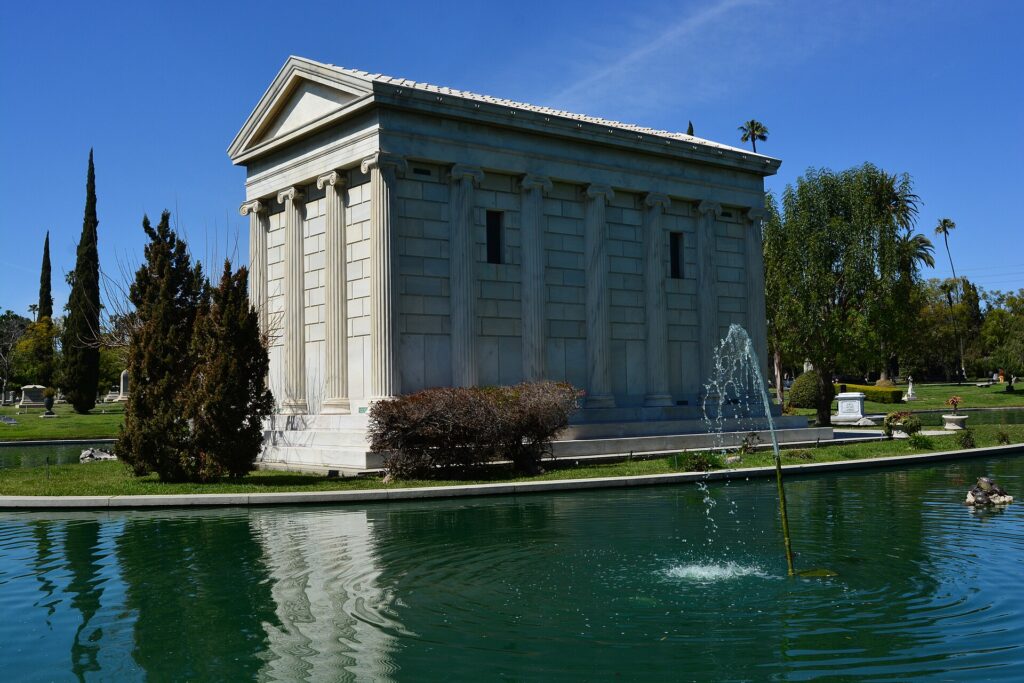
The heart of the grounds is Sylvan Lake, a man-made lake that was part of Earnshaw’s original plan and was built in 1909. In the middle sits a small island reached by a footbridge, and on it stands the most photographed building in the cemetery: the marble temple-style tomb of William Andrews Clark Jr., the copper heir who founded the Los Angeles Philharmonic. Designed by Robert D. Farquhar and completed in 1921, it has Ionic columns outside and, according to the cemetery, Biblical mosaics inside made by Italian craftsmen.
The lake is also home to ducks, and the cemetery is known for its free-roaming peacocks. Enjoy them from a distance, and do not feed the birds.
Cinespia outdoor movies on the Fairbanks Lawn
Since 2002, Cinespia has screened classic and cult films at Hollywood Forever on summer evenings. Guests spread out on the Fairbanks Lawn near the Fairbanks monument, and the film is projected onto the white marble west wall of the Cathedral Mausoleum. Screenings usually take place on Saturdays from May through September, with DJs and photo booths before the film, and people bring picnics, blankets and low chairs. Beer and wine are allowed, and there are beer and wine bars on site.
The 2026 season was Cinespia’s 25th. It opened on May 23, 2026 and ran through the summer, with screenings into September. There are no Cinespia screenings at the cemetery in late fall and winter, so if you are visiting between November and April, plan on a daytime visit instead. Dates for the 2027 season will appear on cinespia.org. Shows often sell out, so buy tickets in advance and arrive early.
Día de los Muertos at Hollywood Forever
Hollywood Forever hosts what it calls the largest Día de los Muertos celebration of its kind in the United States, held every year on the last Saturday before November 2. The day-long festival fills the grounds with family altars, decorated calaveras, live bands, Aztec dancers and a ritual procession. The 27th annual event took place on Saturday, October 24, 2026, from noon to midnight, rain or shine. It is a ticketed event, and the organizers warn that resold tickets are not honored, so buy through the official site, ladayofthedead.com. Look for the 2027 date there next year.
Concerts, talks and screenings at the Masonic Lodge
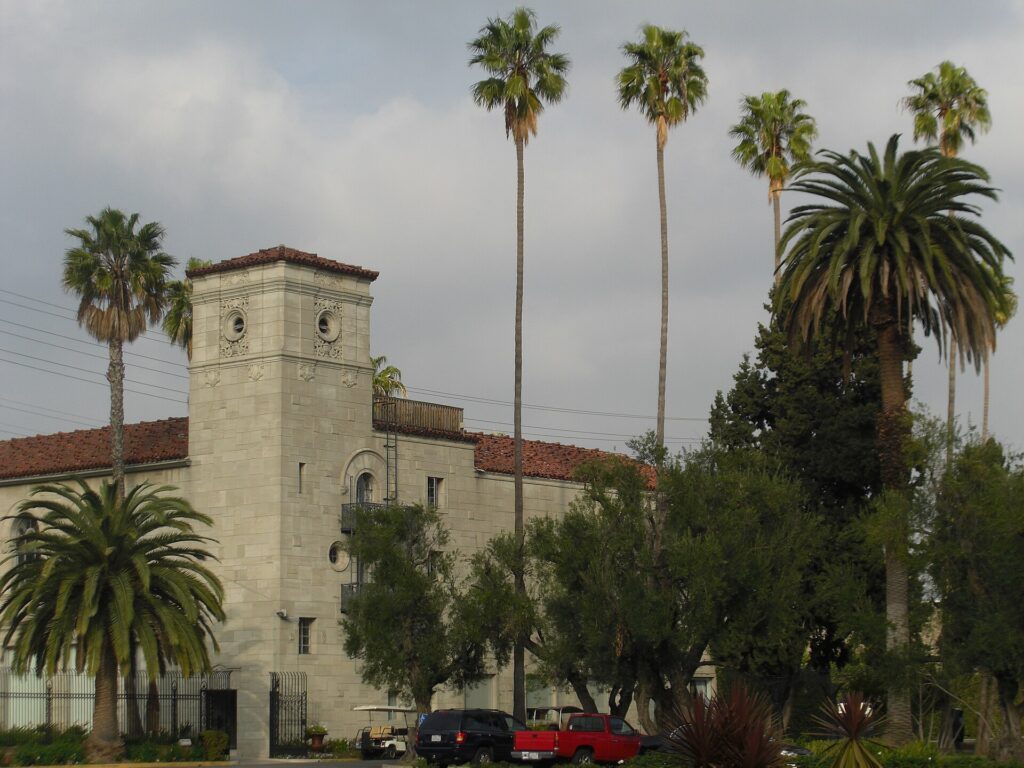
Near the main gate on Santa Monica Boulevard stands a Spanish-style building with a three-story tower. Built in 1931 and designed by Morgan, Walls & Clements, it held shops on the ground floor and the Southland Masonic Temple upstairs. The Masons moved out in 1967, and today the upstairs hall, known as the Masonic Lodge, is one of Hollywood’s most atmospheric small venues, hosting concerts, author evenings, live podcast tapings, storytelling nights and screenings. The interior is open only to ticket holders, and the full calendar is on hollywoodforever.com. Bigger summer concerts are held outdoors on the Fairbanks Lawn.
Walking tours of Hollywood Forever
The cemetery’s website does not list public tours of its own. The best-known guided option is the walking tour led by historian Karie Bible, a longtime guide here who dresses in vintage gowns and is the current “Lady in Black” at the Valentino memorial. Her day tours last about two and a half hours and were listed at $35 per person, with occasional night tours at $50. Dates are announced a few weeks at a time on cemeterytour.com; at the time of writing, a December 12 day tour was on the schedule.
If you prefer to explore on your own, start near the Cathedral Mausoleum and Sylvan Lake in the southeastern part of the grounds, where many of the most famous names are close together, and allow at least an hour.
Getting there and parking
Hollywood Forever’s main entrance is on Santa Monica Boulevard, through a set-back driveway and an iron gate with a guard house; there are also gates on Gower Street on the west side. For a regular daytime visit you can drive onto the grounds, keeping to the roads and designated parking areas as the rules require. There is a surface parking lot behind the Cathedral Mausoleum. Event nights work differently, with their own entry and parking arrangements, so check the event page for Cinespia, Día de los Muertos or Masonic Lodge shows before you set out.
Many visitors fit the cemetery into a wider day in Hollywood. The cemetery pairs naturally with the studios, the Walk of Fame and the Hollywood Hills on a private Hollywood tour, and if you would rather see the neighborhood from the open top of a 1970 Cadillac DeVille convertible, take a look at our classic car tour.
What to see nearby: Paramount, the Walk of Fame and Melrose Avenue
Paramount Pictures Studio Tour
Paramount’s Studio Tour Center is around the corner at 5515 Melrose Ave. The standard Studio Tour lasts two hours, runs daily and costs $71; it includes the New York backlot, the Bronson Gate, soundstages and the prop warehouse. The VIP tour lasts four and a half hours on weekdays and costs $230, with archive access and a meal on the lot. Guests must be over 10, adults need photo ID, and parking at Visitor Lot A on Windsor Boulevard is $20 for the Studio Tour.
Hollywood Walk of Fame
A short drive north, the stars along Hollywood Boulevard and Vine Street honor many of the same people who rest at Hollywood Forever, Valentino and Fairbanks included. Our Hollywood Walk of Fame guide explains how to find specific stars, and our list of things to do in Hollywood covers the rest of the neighborhood. For more silent-era history, read about Charlie Chaplin in Hollywood.
Melrose Avenue
Paramount’s main gate is on Melrose Avenue, and heading west along Melrose takes you to the shops, vintage stores and cafes covered in our Melrose Avenue shopping guide. If you are continuing toward West Hollywood, our Sunset Boulevard guide picks up from there.
Hollywood Forever Cemetery: FAQ
Can you visit Hollywood Forever Cemetery?
Yes. The grounds are open to visitors every day from dawn to dusk. The Beth Olam Jewish section is closed on Saturdays. It is a working cemetery, so stay away from any services in progress and respect the families visiting graves.
Can you take photos at Hollywood Forever?
Yes, for personal use. Photos and video for personal or private use do not need permission. Commercial or other non-personal photography and filming needs prior written approval from the cemetery.
Which famous people are buried at Hollywood Forever?
Rudolph Valentino (Cathedral Mausoleum), Douglas Fairbanks Sr. and Jr. (the Fairbanks monument), Judy Garland (the Judy Garland Pavilion), Cecil B. DeMille, Mickey Rooney, Mel Blanc, Dee Dee Ramone and Chris Cornell (Garden of Legends) are among them. Johnny Ramone has a memorial statue by Sylvan Lake, but his ashes are kept by his widow.
When are the movie nights at Hollywood Forever?
Cinespia screenings usually run on Saturdays from May through September on the Fairbanks Lawn. The 2026 season, Cinespia’s 25th, has finished, and there are no screenings in winter. Check cinespia.org for 2027 dates and tickets.