
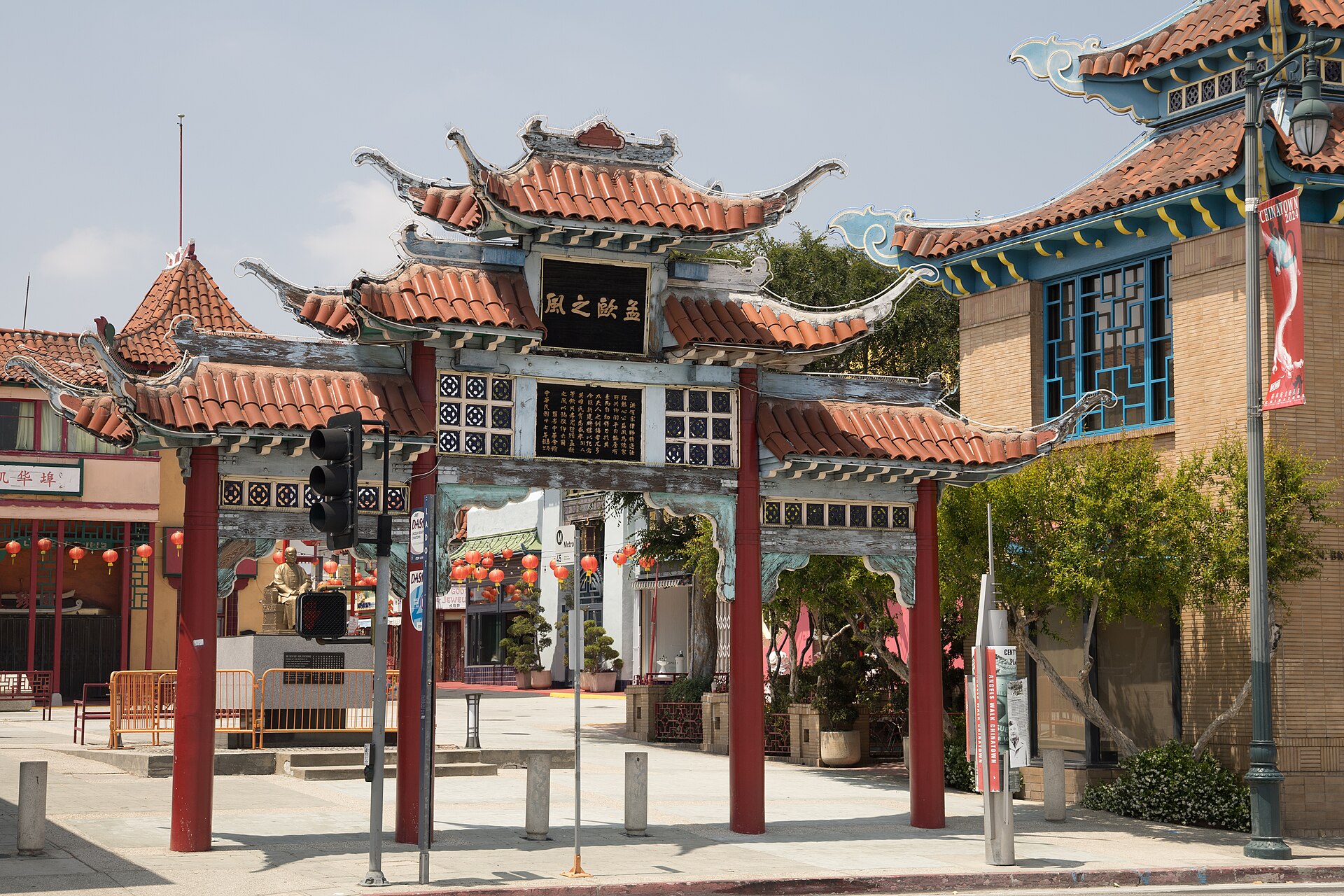
Chinatown Los Angeles sits on the northern edge of downtown, a few blocks up Broadway from Olvera Street and Union Station. It is compact enough to walk in an afternoon, yet it holds almost a century of history: a plaza built by the Chinese American community in 1938, two carved gates, an active Teochew temple, family bakeries, a lane of contemporary art galleries and some of the city’s most talked-about lunch counters. This guide covers how the neighborhood came to be, what to see, where to eat, the Lunar New Year parade, and how to get there by Metro or by car. Hours and event dates change, so check before you go.
A Short History of Chinatown Los Angeles
Old Chinatown and Union Station
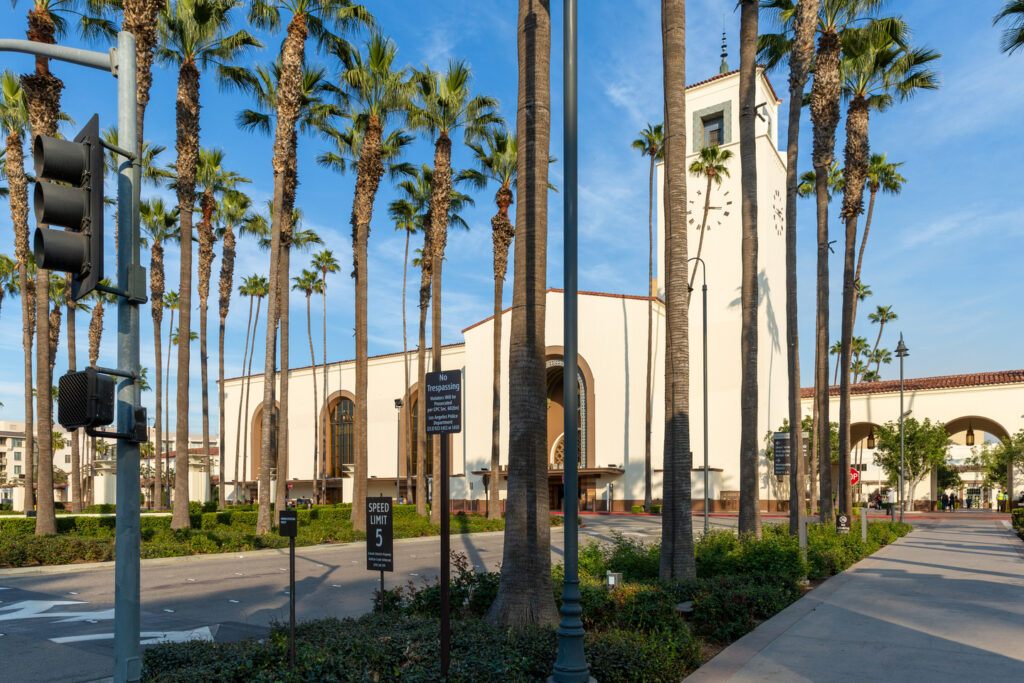
The first Chinatown in Los Angeles grew up in the late 1800s around Alameda and Macy streets, right beside the city’s original plaza. By the early 1930s the city had chosen that land for a new rail terminal, and most of Old Chinatown was demolished to make way for Union Station, which opened in May 1939. Residents and business owners had to find somewhere else to live and work.
One building from that first Chinatown survives: the Garnier Building on Los Angeles Street, now home to the Chinese American Museum inside El Pueblo de Los Angeles. Standing on the Union Station forecourt today, it takes some imagination to picture the streets that once ran beneath it.
New Chinatown, 1938
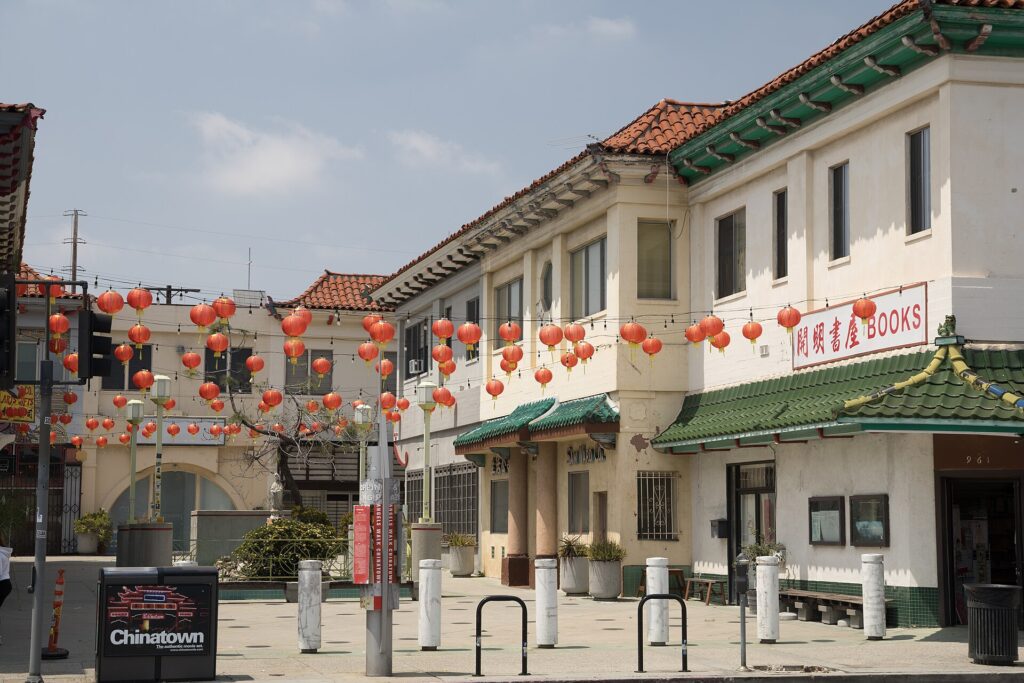
Rather than scatter, community leaders organized. The Los Angeles Chinatown Project Association, led by Peter Soo Hoo Sr., raised money to buy land a few blocks north and to design and build a new commercial center. Central Plaza opened to the public on June 25, 1938. Discover Los Angeles describes New Chinatown as the first such neighborhood in the United States owned by its Chinese American residents, and it is still the heart of the district today.
The same year, a competing tourist attraction called China City opened nearby. It was the project of Christine Sterling, who had earlier reshaped Olvera Street. China City was damaged by fire, rebuilt, and closed for good after a second fire in 1948. New Chinatown is the one that lasted.
In the decades since, the neighborhood has kept changing. Shopping centers and mini-malls went up along Broadway in the 1980s and 1990s, many families moved to the San Gabriel Valley, and since the 2000s new apartments, galleries and restaurants have arrived alongside the long-running businesses.
What to See in Chinatown
Central Plaza and Its Gates
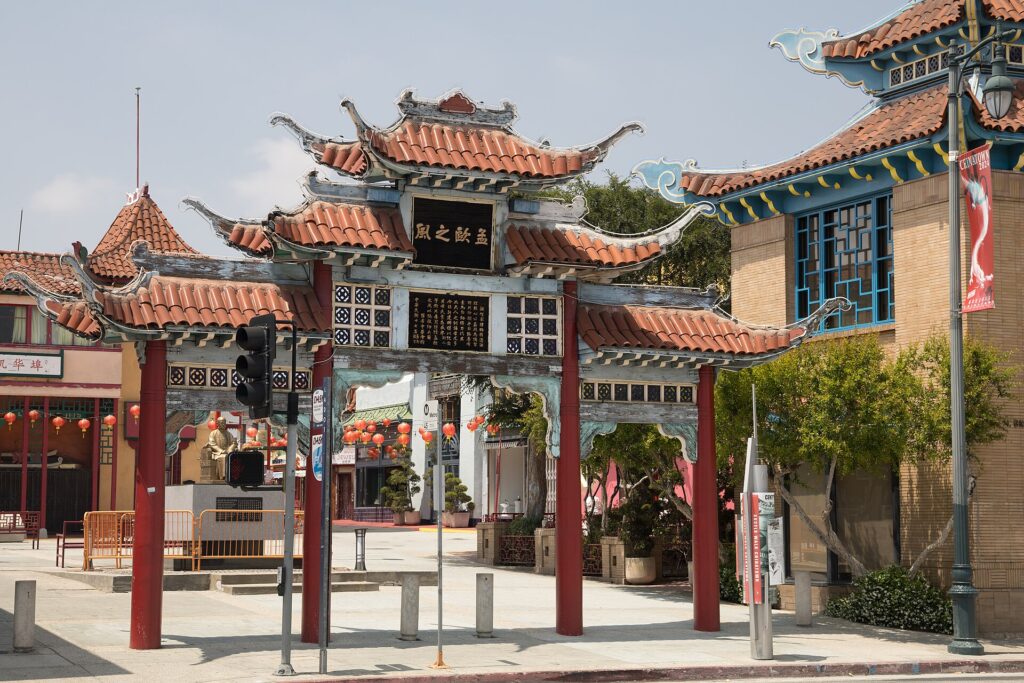
Start at Central Plaza, the pedestrian complex between North Broadway and North Hill Street. Its main lane, Gin Ling Way, is framed by two ornamental gates. The West Gate on the Hill Street side went up with the plaza in 1938. The East Gate on Broadway followed in 1939; it was commissioned by attorney Y.C. Hong in honor of his mother and is also called the Gate of Maternal Virtues. Both gates are Los Angeles Historic-Cultural Monuments.
Inside, look for the upturned tile roofs, painted balconies and strings of red lanterns overhead. The plaza also holds a statue of Dr. Sun Yat-sen near the East Gate and a statue of Bruce Lee, unveiled in 2013. Shops here sell tea sets, porcelain, kites and souvenirs, and the open space hosts many of the neighborhood’s festivals.
The Chinatown Gateway Monument
A few blocks south, two long golden dragons stretch across North Broadway just north of Cesar Chavez Avenue. This is the Chinatown Gateway Monument, dedicated in 2001 and funded largely by the neighborhood’s Teochew-speaking community. It marks the southern entrance to Chinatown and is the landmark most drivers notice first when coming up Broadway from downtown.
Thien Hau Temple
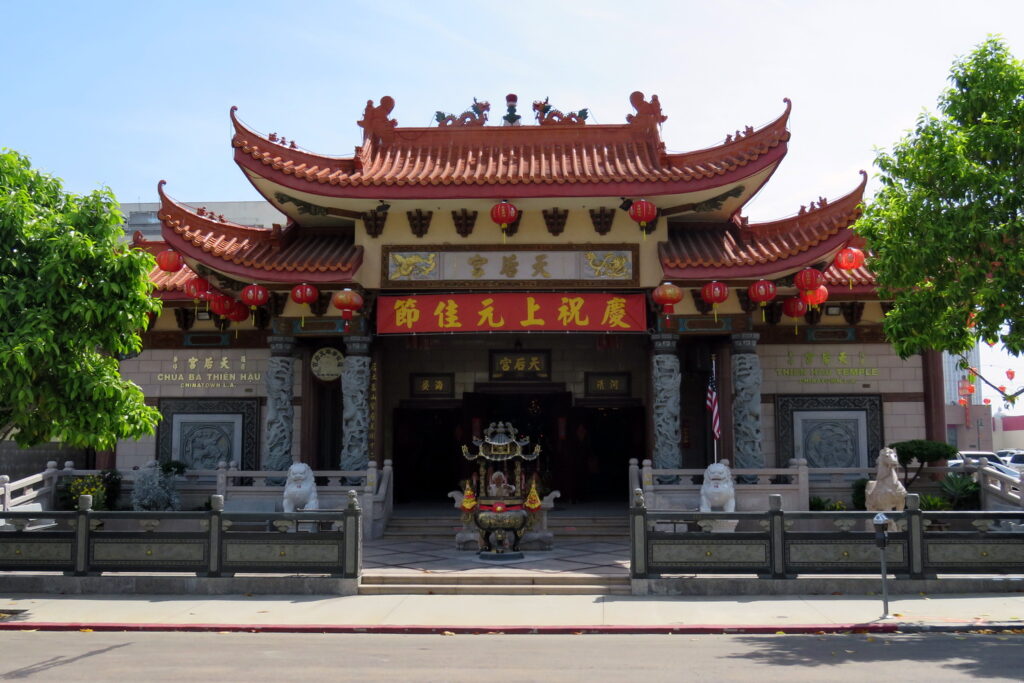
At 756 Yale Street, a short walk west of Broadway, Thien Hau Temple is one of the most active places of worship in Chinatown. It is run by the Camau Association of America, which serves mainly Teochew Chinese-Vietnamese families, and it honors Mazu (Thien Hau), the sea goddess, along with Guan Di and a god of wealth. The association bought and remodeled a former church here in the 1980s, and a larger temple hall was dedicated in 2005.
Visitors are welcome, and entry is free. It is a working temple, so keep your voice down, give people praying plenty of room, and ask before photographing anyone. On Lunar New Year’s Eve the temple is one of the busiest places in the city, with incense, lion dances and firecrackers at midnight.
Chung King Road Galleries
Across from Central Plaza, Chung King Road is a narrow pedestrian lane laid out as part of New Chinatown in the late 1930s. In recent decades many of its storefronts have housed small contemporary art galleries, and the lane gets lively on evenings when several galleries open new shows at once. Tenants change often, so look up current openings on the galleries’ own websites before planning a visit around a particular space.
Chinese American Museum
Technically just outside Chinatown, the Chinese American Museum (425 N. Los Angeles Street) is worth adding if you are walking between El Pueblo and Chinatown. It sits in the Garnier Building, the last surviving structure of Old Chinatown, and includes a re-creation of the Sun Wing Wo general store and herb shop that operated there in the 1890s. The museum’s site lists Tuesday to Sunday, 10 a.m. to 3 p.m. Museum fans can find more ideas in our Los Angeles museum guide.
Los Angeles State Historic Park
Right next to Chinatown, along North Spring Street, Los Angeles State Historic Park covers 32 acres of open lawn, paths and native plantings. Locals still call it “the Cornfield.” Entry is free and the park is open from 8 a.m. until sunset. It is a good place to stretch your legs after lunch, with wide views of the downtown skyline and passing Metro trains, and it hosts concerts and festivals through the year. There is a parking lot inside the park.
Where to Eat in Chinatown
Chinatown’s food scene mixes Cantonese and Chiu Chow institutions with newer restaurants that have made the neighborhood a destination again. All of the places below were open as of late 2026. For more ideas across the city, see our guide to the best restaurants in Los Angeles.
Philippe the Original
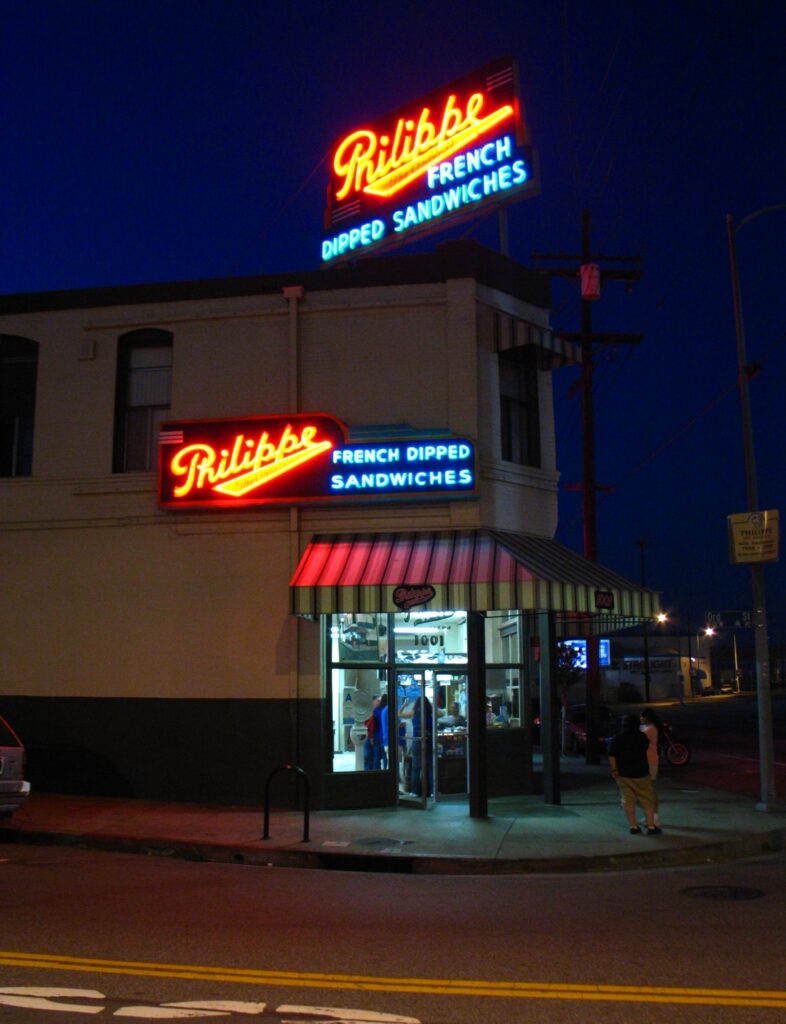
Founded in 1908 and on its current corner at 1001 N. Alameda Street since 1951, Philippe’s is a few minutes’ walk from both Union Station and Chinatown. Its founder claimed to have invented the French dip sandwich, and the beef, pork, lamb or turkey dips are still the reason to come. You order at the counter and eat at long shared tables. The restaurant lists daily hours of 6 a.m. to 10 p.m.
Phoenix Bakery
Fung Chow and Wai Hing Chan opened Phoenix Bakery in 1938, the same year as New Chinatown, and the Chan family still runs it. Since 1977 it has been at 969 N. Broadway. The signature is the strawberry whipped cream cake, developed by the family decades ago and still a favorite Los Angeles birthday cake. Almond cookies, sugar butterflies and, around the Mid-Autumn Festival, handmade mooncakes are also popular.
Far East Plaza and Howlin’ Ray’s
Far East Plaza (727 N. Broadway) is a two-level shopping center that has become one of Chinatown’s best places to eat. Its best-known tenant is Howlin’ Ray’s, the Nashville hot chicken counter that opened here in 2016 and still draws long lines. Its website lists Wednesday to Sunday, 11 a.m. to 7 p.m., so plan around the closed days. In the same plaza:
- Kim Chuy: a family noodle shop serving Chiu Chow-style noodle soups since 1982.
- Lasita: a Filipino rotisserie and wine bar that works well for a relaxed group dinner.
More Places Worth Knowing
- Yang Chow (819 N. Broadway): a Mandarin and Sichuan restaurant open since 1977, best known for its slippery shrimp.
- Firstborn (978 N. Broadway): opened in March 2025 in Mandarin Plaza, with creative takes on Chinese dishes and a strong cocktail list.
- Majordomo (1725 Naud St.): David Chang’s large restaurant just north of Chinatown, built around shareable plates for groups.
Lunar New Year and the Golden Dragon Parade
Lunar New Year is Chinatown’s biggest celebration. The centerpiece is the Golden Dragon Parade, organized by the Chinese Chamber of Commerce of Los Angeles. The 128th parade is listed for Saturday, February 13, 2027, from 1 to 4 p.m. The route starts at Hill Street and Temple Street, runs north to Bernard Street, turns onto Broadway and heads back south toward Temple. Expect dragon and lion dancers, marching bands, floats and firecrackers, with street closures in Chinatown starting at 10 a.m. Dates and routes can change, so confirm on the Chamber’s website closer to the day.
Through the rest of the year the neighborhood has also hosted a Chinese New Year festival, an autumn Moon Festival and summer evening events in Central Plaza. Lunar New Year’s Eve at Thien Hau Temple is a separate, more traditional experience, and it runs late into the night.
Getting to Chinatown and Parking
By Metro
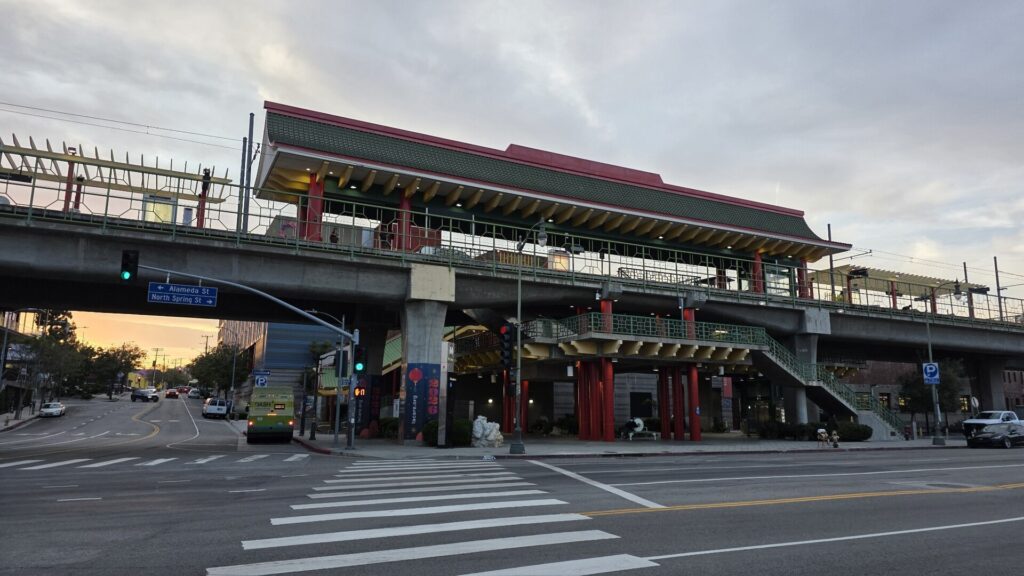
The easiest way in is the Metro A Line. Chinatown station sits above Spring Street at College Street, one stop north of Union Station, and its elevated platform has a pagoda-style roof that is hard to miss. From the station it is a short walk east to Central Plaza and Broadway, and Los Angeles State Historic Park is right alongside. The regular one-way Metro fare is $1.75, paid with a TAP card or a contactless bank card, and transfers within two hours are free.
By Car
Street parking around Broadway and Hill Street is metered and fills up quickly, especially on weekends and during festivals. Several paid lots and garages line Broadway; the underground garage at Far East Plaza is convenient for lunch there. On Lunar New Year parade day, streets close in the morning, so arriving by Metro is far easier. If you would rather not deal with parking at all, a driver can drop you at Central Plaza and wait while you explore; our private SUV tour can include Chinatown as one of the stops.
Pairing Chinatown with Olvera Street and Little Tokyo
Chinatown works best as part of a longer walk through the oldest parts of Los Angeles. Its neighbors tell the city’s early story from different angles:
- Olvera Street and El Pueblo: a short walk south along Broadway or Spring Street. The historic plaza area has Mexican market stalls, the Avila Adobe and the Chinese American Museum, and Union Station is just across Alameda Street. Philippe’s sits between the two, which makes it an easy lunch stop.
- Little Tokyo: two stops south of Chinatown on the A Line (via Union Station) at Little Tokyo/Arts District station. Read our Little Tokyo guide for museums, temples and food there.
- The rest of downtown: Grand Park, the Music Center and the Broadway theater district are close by. Our list of things to do in downtown Los Angeles covers more.
A sample half day: start with a French dip at Philippe’s, walk up to Central Plaza and Chung King Road, visit Thien Hau Temple, pick up a cake at Phoenix Bakery, then finish with a stroll in Los Angeles State Historic Park. Add Olvera Street at the beginning or Little Tokyo at the end if you have more time. Visitors who want to see downtown alongside Hollywood, Beverly Hills and the coast in a single day can do it on our One Day in LA tour.
Tips for Visiting
- Go earlier in the day. Some bakeries and older restaurants keep mostly daytime hours, and Howlin’ Ray’s is closed Monday and Tuesday.
- Carry some cash. Some smaller, long-running shops and restaurants may prefer it.
- Wear comfortable shoes. The sights are spread over several blocks, and a loop from Union Station through Chinatown and the state park adds up.
- Be respectful at temples. Thien Hau is a place of worship first; dress modestly and keep photos discreet.
Chinatown Los Angeles: FAQ
Why did Chinatown in Los Angeles move?
The original Chinatown stood on the land chosen for Union Station. Most of it was demolished in the early 1930s, and the station opened in 1939. Community leaders built New Chinatown a few blocks north, and its Central Plaza opened on June 25, 1938.
When is the Golden Dragon Parade in 2027?
The Chinese Chamber of Commerce of Los Angeles lists the 128th Golden Dragon Parade for Saturday, February 13, 2027, from 1 to 4 p.m. in Chinatown. Check the Chamber’s website for any changes before you go.
How do I get to Chinatown by Metro?
Take the A Line to Chinatown station on Spring Street at College Street, one stop north of Union Station. Central Plaza is a short walk east of the station.
Is Philippe’s in Chinatown?
Philippe the Original is at 1001 N. Alameda Street, on the edge of Chinatown between Union Station and the neighborhood’s southern blocks. It has been at that location since 1951 and is known for its French dip sandwiches.