
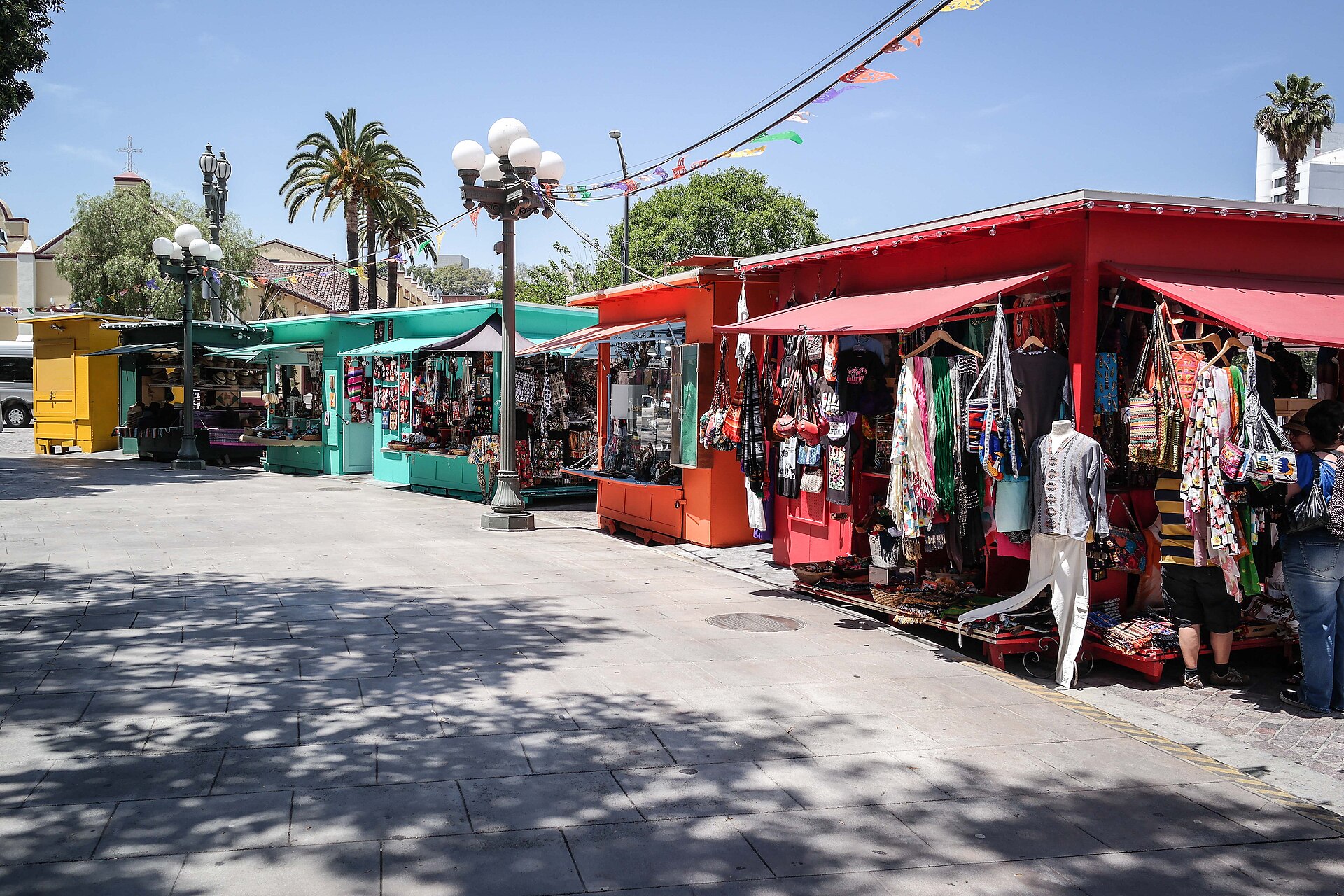
Olvera Street is a short brick-paved lane in downtown Los Angeles where the city began. It sits inside El Pueblo de Los Angeles Historical Monument, a district of old adobes, Victorian commercial blocks and a working 1820s church built around the original town plaza. Today the street is a Mexican marketplace lined with puestos (stalls) selling leather goods, embroidered blouses, candles, toys and folk art, with taquito stands and family restaurants between them. Entry to the street and the plaza is free, and several of the small museums around it are free too.
This guide covers the history, the buildings worth stepping into, where to eat, the yearly celebrations, the free guided tours run by El Pueblo, and how to get there. Hours and event dates below come from the official El Pueblo, museum and organizer websites as of November 2026. They do change, so check before you go.
A short history of Olvera Street and El Pueblo
Long before the Spanish arrived, this part of the Los Angeles basin was home to the Tongva village of Yaanga, and El Pueblo’s own tours start the story there. In 1781 a small group of settler families, the pobladores, founded the pueblo that became Los Angeles. A plaque honoring them stands in the plaza today.
Olvera Street itself began as a very short lane called Calle de las Vignas, or Wine Street. In 1877 the City Council renamed it in honor of Agustín Olvera, the first judge of Los Angeles County. By the 1920s the area had been left behind as downtown grew south, and many of its old buildings were falling apart.
The turning point came in 1928. A woman named Christine Sterling walked through the plaza and saw a condemnation notice on the Avila Adobe, the oldest house in the city. She raised money to repair it and pushed for a “Mexican marketplace” next to it where people could learn about the city’s Spanish and Mexican heritage. She brought in artisans and craftspeople, and Olvera Street opened as a marketplace on Easter Sunday, 1930. In 1953 the State of California, the City and the County of Los Angeles joined to create the historical monument, and the plaza district was listed on the National Register of Historic Places in 1972. According to El Pueblo, Olvera Street draws more than 2 million visitors a year.
What to see at El Pueblo
The historic district covers about 9.5 acres, and everything below is within a few minutes’ walk of the plaza. Most of the museums are closed on Mondays, so plan a Tuesday-to-Sunday visit if you want to go inside.
Avila Adobe: the oldest house in Los Angeles
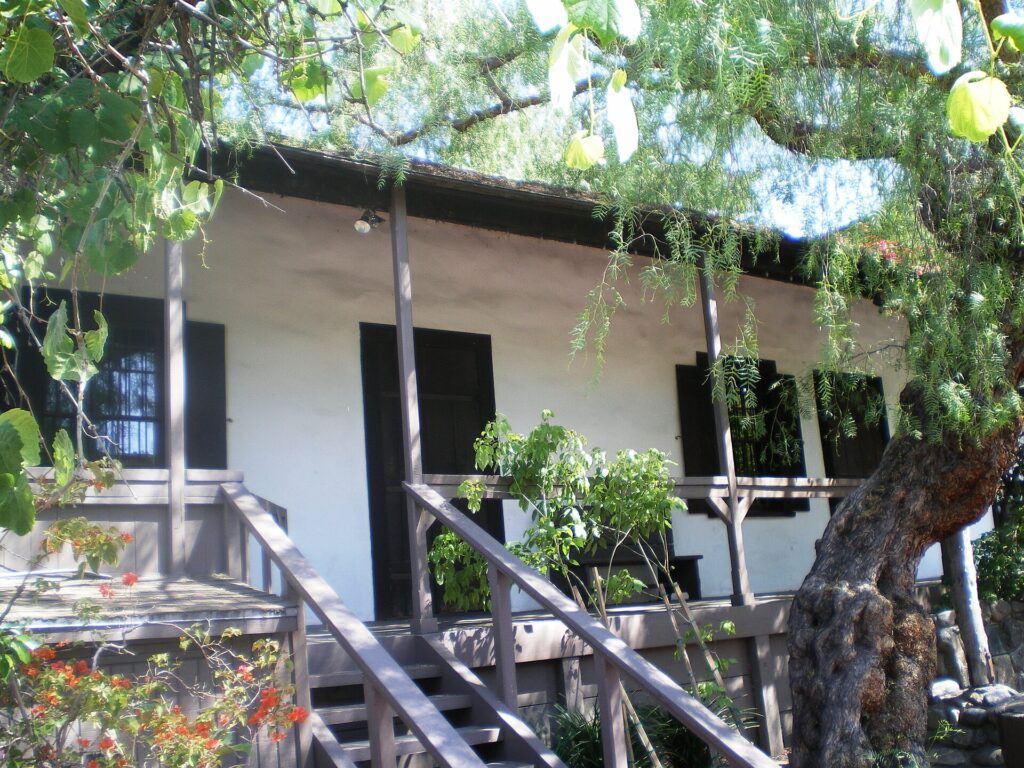
Francisco José Avila, a ranchero from Sinaloa who had served as alcalde (mayor) of Los Angeles in 1810, built this single-story adobe in 1818. In January 1847 the invading American army under Robert Stockton briefly used it as a military headquarters. It later decayed and was condemned in the 1920s before Sterling’s campaign saved it.
Today the rooms are furnished as they might have looked in the late 1840s, and the shaded courtyard is one of the quietest spots downtown. Address: 10 Olvera Street. Hours: Tuesday to Sunday, 9 a.m. to 4 p.m. Admission is free.
Sepulveda House
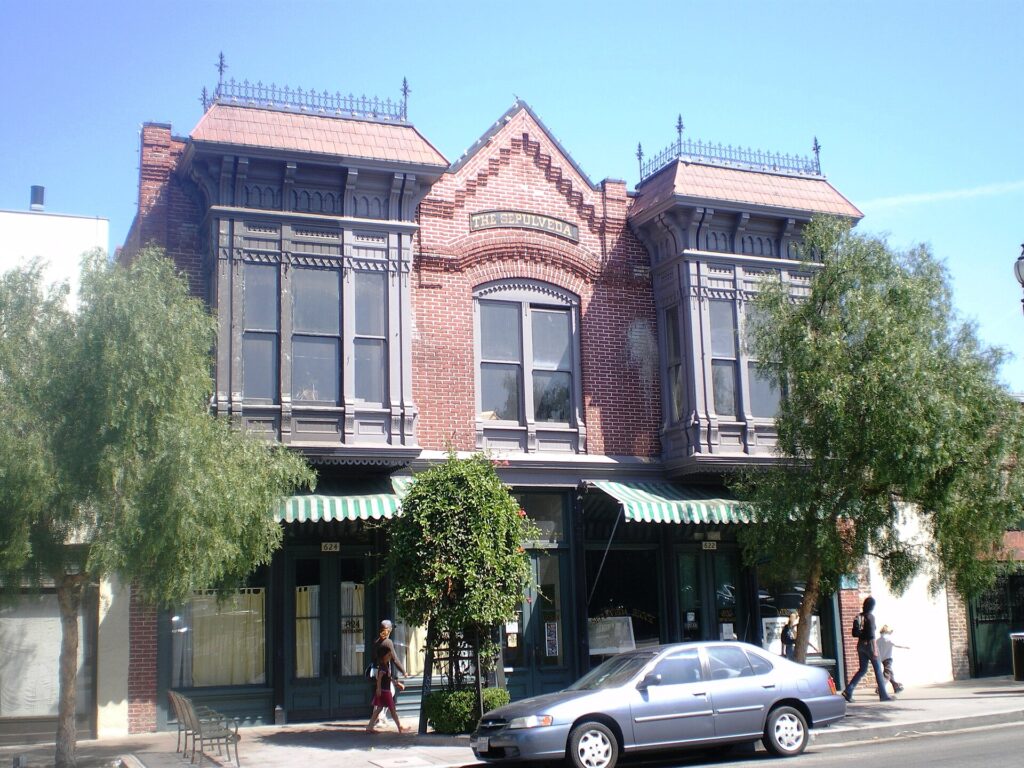
Eloisa Martinez de Sepúlveda built this red-brick building in 1887 after the widening of Main Street cost her part of the family lot and adobe. It has an unusual Eastlake design with a triangular gable and two bay windows topped with iron cresting. During World War II, a USO canteen inside served troops passing through Union Station. Address: 12 Olvera Street. Hours: Tuesday to Sunday, 10 a.m. to 3 p.m.
The Plaza and the kiosko
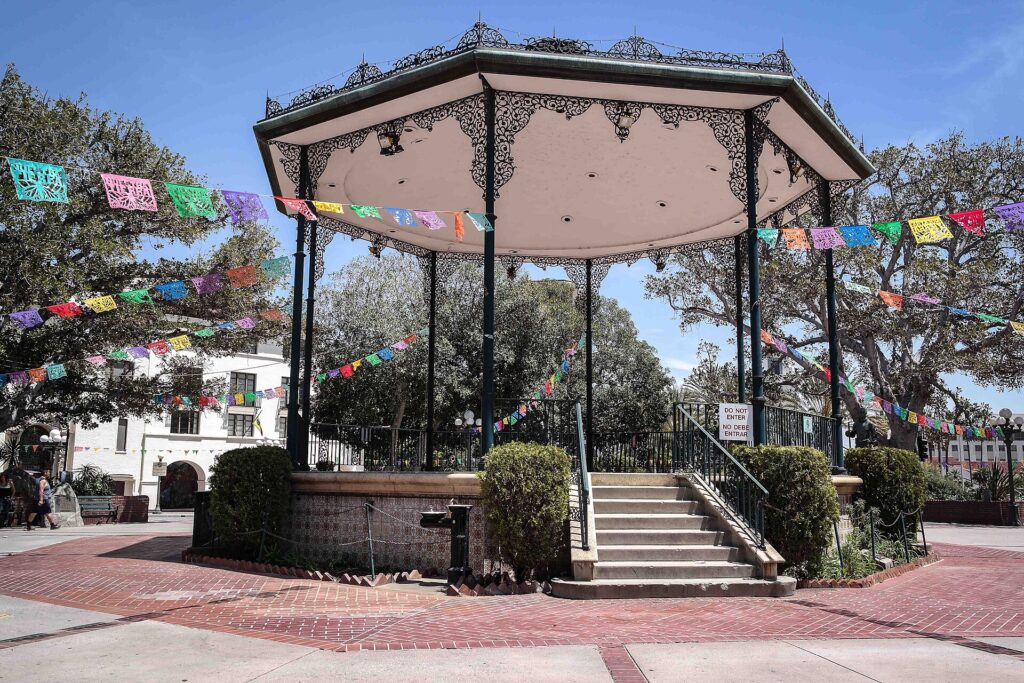
The Old Plaza is the heart of El Pueblo. Its centerpiece is the wrought-iron kiosko (bandstand), which hosts the nightly ceremonies of the Día de los Muertos festival.
La Placita: the Old Plaza Church
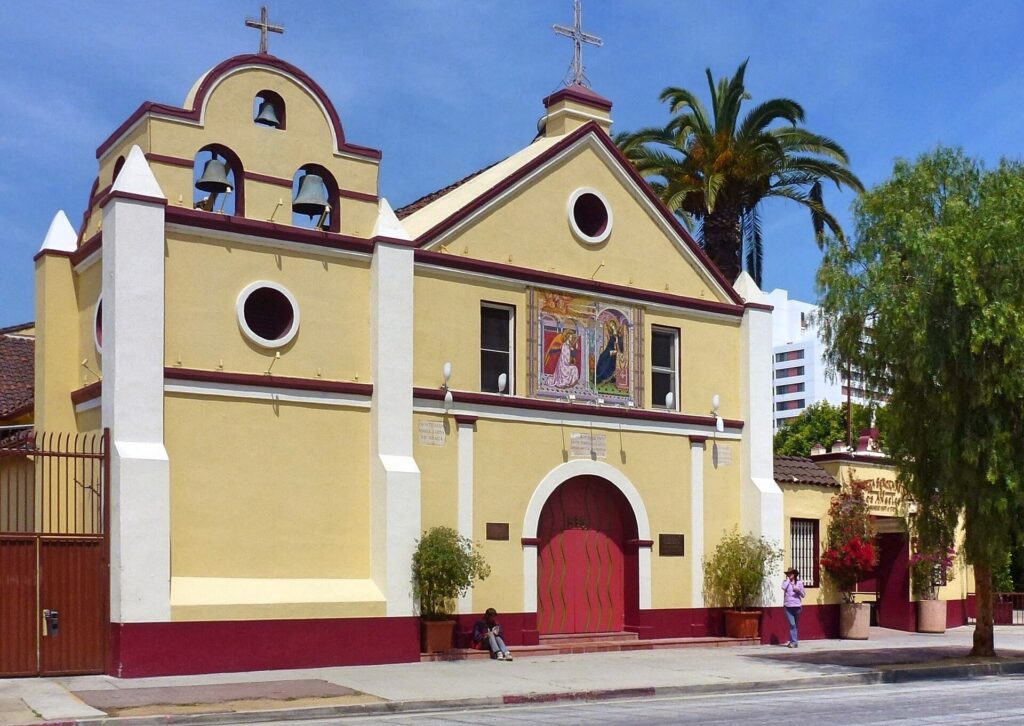
Our Lady Queen of Angels Catholic Church, known locally as La Placita, faces the plaza across Main Street. It was dedicated in December 1822 as La Iglesia de Nuestra Señora la Reina de Los Ángeles. It is the oldest church in the city, and it is the only building at El Pueblo still used for its original purpose. It remains an active parish of the Archdiocese of Los Angeles, so visitors are welcome but should be quiet during Mass and weddings. Address: 535 North Main Street. Open daily.
Pico House and the Merced Theatre
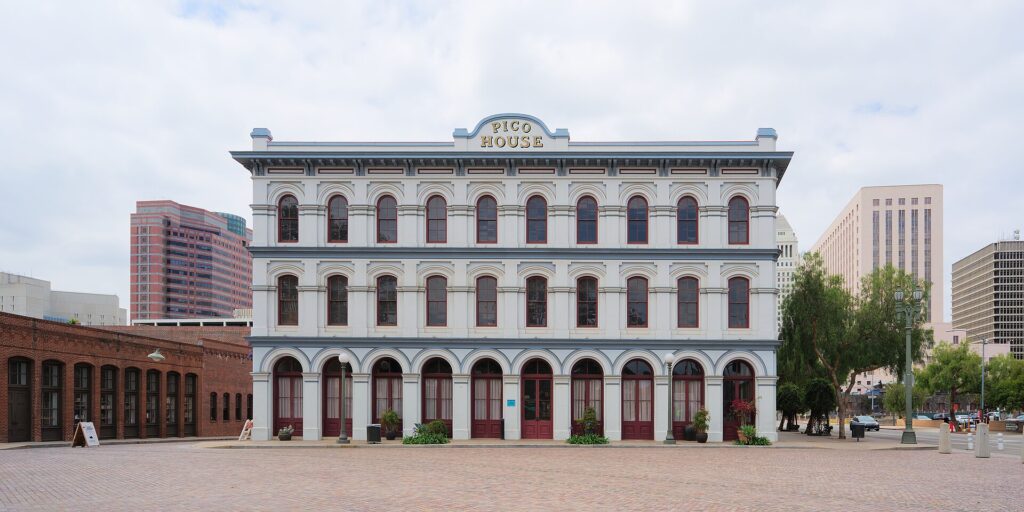
Pío Pico, the last governor of California under Mexican rule, built the Pico House as the finest hotel in Los Angeles. It opened on June 9, 1870, as the city’s first three-story building, with 82 bedrooms and 21 parlors in an Italianate design. Next door, the Merced Theatre (1870) was the center of the city’s theater scene in the early 1870s. Today the Pico House opens only for special events, exhibitions and filming, and the Merced’s interior is closed, but both facades are worth a look from the plaza. If old theaters interest you, our guide to historic theaters in Los Angeles picks up the story on Broadway.
Old Plaza Firehouse
Built in 1884, this was the first building the City of Los Angeles built to house fire-fighting equipment and crews. A turntable in the floor meant the horses never had to back the engines in or out. It was the first building in the monument to be restored and is now California Historical Landmark No. 730, with antique fire equipment on display. Address: 501 North Los Angeles Street. Hours: Tuesday to Sunday, 10 a.m. to 3 p.m.
Chinese American Museum (Garnier Building)
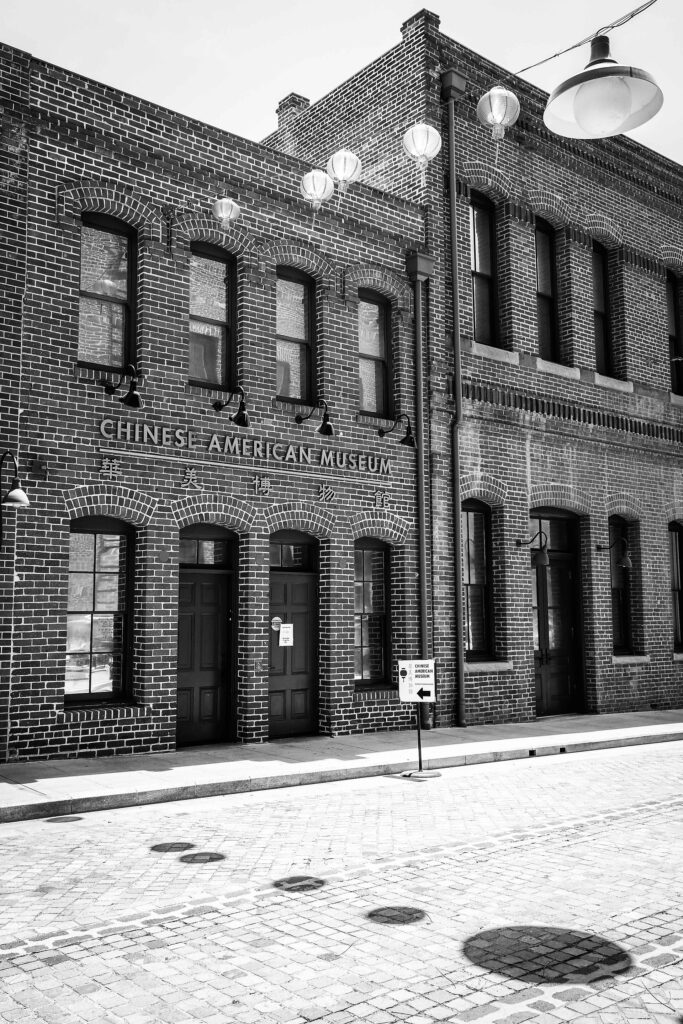
The red-brick Garnier Building went up in 1890 and was designed mainly for Chinese commercial tenants. According to El Pueblo, it was occupied by Chinese immigrants from the day it opened until the state took it over in 1953. It was the headquarters of major Chinese American organizations, housed businesses, churches and schools, and was an important part of the original Los Angeles Chinatown. Today it holds the Chinese American Museum, with permanent and rotating exhibits. Address: 425 North Los Angeles Street. Hours: Tuesday to Sunday, 10 a.m. to 3 p.m. Closed Mondays, Thanksgiving, Christmas and New Year’s Day. Suggested admission is $3 for adults and $2 for seniors and students.
Italian Hall and the Italian American Museum
El Pueblo notes that in the 19th century Italians owned or ran about a third of the businesses in the area. The Italian Hall (1907–08), at the corner of North Main Street and Cesar Chavez Avenue, hosted meetings, banquets, dances and wine-harvest celebrations. It now houses the Italian American Museum of Los Angeles. Address: 644 North Main Street. Hours: Tuesday to Sunday, 10 a.m. to 3 p.m. Admission is free, and donations are encouraged.
América Tropical Interpretive Center
In 1932 the Mexican muralist David Alfaro Siqueiros painted América Tropical on a second-story wall above Olvera Street. Its political imagery caused an immediate controversy, and within a decade it was whitewashed. After conservation work by the Getty Conservation Institute and the City, it is viewable again from a protective shelter and platform, and the interpretive center explains its story. Hours: Tuesday to Sunday, 10 a.m. to 3 p.m.
LA Plaza de Cultura y Artes
Across Main Street from the plaza, LA Plaza de Cultura y Artes is a museum and cultural center for Mexican American and Latinx history and culture in Los Angeles. Address: 501 North Main Street. Hours: Wednesday to Sunday, noon to 5 p.m. For more museums around the city, see our Los Angeles museum tour guide.
The Olvera Street marketplace and where to eat
The marketplace runs the length of the street, with puestos down the middle and shops and restaurants in the old buildings on either side. El Pueblo says the shops are open every day of the year, though each business sets its own hours. Expect clothing, jewelry, hats, bags and artwork, much of it from Mexico, sold by small family-owned businesses.
Cielito Lindo
The most famous food on Olvera Street is the rolled beef taquito at Cielito Lindo, a small stand that has served them since 1934, topped with its avocado sauce. The stand was founded by Aurora Guerrero and is now run by her great-grandchildren. After a temporary closure in May 2026, it reopened in late June 2026 following a community fundraiser, LA Magazine reported. Address: E-23 Olvera Street.
Sit-down meals on the street
The Simpson/Jones Building, given a Mexican-style facade in 1960, now houses two restaurants, La Luz del Dia and Chiguacle (Sabor Ancestral de México). Other cafes along the street come and go, and each sets its own hours, so a lunchtime visit is the simplest plan. One name you may see in older guides, La Golondrina in the Pelanconi House, has been closed since 2020.
Just across Alameda: Philippe the Original
A short walk north along Alameda Street from Union Station, Philippe the Original has been at 1001 North Alameda Street since 1951 (the business dates to 1908). Founder Philippe Mathieu claimed to have invented the French dip sandwich, still the house specialty. It is open daily from 6 a.m. to 10 p.m.
Annual events on Olvera Street
The Olvera Street Merchants Association Foundation and El Pueblo host several traditional celebrations each year. All of the events below are free.
Las Posadas (December 16 to 24)
Las Posadas has been part of Olvera Street since it opened in 1930. For nine nights, a candlelit procession with traditional songs reenacts Mary and Joseph’s search for shelter in Bethlehem. The festival ends on Christmas Eve with a live Mary and Joseph. The organizers’ nightly program lists a children’s piñata in the plaza at 6:30 p.m. and the procession at 7:15 p.m., starting in front of the Avila Adobe. Afterward, everyone gets a cup of hot champurrado and a piece of pan dulce.
Blessing of the Animals (Holy Saturday)
Every year on the Saturday before Easter, hundreds of people line up on Olvera Street with their pets, from dogs and cats to snakes and lizards, to have them blessed. Animals that live on land, in water or in trees are all welcome. In recent years Archbishop José H. Gomez has given the blessing; in 2026 it took place on April 4. The custom has been part of Olvera Street since 1930. It traces back to early pueblo days, when the priest from La Placita blessed farmers’ livestock, and before that to St. Anthony the Abbot, the patron saint of animals.
Día de los Muertos (late October to November 2)
The merchants have celebrated Día de los Muertos on Olvera Street for nearly 40 years. The 2026 festival ran for nine days, from October 25 to November 2, with community altars (ofrendas) on display. Each night a procession, led by an Indigenous Aztec group with incense, wound its way to a ceremony at the kiosko honoring the loved ones of a merchant family or community member. Teatro del Barrio staged La Danza de la Muerte nightly, and sweet bread and drinks were handed out free.
El Pueblo also lists Cinco de Mayo, Mexican Independence Day in September and a spring festival among its major events. If you are planning a December visit, our guide to Los Angeles at Christmas covers more holiday ideas.
Free guided walking tours of El Pueblo
El Pueblo offers free one-hour guided tours of the historic district, led by its certified tour guides. They start with the village of Yaanga and come up to the present day. A typical route covers the Old Plaza and pobladores plaque, the Pico House, the Old Plaza Firehouse, the Chinese American Museum, the Olvera Street marketplace, the Avila Adobe and the América Tropical Interpretive Center. On request, guides can also include the Italian American Museum.
- When: Thursday to Saturday, with start times at 10 a.m., 11 a.m. and noon.
- Booking: Required at least two weeks in advance through the El Pueblo tours page. Requests with less notice are not considered.
- Groups and minors: Groups with anyone under 18 must complete a waiver. For groups of 60 or more, El Pueblo suggests a self-guided visit instead.
- Contact: eptours@lacity.org or (213) 485-6855.
If you can’t book two weeks ahead, it is easy to walk the district yourself in about an hour using the stops in this guide.
Getting to Olvera Street
By Metro and train
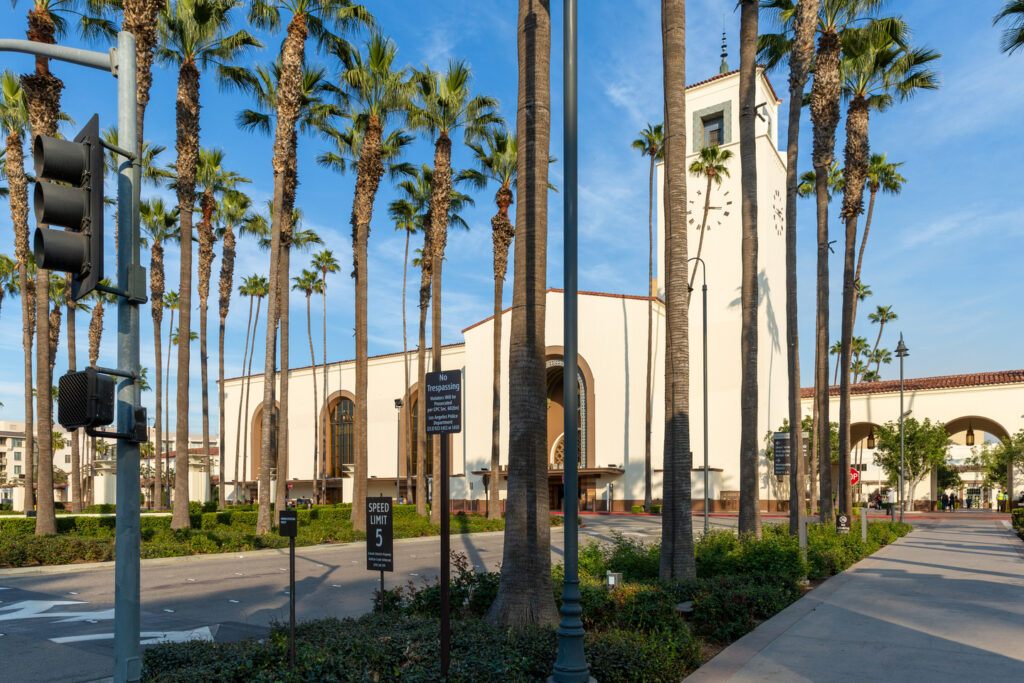
El Pueblo is directly across Alameda Street from Union Station, the region’s main transit hub. Metro’s A, B and D Lines stop at Union Station, along with Metrolink and Amtrak trains, the LAX FlyAway bus, the Dodger Stadium Express and local DASH buses. Walk out the main entrance, cross Alameda Street and you are at the plaza. There is also a Metro Bike Share station at Union Station, and bike racks around the park.
Parking
El Pueblo operates four public lots, and the parking revenue goes back into the monument’s museums and upkeep:
- Lot 1: 419 North Main Street
- Lot 2: 615 North Main Street (corner of Main Street and Cesar Chavez Avenue, the lot the Chinese American Museum recommends)
- Lot 3: 852 North Alameda Street
- Lot 4: 426 North Los Angeles Street
Visitors who would rather skip parking altogether can see El Pueblo as one stop on a private SUV tour with hotel pickup.
Nearby: Chinatown, Little Tokyo and downtown
- Chinatown: Just north of El Pueblo, and one stop north of Union Station on the Metro A Line. The Chinese American Museum is a good warm-up, since it tells the story of the original Chinatown that stood around the plaza.
- Little Tokyo: A short walk south, or one stop on the A Line to Little Tokyo/Arts District station, which reopened underground with the Regional Connector in 2023. See our Little Tokyo guide.
- The rest of downtown: Our list of things to do in downtown Los Angeles has more ideas.
If you would rather see El Pueblo as part of a wider sightseeing day with a driver, take a look at our One Day in LA tour.
Tips for visiting
- Go Tuesday to Sunday. The Avila Adobe, Sepulveda House, Firehouse, Chinese American Museum and Italian American Museum are all closed on Mondays.
- Arrive by late morning. Most museums close at 3 p.m. (the Avila Adobe at 4 p.m.), so a 10 a.m. start gives you time for the buildings, lunch and the market.
- Allow two to three hours. That is enough to see the adobe, a museum or two, the church and the plaza, and to eat.
Olvera Street: FAQ
Is Olvera Street free to visit?
Yes. The street, the plaza and the Avila Adobe are free, and so are the Italian American Museum and El Pueblo’s guided tours. The Chinese American Museum asks for a suggested donation of $3 for adults.
What is the oldest house in Los Angeles?
The Avila Adobe at 10 Olvera Street, built in 1818 by Francisco José Avila. It is open Tuesday to Sunday, 9 a.m. to 4 p.m.
When did Olvera Street open as a marketplace?
On Easter Sunday, 1930, after Christine Sterling’s campaign to save the Avila Adobe and the surrounding buildings.
How do I get to Olvera Street by Metro?
Take the Metro A, B or D Line, or Metrolink or Amtrak, to Union Station, then walk across Alameda Street to the plaza.