
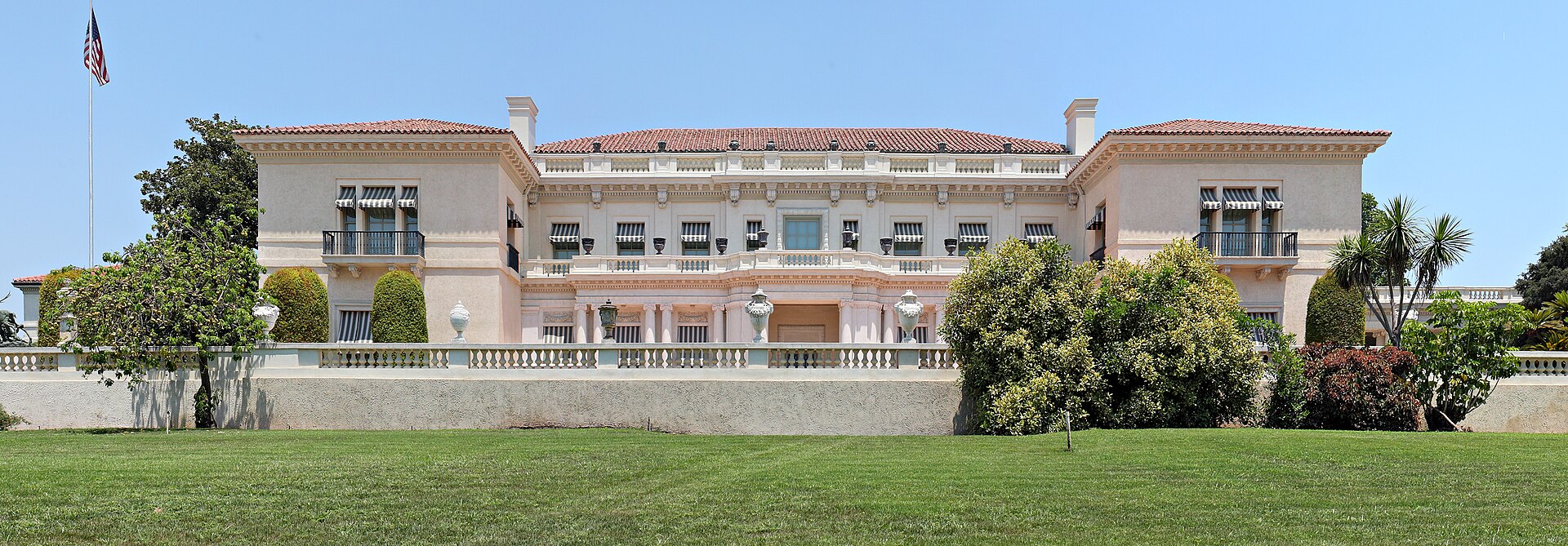
The Huntington Library, Art Museum, and Botanical Gardens in San Marino, just next to Pasadena, is three great days out packed into one ticket. It has 130 acres of themed gardens open to visitors, a Beaux-Arts mansion full of British and European art (Gainsborough’s The Blue Boy among them), and a research library of about 12 million items. Most people come for the gardens, and the most common question is how Huntington Gardens tickets and reservations work. This guide covers that first, then hours, parking, getting there, what to see, where to eat, how long to stay and a route that works. Prices, hours and closures below come from huntington.org as of November 2026. They change by season, so check before you go.
The Huntington at a Glance
- Address: 1151 Oxford Road, San Marino, CA 91108. Phone 626-405-2100.
- Where: in the city of San Marino near Pasadena, about 12 miles northeast of downtown Los Angeles.
- Hours: 10am–5pm, Wednesday through Monday. Closed Tuesdays.
- Admission: adults $29 Monday–Thursday, $34 Friday–Sunday, holidays and peak seasons. Members free.
- Reservations: required Friday–Sunday, on holidays and during peak seasons.
- Parking: free, but the lot can fill on weekends, holidays and in peak seasons.
- Founded: 1919, by Henry E. and Arabella Huntington.
Huntington Gardens Tickets: Prices and Reservations
One general admission ticket covers everything that is open on the day: the botanical gardens, the art galleries and the current exhibitions. Prices depend on the day you visit. Monday through Thursday is cheaper. Friday through Sunday, holidays and the Huntington’s peak seasons cost more.
Ticket prices
- Adult: $29 Monday–Thursday; $34 Friday–Sunday, holidays and peak seasons
- Senior (65+), military (with ID), student (12–18, or full-time with ID): $24 / $28
- Youth (4–11): $13 / $15
- Child (under 4): free
- Members: free
- Museums for All (SNAP EBT): $5 per person, for the cardholder and up to three guests
Tickets are sold at tickets.huntington.org and are nontransferable. Each ticket is good only for the day you choose, and the time on your ticket is your earliest arrival time, not a slot you must leave by. Check-in closes at 4:15pm. For ticket help, email tickets@huntington.org or call 626-405-2100.
When you need an advance reservation
Advance reservations are required Friday through Sunday, on holidays and during peak seasons. The Huntington’s 2026 peak seasons are Thanksgiving (November 20–29) and the winter holidays and New Year (December 18, 2026–January 3, 2027). The 2027 peak dates had not been published at the time of writing.
Free Day and membership
The Huntington runs a Free Day program. Free tickets are released on the last Thursday of every month at 9am and are good for admission the following week. They go until they are sold out, which on popular weeks is fast, so be online right at 9am. Membership includes free admission, and upper-level members get early entry from 8am to 10am.
Hours and Closed Days
Regular hours are 10am to 5pm, Wednesday through Monday. The Huntington is closed every Tuesday, which catches many visitors out. A few exceptions for the 2026 holidays:
- Closed Thanksgiving Day (November 26), Christmas Eve (December 24), Christmas Day (December 25) and New Year’s Day (January 1, 2027).
- Open on two Tuesdays: December 22 and December 29, 2026.
- The Japanese Heritage Shōya House keeps shorter hours: noon to 4pm, Wednesday through Monday.
- The Desert Conservatory opens on Wednesdays only, 10am to 1pm, from November 11, 2026 to April 28, 2027 (closed November 25, December 23 and December 30).
Some areas are closed for now. The Library exhibition halls are closed for construction (more on that below). So are some galleries in the Huntington Art Gallery and the Virginia Steele Scott Galleries of American Art, plus the Ranch Garden and the Mausoleum. The Kitchen Garden opens only on Saturdays and Sundays. The Plan Your Visit page at huntington.org lists current closures.
Parking and Getting There
Is parking free?
Yes. Parking at the Huntington is free. The lot is limited, though, and can fill on weekends, holidays and during peak seasons. The lot has two entrances, on Oxford Road and on Allen Avenue (just south of California Boulevard). On busy days the Huntington strongly encourages carpooling or ride-share. Drop-off and pickup are near the Admission entry area. Bike racks are between the parking lot and the entrance.
From Los Angeles and Pasadena
The Huntington sits in a quiet residential area of San Marino, about 12 miles northeast of downtown Los Angeles and right on the southern edge of Pasadena. Driving or ride-share is the practical choice. Public transit is awkward because the Huntington says the nearest bus stops are about a mile away. If you are staying in Pasadena, it pairs naturally with a day in Old Pasadena. Our guide to things to do in Pasadena has ideas.
If you would rather not drive, our private SUV tour runs on a custom route and can include a stop at the Huntington, with hotel pickup. Admission is not included in the tour. You book your Huntington tickets yourself, for the time you plan to arrive.
The Gardens: What to See
The property was once Henry E. Huntington’s San Marino Ranch, bought in 1903. Today it covers 207 acres, of which about 130 are open to visitors, with 16 themed gardens and roughly 28,000 different kinds of plants. You cannot see all of it in one visit, so pick a few favorites. Wear comfortable closed-toe shoes, and bring sunscreen and insect repellent, which the Huntington itself recommends.
Chinese Garden (Liu Fang Yuan)
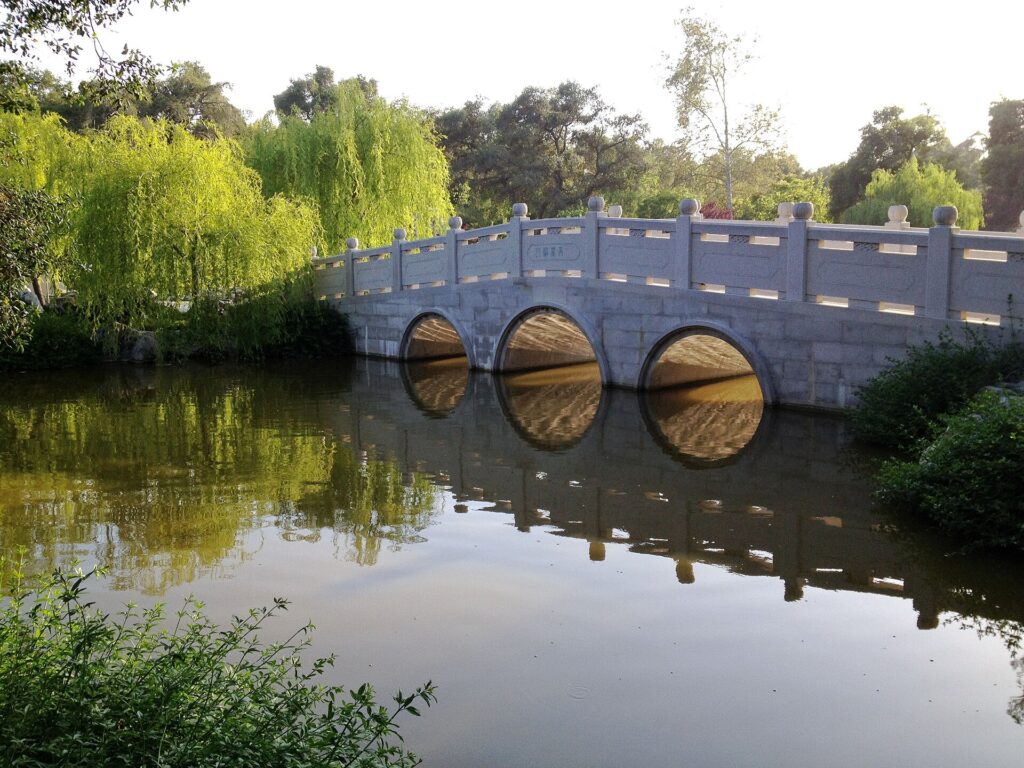
Liu Fang Yuan, the Garden of Flowing Fragrance, covers 15 acres. The Huntington calls it one of the finest classical-style Chinese gardens outside China. It is modeled on the scholars’ gardens of Suzhou: pavilions around the Lake of Reflected Fragrance, stone bridges, waterfalls and large, holey limestone rocks of the kind traditionally taken from Lake Tai. Two of the Huntington’s food spots are inside the garden (see below).
Japanese Garden and the Shōya House
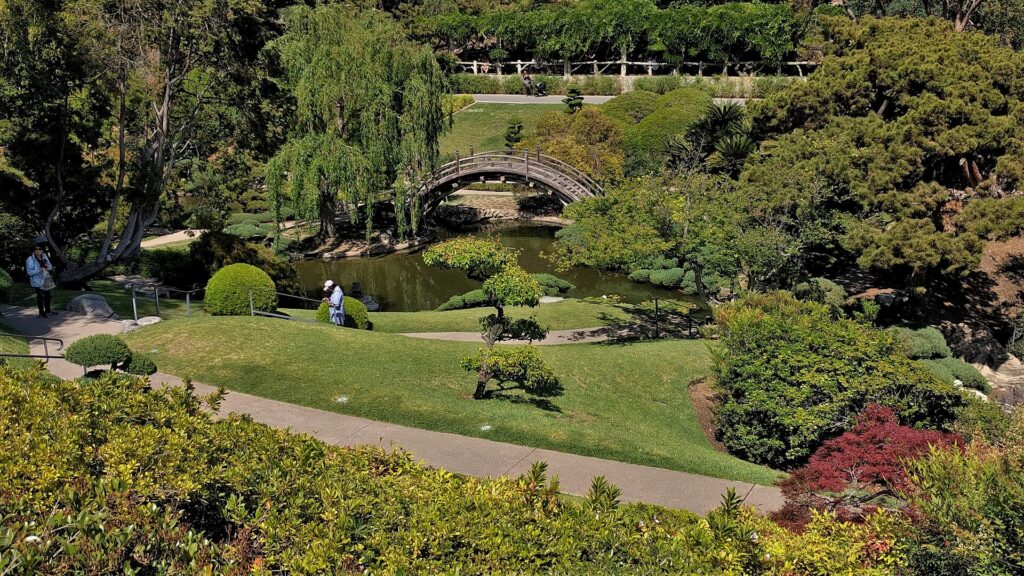
The Japanese Garden has been one of the best-loved landscapes here for more than a century. It has the curved moon bridge over a koi pond, a historic Japanese house, a Zen garden, a bonsai court and a ceremonial teahouse. Next to it is the Japanese Heritage Shōya House, a 3,000-square-foot house built around 1700 that was once the center of village life in Marugame, Japan. It was reconstructed on a two-acre site, and visitors can walk through part of the house from noon to 4pm.
Desert Garden
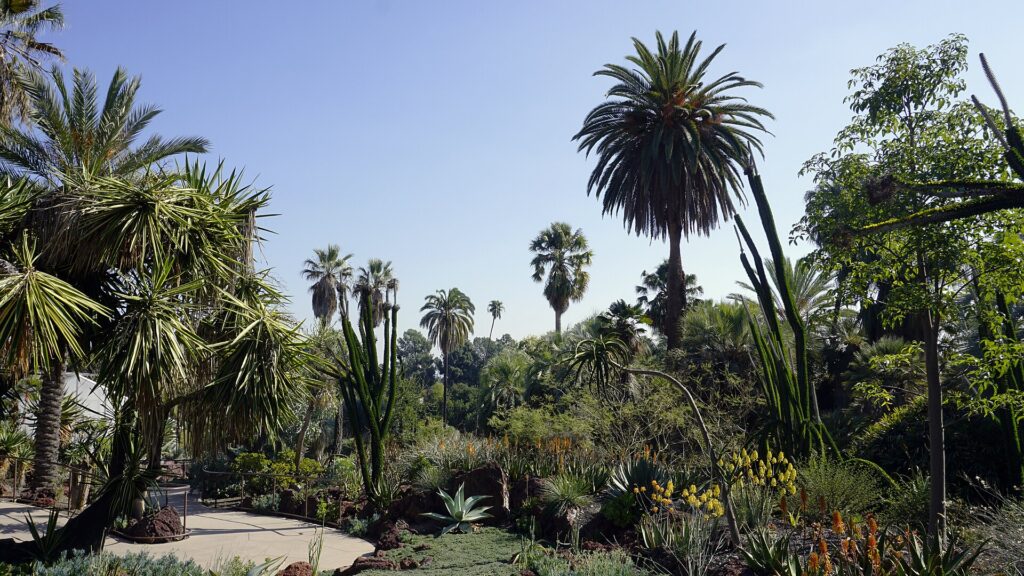
The Desert Garden is one of the largest outdoor collections of cacti and succulents in the world. It has more than 5,000 species of desert plants in sixty landscaped beds, from tall cacti to spreading aloes and agaves. The small Desert Conservatory nearby opens Wednesday mornings from November to April.
Rose Garden and Shakespeare Garden
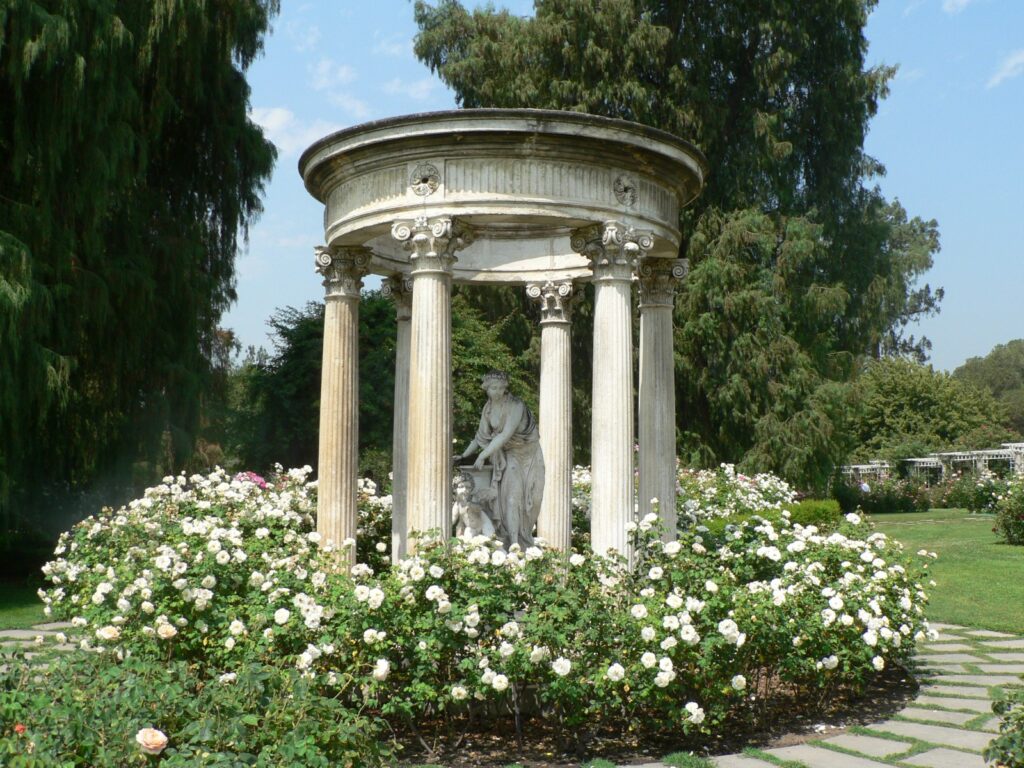
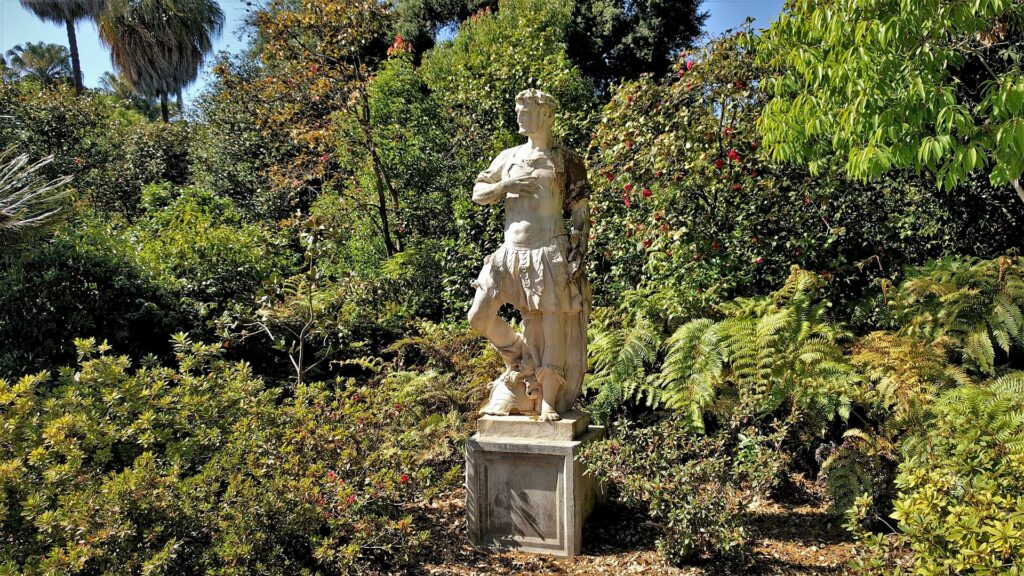
The three-acre Rose Garden holds more than 3,000 plants in over 1,200 cultivated varieties. Its bloom starts in late March and lasts beyond November. A small classical pavilion with a statue stands among the roses, and the Rose Garden Tea Room is here too. Next door, the Shakespeare Garden is planted with flowers known in England in Shakespeare’s time, and it links the Rose Garden to the art galleries.
Camellias, Lily Ponds and more
Other gardens worth your time:
- Camellia Garden: camellias peak in January and February, along the North Vista, in the Japanese Garden and in the Chinese Garden.
- Lily Ponds: four acres and five ponds with water lilies, lotus and papyrus, plus turtles and koi.
- Jungle Garden and Palm Garden: giant leaves, orchids and bromeliads under a high canopy, and about ninety species of palms.
- Conservatory: a 16,000-square-foot greenhouse with hands-on exhibits.
- Children’s Garden: interactive sculptures for kids, and a good break for families.
The Art Collections: Blue Boy and Pinkie
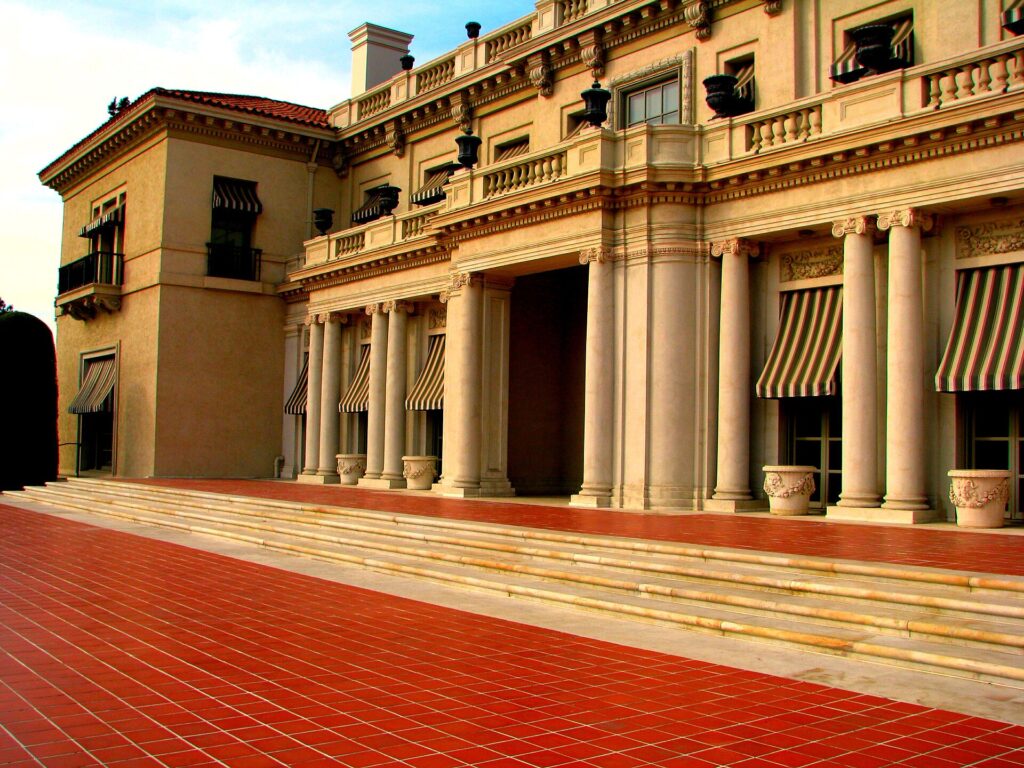
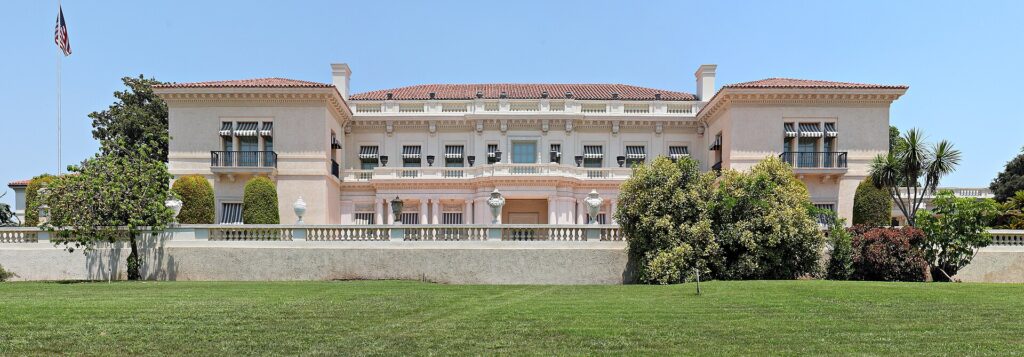
The Huntington Art Gallery is the early 20th-century Beaux-Arts house that was Henry and Arabella Huntington’s winter home. It holds one of the most significant collections of British art outside the United Kingdom. The best-known pictures are the 18th-century “grand manner” portraits in the Thornton Portrait Gallery: Thomas Gainsborough’s The Blue Boy (about 1770), Thomas Lawrence’s Pinkie and Joshua Reynolds’ Sarah Siddons as the Tragic Muse.
The Huntingtons bought The Blue Boy in 1921 for $728,000, then the highest price ever paid for a painting. Since 2021 it has faced Kehinde Wiley’s A Portrait of a Young Gentleman, a work painted in response to it. Wiley took art classes at the Huntington as a boy. Some galleries in the Art Gallery are temporarily closed, so if a particular painting is the reason for your trip, check the Huntington’s closures list before you go.
A short walk away, the Virginia Steele Scott Galleries of American Art show American art and design, including work by the designers Charles and Henry Greene. Current exhibitions include “Doyle Lane: Master of Clay” (through March 1, 2027) and “Betye Saar: Drifting Toward Twilight” (through November 30, 2027). For 2027 the Huntington has announced “Petromania,” about the art of stone appreciation (from January 31), “David Hockney: The Four Seasons” (from April 18) and “William Blake: From the Ancients to L.A.” (May 22–September 13). If you like museums, our Los Angeles museum guide covers the city’s other big collections.
The Library: Gutenberg Bible and Ellesmere Chaucer
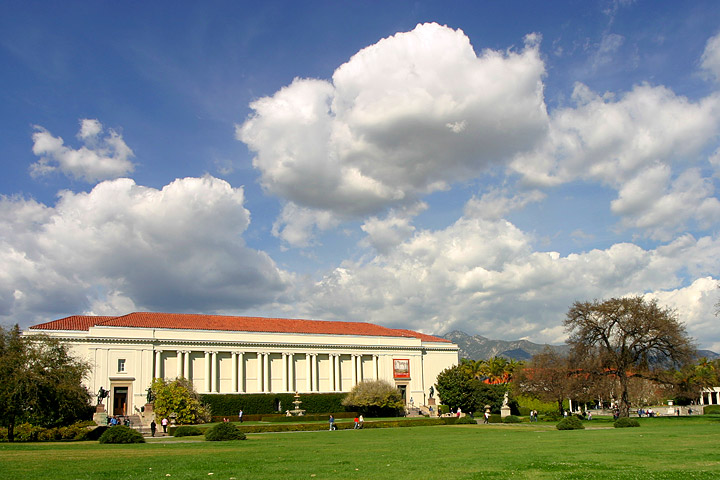
The Huntington Library is one of the world’s great independent research libraries. It holds about 12 million items from the 11th to the 21st century. Its treasures include a Gutenberg Bible printed on vellum, one of 12 vellum copies that survive and one of three in the United States. It also has the Ellesmere Chaucer, the 15th-century manuscript of The Canterbury Tales, and the original manuscript of Benjamin Franklin’s autobiography.
What you can see right now is limited. The 1919 Library exhibition halls are closed for the Library/Art Building restoration project and are expected to reopen in spring 2029. Neither the Gutenberg Bible nor the Ellesmere Chaucer is listed on view at the moment. Instead, library items appear in a rotating series called “Stories from the Library,” held in two rooms of the Huntington Art Gallery. The Huntington has scheduled the Gutenberg Bible to return to view in “Stories from the Library: Lure of the Gothic,” June 26–November 29, 2027. If seeing it matters to you, plan your visit for that window.
Food: Tea Room and Cafés
- Rose Garden Tea Room: tea service with seasonal house-made scones and savory and sweet bites, inside the Rose Garden. Reservations are strongly recommended. Book through the Huntington’s dining page before your visit, especially for weekends.
- 1919 Cafe: grilled items, soups, sandwiches, salads and tacos, with indoor and outdoor seating and a bar for wine and beer.
- Red Car coffee shop: espresso, pastries, ice cream and grab-and-go food.
- Jade Court Cafe and Freshwater Pavilion (in the Chinese Garden): pot stickers, dan dan noodles, milk tea and pastries. No reservations.
You do not need an admission ticket to eat at 1919 Cafe or Red Car. Picnicking is not allowed in the gardens, but there are picnic tables in the Barth Family Grove next to Admission. No outside alcohol is allowed.
How Long to Spend and a Suggested Route
Give the Huntington at least half a day. Three to four hours lets you see the big gardens and spend a little time in the art galleries. A full day, from 10am opening to 5pm, lets you slow down, have tea and explore the quieter gardens. The grounds are big and hilly, so the visitor shuttle (eight stops, counter-clockwise loop, 10am–5pm) helps a lot. Here is a route that works for a first visit:
- Arrive at opening. Head first to the Chinese Garden, while it is calm.
- Walk on to the Japanese Garden and the moon bridge. Visit the Shōya House if you are there after noon.
- Cross to the Desert Garden before the midday sun gets strong.
- Have lunch at 1919 Cafe, or your reserved tea at the Rose Garden Tea Room.
- Spend the afternoon indoors at the Huntington Art Gallery (Blue Boy and the “Stories from the Library” rooms), then the Scott Galleries.
- Finish in the Rose Garden and the Lily Ponds on your way out.
Best Time of Year to Visit
Winter (January–February) is camellia season, Spring brings the first big rose bloom from late March, and it is the most popular and busiest time. Summer can be hot in the San Gabriel Valley, so start early, stay in the shade and use the shuttle. Fall is often pleasant and the roses keep going into November. For fewer people, a Monday, Wednesday or Thursday outside the peak seasons is the best bet. Those are also the cheaper ticket days.
The Huntington is also a good choice on a gray day, since the galleries, Conservatory and tea room are all under a roof. Our rainy day in Los Angeles guide has more indoor ideas. For couples, a garden walk followed by afternoon tea is one of the classic date ideas in Los Angeles.
An alternative while the Getty Center is closed
According to getty.edu, the Getty Center will close to the public from March 15, 2027 for a major modernization, with reopening planned for spring 2028. During that time, the Huntington is the closest match in Los Angeles if you want great art and great gardens in one visit. See our Getty Center guide if you can visit before the closure.
Accessibility and Visitor Rules
All buildings and most gardens are accessible to visitors who need physical accommodation. Wheelchairs are available for loan on a first-come, first-served basis, and you may bring your own scooter or wheelchair. The visitor map is color-coded to show steep areas, and the shuttle vehicles take wheelchairs. A few rules worth knowing before you go:
- No pets. Only ADA service dogs are allowed.
- Bags are checked at entry. Drones, selfie sticks, bicycles and sports equipment are not allowed on the grounds.
- Casual photos are welcome, but no flash indoors. Posed portrait sessions (engagement, family, quinceañera and so on) must be booked in advance for a fee.
- Free Wi-Fi (“AtTheH Free Wifi”) works in some areas. The free Bloomberg Connects app has a map and audio tours.
If you want to see more of Los Angeles on another day, our classic car tour in a 1970 Cadillac DeVille convertible is another way to see the city. It is a separate experience and does not include Huntington admission.
Huntington Library: FAQ
How much are Huntington Gardens tickets?
Adult general admission is $29 Monday–Thursday and $34 Friday–Sunday, on holidays and during peak seasons. Seniors, military and students pay $24/$28, and youth 4–11 pay $13/$15. Children under 4 and members get in free. One ticket covers the gardens and the art galleries.
Is there a free day at the Huntington?
Yes. Free Day tickets are released online on the last Thursday of every month at 9am, for admission the following week, and are available until sold out.
Is the Huntington open on Tuesdays?
No. It is normally open 10am–5pm Wednesday through Monday and closed on Tuesdays. In 2026 there are two exceptions: it opens on Tuesday, December 22 and Tuesday, December 29.
Can I see the Gutenberg Bible at the Huntington Library?
Not right now. The Library exhibition halls are closed for restoration until an expected reopening in spring 2029. The Huntington plans to show the Gutenberg Bible in the “Lure of the Gothic” exhibition in the Huntington Art Gallery from June 26 to November 29, 2027.